A Slaughtered Ox
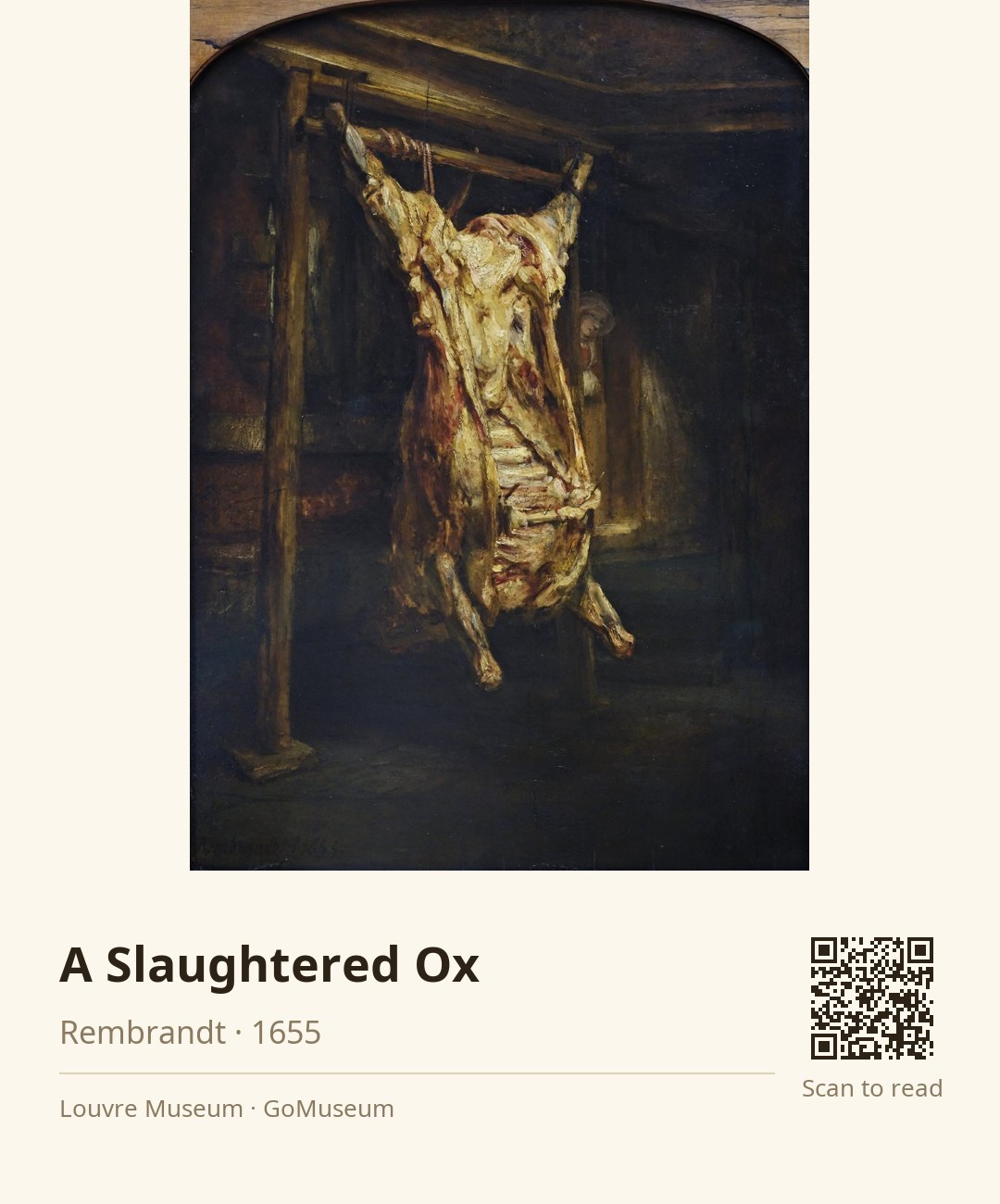
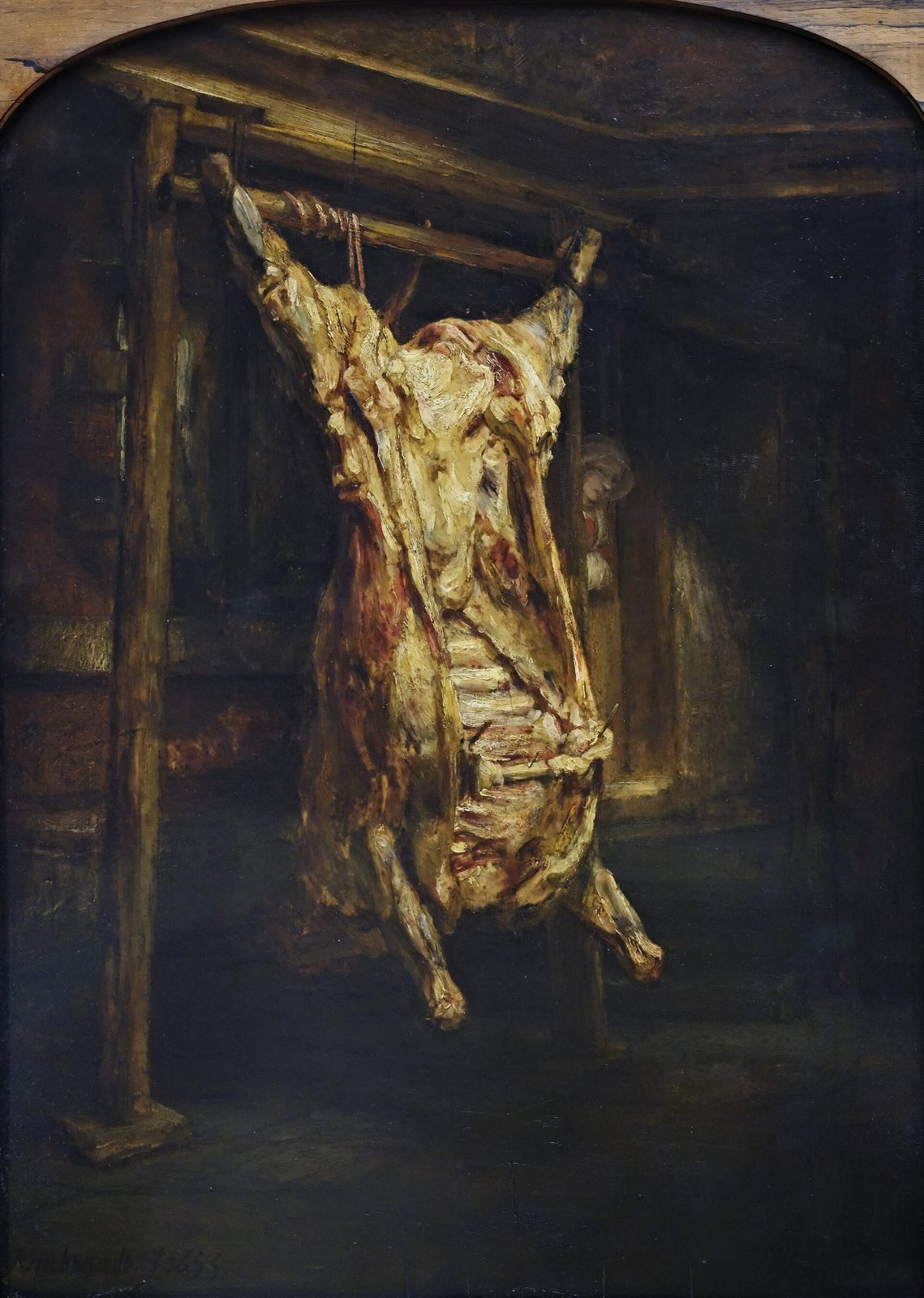
🎧 This work has audio narration — listen in the appTake a moment to really look at Rembrandt's "A Slaughtered Ox." Notice how the carcass hangs there, its flesh glistening under the light, almost inviting yet undeniably grotesque. The way the skin has been flayed back reveals not just the raw meat but the intricate network of fat and muscle underneath, showcasing Rembrandt's masterful technique.
These details matter because they pull you into a visceral experience, challenging your comfort with the subject matter. This isn’t just a still life; it’s a powerful commentary on life, death, and the cycle of nature. The presence of the woman peeking in from the background adds a layer of humanity, reminding us that this scene is part of everyday life, a moment of butchery that was common in the 17th century.
Painted in 1655, this work reflects a tradition of depicting butchery, yet Rembrandt elevates it to an art form, blending realism with deeper philosophical themes. It’s a memento mori, a reminder of mortality that resonates through the ages.
As you stand here, consider this: what does this stark representation of death say about the life we lead today? How do we engage with the cycle of life and death in our own lives?
Rembrandt Harmenszoon van Rijn, born on July 15, 1606, in Leiden, was a pivotal figure of the Dutch Golden Age and is celebrated as one of the greatest artists in Western art history. His oeuvre includes around three hundred paintings, three hundred etchings, and numerous drawings, showcasing a remarkable range of styles and subjects, from intimate portraits to grand historical and biblical scenes.
Rembrandt's artistic journey began in Leiden, where he was influenced by both Dutch and Italian masters. He opened his studio in 1625 and quickly gained recognition for his portrait work. His move to Amsterdam marked a significant turning point, as he became a sought-after portraitist and married Saskia van Uylenburgh, a union that brought both joy and tragedy. The couple faced immense personal losses, including the deaths of their children and Saskia's own passing in 1642, which deeply affected his work.
Despite financial struggles later in life, Rembrandt's innovative techniques, particularly in etching, transformed the medium into a respected art form. His mastery of light and shadow, known as chiaroscuro, and his empathetic portrayal of human experience set him apart from his contemporaries. Rembrandt's legacy endures through his profound ability to capture the complexities of the human condition, making him a cornerstone of art history.
Rembrandt's 'A Slaughtered Ox' was painted in 1655 and has a fascinating history. Before that, it passed through several hands, including Christoffel Hirschvogel in 1661 and Pieter Locquet in Amsterdam, where it was viewed by Joshua Reynolds in 1781. This painting is a part of a tradition of butchery depictions, following works by artists like Pieter Aertsen and Annibale Carracci. Rembrandt himself had sketched similar scenes earlier in his career, indicating a long-standing interest in the subject. The painting's setting—a wooden building, possibly a stable—hints at the everyday life of the 17th century, a time when livestock slaughter was a common practice, especially in November, just before winter.
As you gaze at 'A Slaughtered Ox,' take note of Rembrandt's masterful brushwork and the way he handles paint. The impasto technique creates a visceral texture, making the flesh appear almost alive, glistening under the light. The careful use of color gives depth to the carcass, while the stark contrasts of light and shadow enhance the drama of the scene. Notice how the carcass is suspended by its rear legs, tied to a wooden crossbeam, which adds a sense of weight and realism. The composition is structured yet dynamic, drawing your eye to the intricate details of the flayed skin and exposed organs. In the background, the woman peeking in adds a human element, transforming this still life into a moment of everyday life. This juxtaposition of beauty and grotesqueness is a hallmark of Rembrandt's style, inviting you to confront the uncomfortable reality of mortality.
Its raw depiction of death and the human condition inspired figures like Honoré Daumier and Eugène Delacroix, but perhaps most notably, it impacted 20th-century artists such as Chaïm Soutine and Francis Bacon. Bacon's 'Figure with Meat' directly references this work, showcasing how Rembrandt's exploration of mortality resonates through time. The painting challenges viewers to confront the cycle of life and death, making it a significant piece in the canon of art history, often regarded as a memento mori that remains relevant today.
It actually follows a long tradition of butcher-themed artworks, echoing back to the likes of Pieter Aertsen and Annibale Carracci. But here's the twist: while many artists depicted the act of butchery, Rembrandt's approach was groundbreaking. He infused this still life with a sense of life and narrative, drawing the viewer into a moment that feels both visceral and intimate. Imagine the scene in a bustling 17th-century Amsterdam, where the smell of fresh meat mingles with the chatter of market-goers.
Rembrandt's use of impasto, where thick layers of paint create a textured surface, enhances the lifelike quality of the carcass, making the flesh appear almost alive and glistening under the light.
The raw depiction of the slaughtered ox inspired 20th-century artists like Francis Bacon, who referenced this work in his own pieces, demonstrating the lasting impact of Rembrandt's exploration of mortality on modern art.
The painting's setting during November reflects the traditional time for livestock slaughter in northern Europe, highlighting the seasonal cycles of life and death that were integral to 17th-century rural life.