Allegory of Virtues
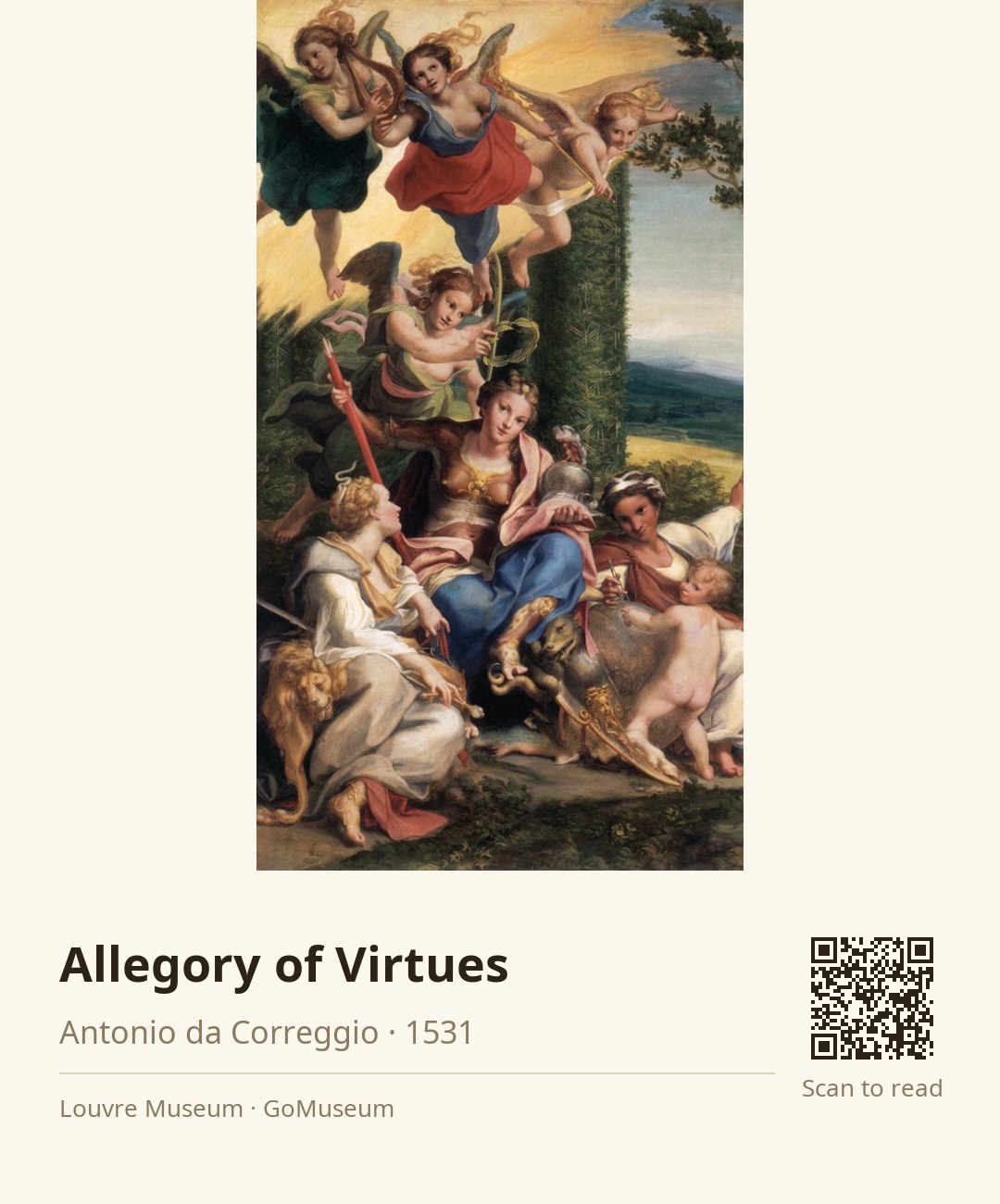
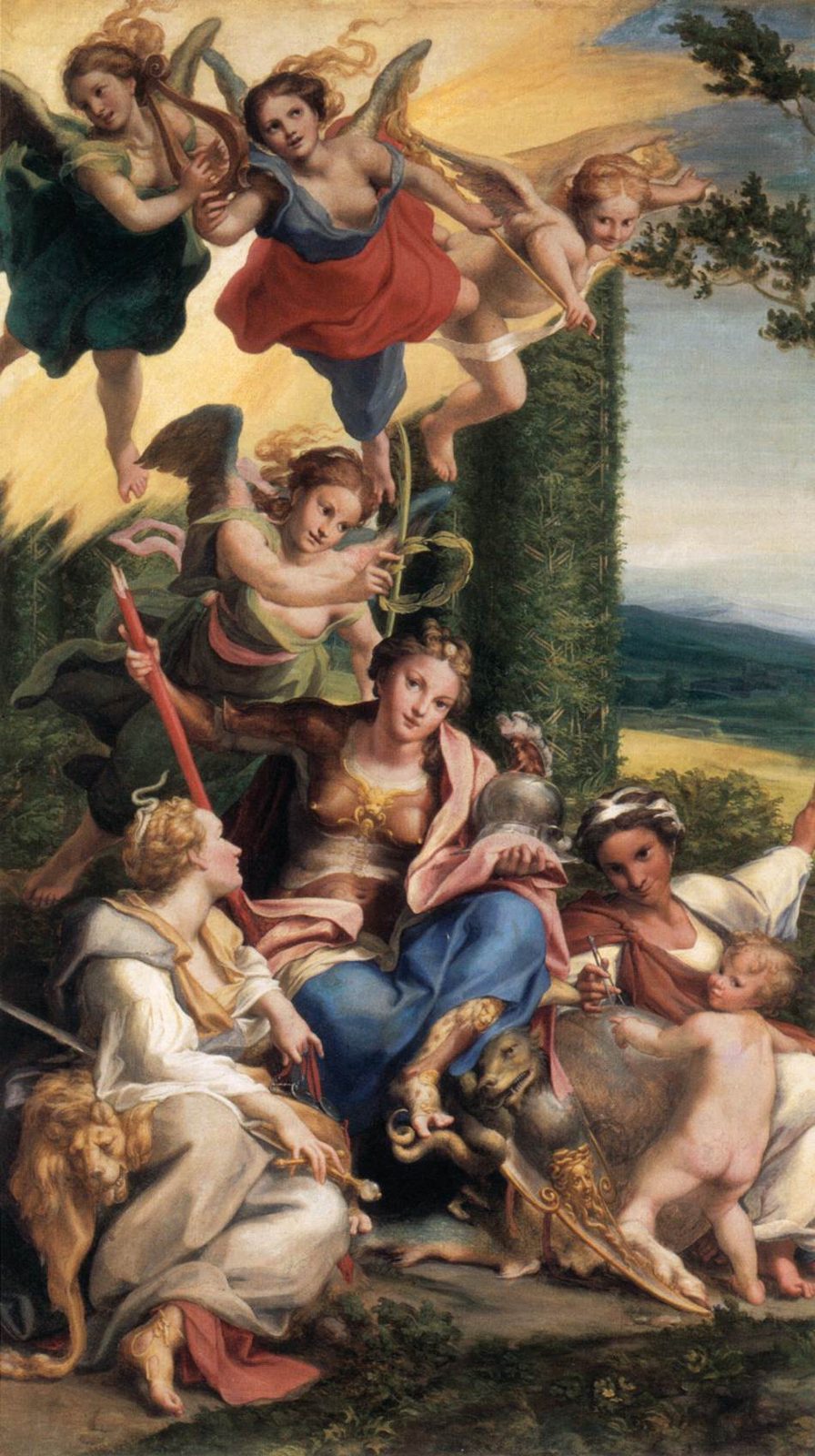
🎧 This work has audio narration — listen in the appAs you stand before "Allegory of Virtues," let your eyes be drawn to the striking figure at the center—Minerva, the goddess of wisdom. Notice her poised stance, lance in hand and a plumed helmet resting atop her head. This isn’t just a pretty image; it’s a powerful symbol of intellect and strength, embodying the very essence of virtue.
Now, look closely at the seated figure to her left, surrounded by symbols like a snake for Prudence and a sword for Justice. These details matter because they weave a narrative about the cardinal virtues that guide human behavior. Each symbol is a reminder of the qualities we aspire to embody in our lives.
Painted by Antonio da Correggio in 1531 for Isabella d'Este's studiolo, this work reflects the Renaissance's fascination with humanistic ideals. Correggio’s mastery of light and shadow brings these figures to life, inviting you to ponder not just their beauty, but their significance.
As you take in this masterpiece, consider: what virtues do you hold dear in your own life?
Antonio Allegri da Correggio, known simply as Correggio, was an influential Italian Renaissance painter born around August 1489 in Correggio, Emilia-Romagna. He emerged as a leading figure in the Parma school, celebrated for his dynamic compositions and mastery of chiaroscuro. Little is known about his early life, but he likely received his initial training from his uncle, Lorenzo Allegri, and later apprenticed with Francesco Bianchi Ferrara in Modena.
Correggio's career flourished in Parma, where he created some of his most significant works, including the ceiling frescoes of the Camera di San Paolo and the dome of the Cathedral of Parma. His innovative use of illusionistic perspective and foreshortening prefigured the Baroque style, influencing future generations of artists. His mythological series, particularly the Loves of Jupiter, showcased his ability to blend sensuality with narrative depth.
Despite a relatively short life, ending in 1534, Correggio's contributions to art were profound, establishing him as a precursor to Baroque painting and a master of emotional expression. His legacy endures, with his works continuing to inspire artists and captivate audiences.
Antonio da Correggio painted 'Allegory of Virtues' around 1531, commissioned by Isabella d'Este for her studiolo in Mantua. This piece was created alongside its counterpart, 'Allegory of Vice,' which likely followed in its completion. Interestingly, while two preparatory sketches for 'Virtue' exist, only one sketch for 'Vice' remains, hinting at Correggio's evolving mastery. After Isabella's studiolo was dismantled, both paintings were transferred to Cardinal Richelieu around 1627 and eventually made their way to the Louvre in Paris, where they still reside today.
As you gaze at 'Allegory of Virtues,' pay attention to Correggio's deft brushwork and the way he manipulates light and shadow. The figures seem to emerge from the canvas, almost three-dimensional, thanks to his skillful use of chiaroscuro. Notice how the central figure of Minerva, with her striking red lance, draws your eye, while the surrounding characters are arranged in a dynamic composition that creates a sense of movement. The diagonal lines and overlapping forms invite you to explore the space, making the painting feel alive. Correggio's choice of tempera on canvas allows for vibrant colors that pop against the subtler tones, enhancing the emotional impact of the scene. Each stroke feels deliberate, contributing to a harmonious balance that captures the essence of virtue in a visually compelling way.
Created for Isabella d'Este's studiolo, it showcases Correggio's mastery of dynamic composition and illusionistic perspective, techniques that would later influence Baroque artists. The way he captures the essence of virtue through Minerva and the surrounding symbols not only reflects the ideals of his time but also sets a precedent for how allegorical themes could be expressed with emotional depth and visual drama. This painting, alongside its counterpart 'Allegory of Vice', invites viewers into a dialogue about morality and virtue, making it a cornerstone for future explorations in allegorical art. Remember, Correggio’s innovative approach to light and space here foreshadows the dramatic flair that would define the Baroque period.
One intriguing detail about 'Allegory of Virtues' is that it may have been inspired by Andrea Mantegna's earlier work, 'Triumph of the Virtues.' This connection hints at a dialogue between artists across generations, showing how Correggio built upon the foundations laid by his predecessors. The red lance held by Minerva not only symbolizes strength but also serves as a visual link to Mantegna's depiction, creating a fascinating continuity in the representation of virtue in Renaissance art.
The existence of two preparatory sketches for 'Allegory of Virtues' suggests that Correggio was refining his technique and ideas, indicating a more confident and skilled approach compared to the single surviving sketch for 'Allegory of Vice'. This evolution in his preparatory work reflects his growth as an artist during this period.
After the dismantling of Isabella d'Este's studiolo, 'Allegory of Virtues' was transferred to Cardinal Richelieu around 1627, marking a significant shift in its history as it left its original context and became part of a collection that would eventually end up in the Louvre.