The Woman with a Gambling Mania
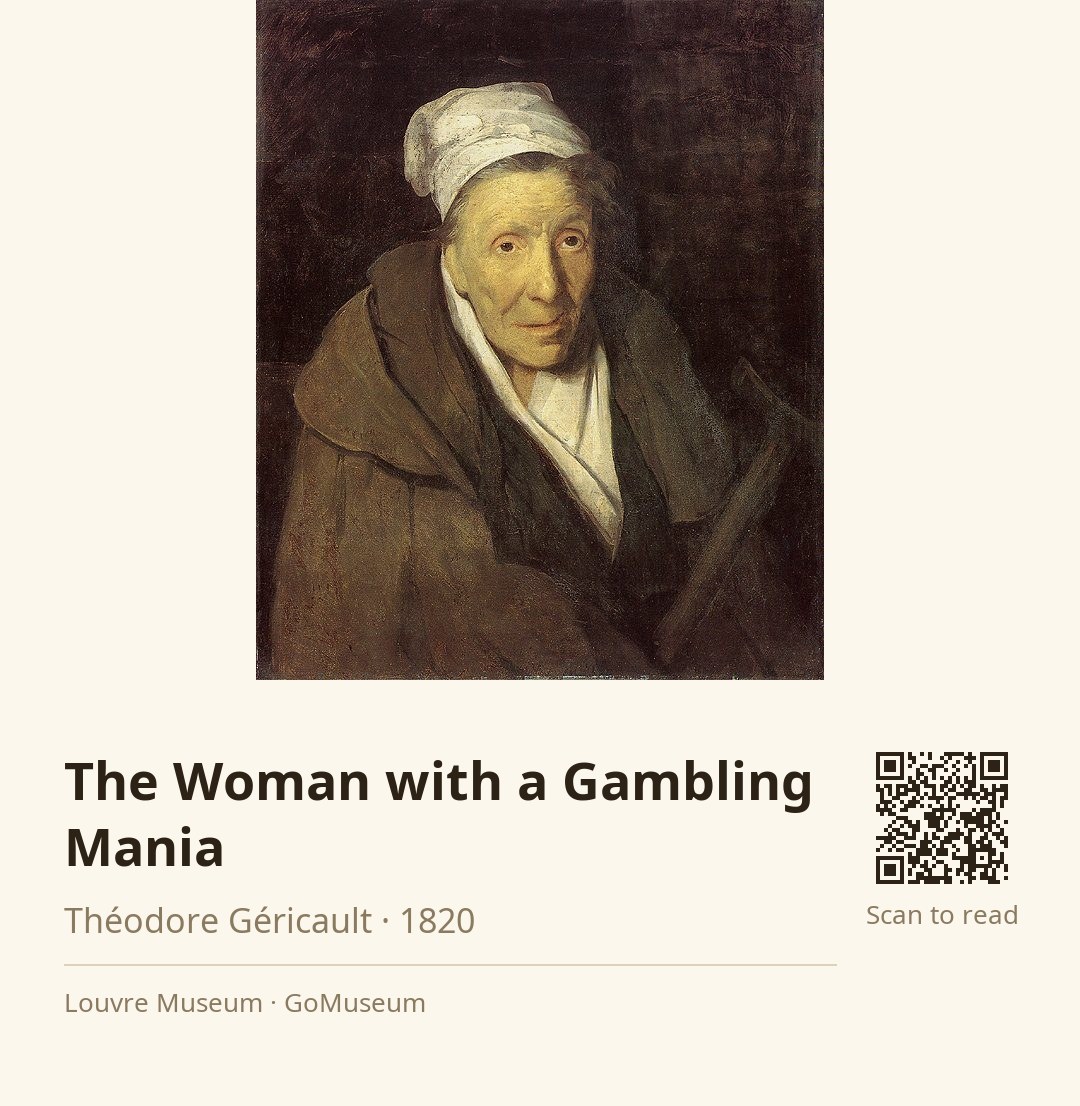
🎧 This work has audio narration — listen in the appTake a moment to really look at “The Woman with a Gambling Mania.” Notice the intense gaze of the woman; her eyes seem to pierce right through you. Now, focus on the way her fingers are splayed, almost clutching at something unseen. This isn’t just a portrait; it’s a window into the turmoil of a mind consumed by obsession.
These details matter because they capture the essence of a specific mania—gambling—that Géricault sought to portray. The artist was fascinated by the psychological states of his subjects, and here, he conveys not just a moment, but the weight of addiction. You can almost feel the desperation and the thrill that comes with the gamble, a reflection of the societal curiosity about mental illness in the early 19th century.
Géricault created this work in 1820 as part of a series exploring various forms of madness, a project inspired by his collaboration with a psychiatrist. At a time when mental health was poorly understood, these portraits offered a glimpse into the lives of those often marginalized by society.
As you stand here, consider this: What do you think Géricault wanted us to feel about this woman? Was he inviting empathy, or perhaps a deeper reflection on our own obsessions?
Jean-Louis André Théodore Géricault was a French painter and lithographer born on September 26, 1791, in Rouen. He moved to Paris as a child, where his artistic talent was nurtured by family connections in the art world. Géricault's life was marked by a passionate pursuit of art, characterized by a fascination with the human condition and dramatic themes. His early works, influenced by the classical tradition, evolved into a distinctive style that bridged Neoclassicism and Romanticism.
Géricault's most renowned painting, The Raft of the Medusa, created between 1818 and 1819, reflects his deep engagement with contemporary issues, depicting the aftermath of a tragic shipwreck that became a national scandal. This monumental work showcased his ability to convey intense emotion and the struggle against nature, establishing him as a pioneer of the Romantic movement. Despite his brief life—he died at just 32—Géricault's innovative approach and exploration of human suffering left a lasting impact on the art world, influencing future generations of artists. His legacy endures, celebrated for its emotional depth and dramatic intensity.
This particular work emerged in a period when Géricault was grappling with the aftermath of his earlier success, The Raft of the Medusa, which had sparked a national scandal. Following this, he fell into a depression but found a new direction through his collaboration with psychiatrist Étienne-Jean Georget. In exchange for Georget's assistance, Géricault produced these poignant portraits of mental patients, reflecting the 19th-century fascination with the human psyche. The painting was later acquired by the Louvre in 1938, adding to its storied provenance. Géricault's work not only captures a specific form of insanity but also serves as a window into the evolving relationship between society and mental health during his time.
Notice how the brushwork feels almost restless, with bold strokes that convey the emotional turmoil of the woman. The colors are deliberately chosen; the dark tones surrounding her face contrast sharply with her pale skin, enhancing the sense of isolation and obsession. The way her fingers are splayed suggests a frantic grasping for something just out of reach, mirroring the chaotic nature of her mind. Géricault's technique captures not just the physical likeness but also the psychological depth of his subject, making the viewer feel the weight of her addiction. This painting is a masterclass in how to use light and shadow to evoke emotion, creating a palpable tension that lingers long after you look away.
Did you know that Géricault's painting, The Woman with a Gambling Mania, is part of a fascinating series? He created ten portraits of individuals suffering from specific manias, like kleptomania and obsession with gambling. This series emerged during a time when society was just beginning to explore the complexities of mental health. Géricault, himself grappling with depression after the fallout from his famous work The Raft of the Medusa, turned to psychiatrist Étienne-Jean Georget for inspiration.
Géricault was inspired to create this series after collaborating with psychiatrist Étienne-Jean Georget, who was interested in exploring the psychological states of mental patients during a time when mental health was poorly understood.
Géricault's brushwork in this painting is characterized by bold and restless strokes, which not only enhance the emotional turmoil of the subject but also reflect his interest in capturing the psychological depth of his characters.