Diana leaving her Bath
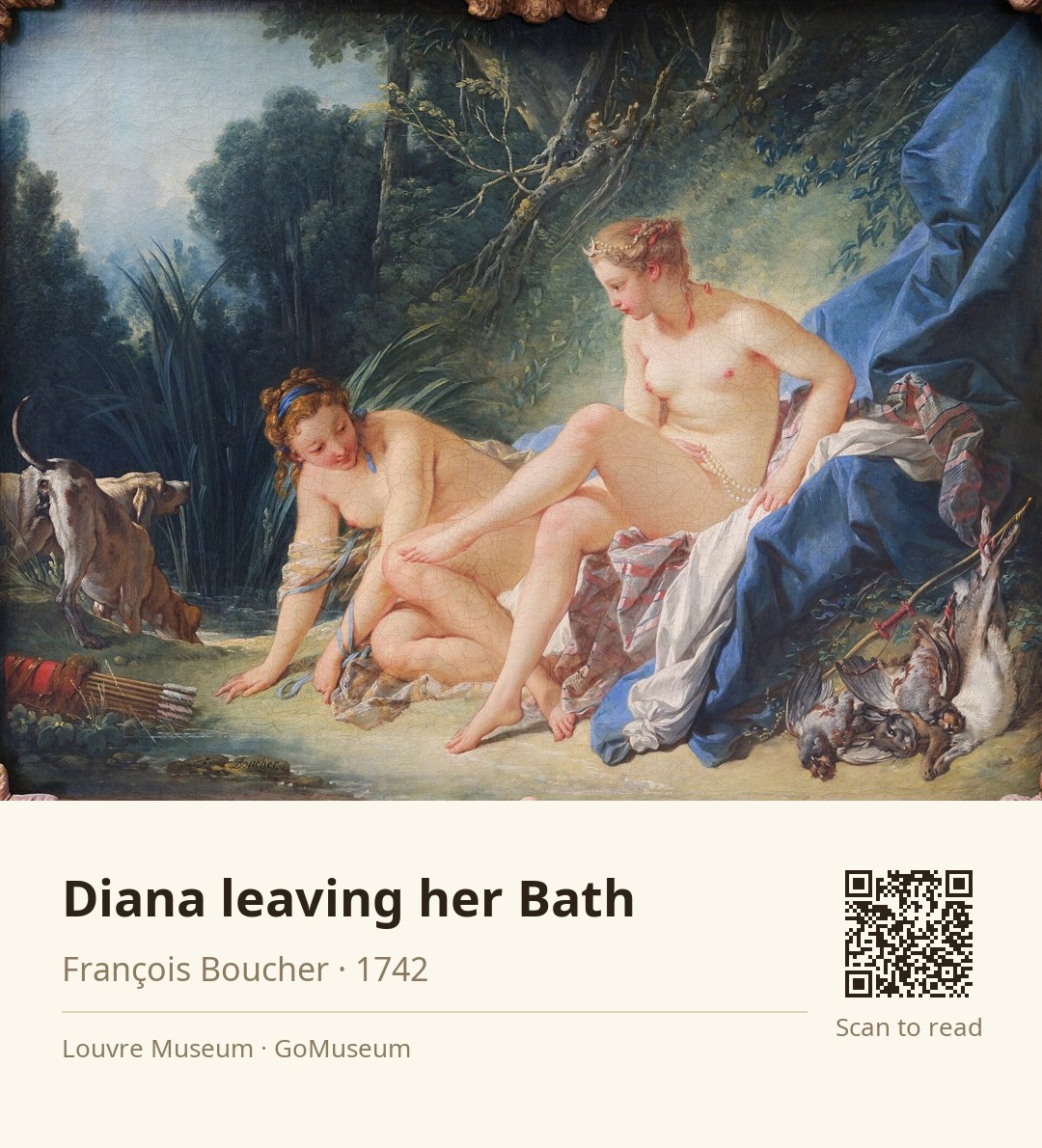
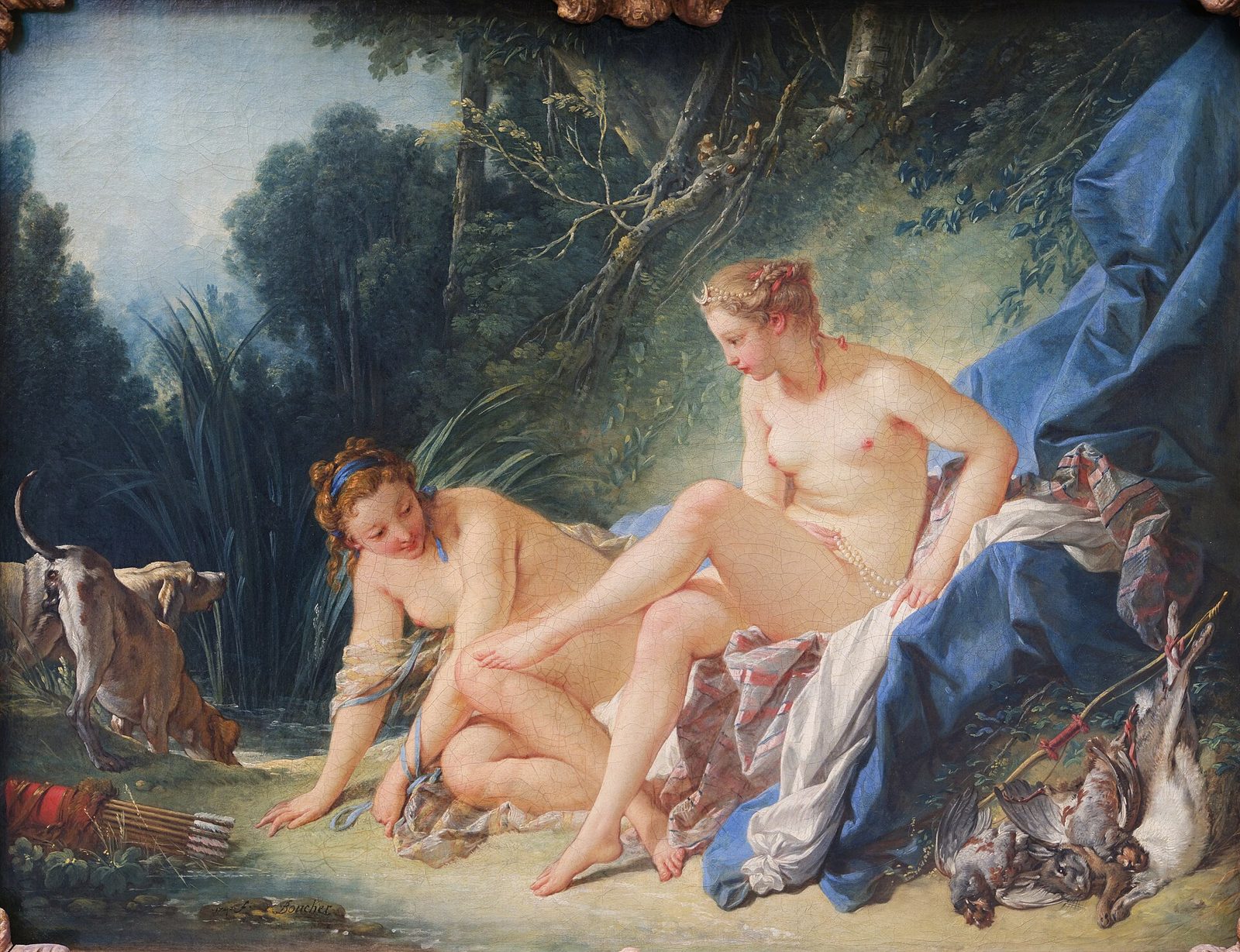
🎧 This work has audio narration — listen in the appTake a moment to really absorb the scene before you in François Boucher’s “Diana Leaving Her Bath.” Notice how the goddess Diana, with her radiant skin and delicate features, seems to glow against the lush greens of the landscape. Look closely at the crown of pearls resting on her head, adorned with a crescent jewel—this isn’t just decoration; it signifies her divine status as the Roman goddess of the hunt.
Boucher masterfully contrasts Diana’s luxurious, soft silks with the rugged, natural world around her, emphasizing the tension between nature and opulence. The two hunting dogs at her feet, one drinking from the pond, remind us of her role as a huntress, while the doves nearby hint at love and beauty, adding layers to her character.
Painted in 1742, this work reflects the Rococo style that Boucher is famous for—intimate, sensual, and playful. It’s a celebration of femininity and nature, capturing a moment that feels both timeless and fleeting.
As you stand here, think about the stories this painting tells.
François Boucher, born on September 29, 1703, in Paris, was a prominent French painter and etcher known for his Rococo style. He was the son of a lesser-known painter and received early training from his father. Boucher's artistic journey began when he caught the attention of François Lemoyne, who briefly took him on as an apprentice. After winning the Grand Prix de Rome in 1720, he studied in Italy, returning to Paris to join the Académie de peinture et de sculpture.
Boucher's work is characterized by idyllic and sensual themes, often depicting mythological and pastoral scenes infused with eroticism. His close relationship with Madame de Pompadour, the mistress of King Louis XV, significantly influenced his career, as she became his patron and helped elevate his status in the art world. Boucher's paintings, such as "The Breakfast" and "The Flute Players," showcase his mastery of genre scenes and family life, contrasting with his more provocative works.
Throughout his career, Boucher also ventured into tapestry design and theatrical set design, reflecting his versatility as an artist. He became the First Painter of the King in 1765, solidifying his place in art history. Boucher's legacy endures, as he is celebrated for embodying the essence of the Rococo style, with his works influencing generations of artists. He passed away on May 30, 1770, leaving behind a rich body of work that continues to captivate audiences.
Created in 1742, 'Diana leaving her Bath' is a captivating oil-on-canvas painting by François Boucher, a leading figure of the Rococo style. This artwork, depicting the Roman goddess Diana in a moment of serene nudity, was later acquired by the Louvre in 1852, where it continues to enchant visitors. Boucher, known for his lush and idyllic scenes, crafted this piece during a time when he was rising in prominence, having just returned from Italy where he honed his skills. The painting's reception has evolved, reflecting changing tastes in art, but it remains a celebrated example of Boucher's ability to blend mythological themes with sensuality. Its journey from creation to the Louvre is a testament to its enduring appeal and the artist's legacy.
Notice how the brushwork feels both fluid and deliberate, creating a sense of movement as Diana emerges from the water. The soft, almost glowing skin tones of Diana contrast beautifully with the cooler greens and blues of the landscape, drawing your eye directly to her figure. The composition is carefully structured; Diana is centrally placed, surrounded by silks that cascade around her, emphasizing her divine status. The inclusion of the nymph and the hunting dogs adds layers of narrative, while the interplay of light and shadow creates depth, making the scene feel alive and inviting. This technique not only showcases Boucher's skill but also immerses you in a moment that feels both intimate and grand.
The nymph accompanying Diana has dark hair, which contrasts with Diana's blonde locks, creating a visual distinction that highlights their different roles and attributes in the scene.
Boucher often used his own wife and children as models in his genre scenes, which adds an intimate, personal touch to his work and reflects the domestic life he experienced.
In 1987, artist Herman Braun-Vega reinterpreted Boucher's work by introducing mixed-race figures in his painting 'Diane des tropiques', aiming to comment on multiculturalism and diversity.