Saint Sebastian
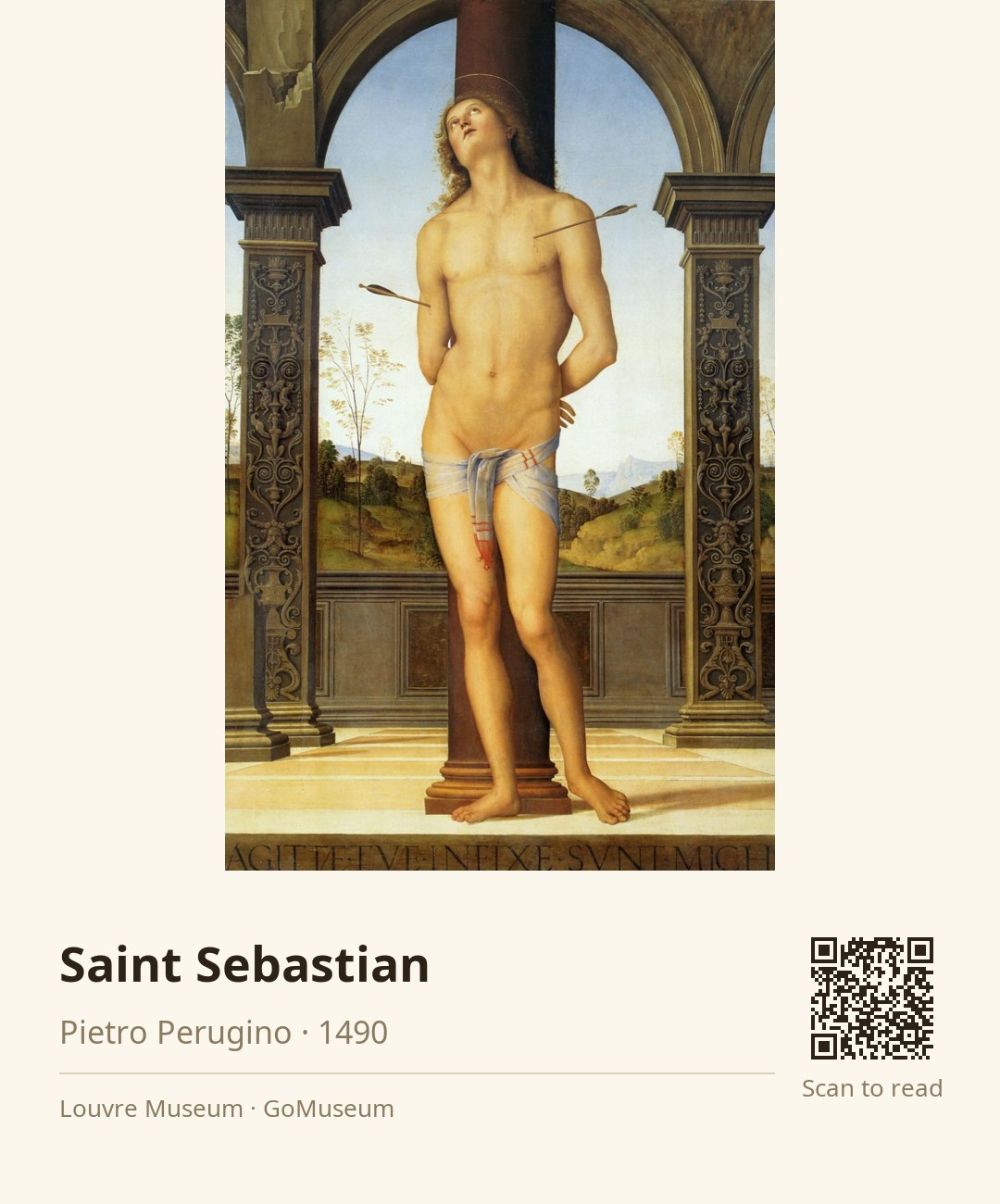
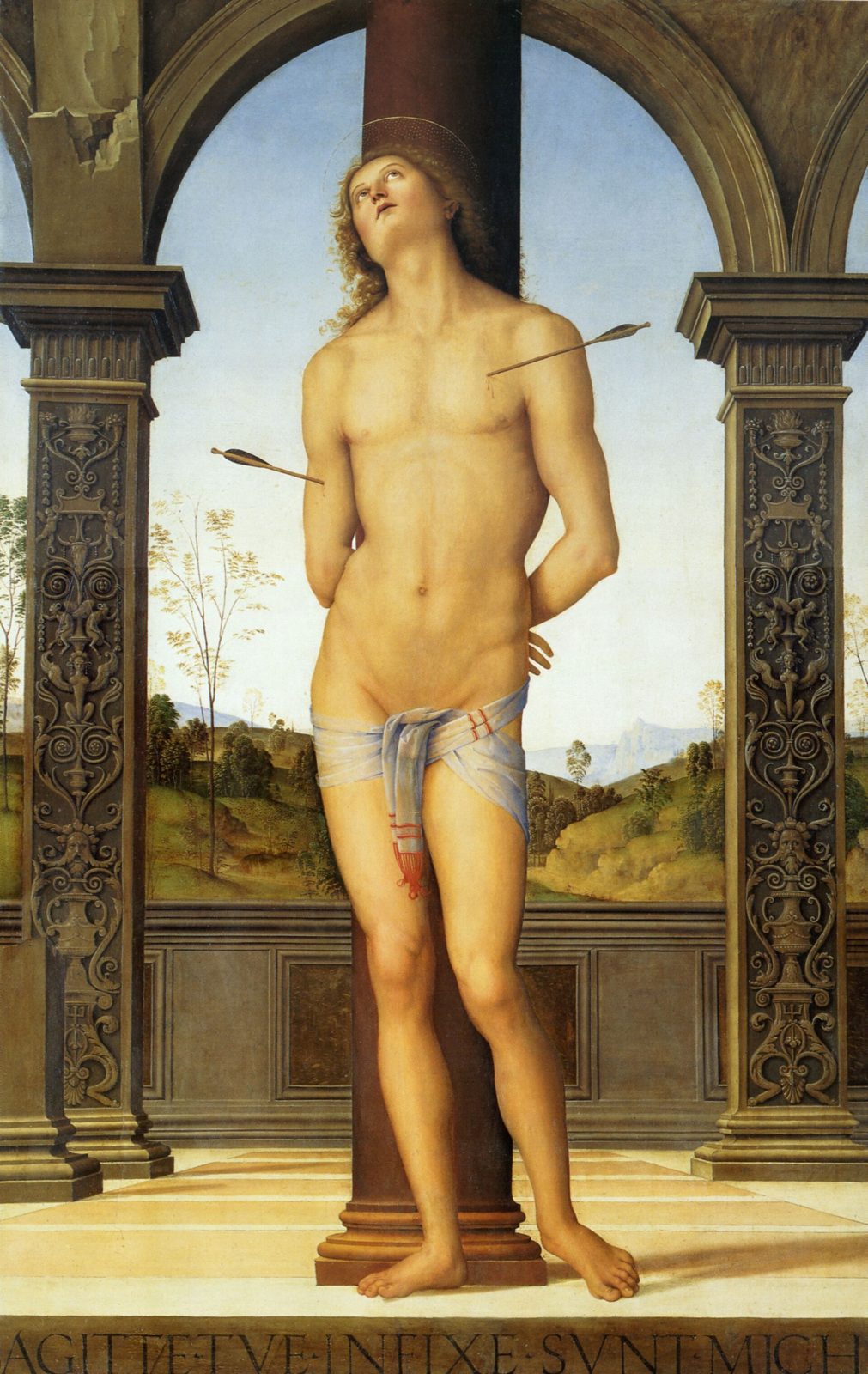
🎧 This work has audio narration — listen in the appSaint Sebastian stands bound against a rich, ornate column, arrows piercing his body, a powerful image of martyrdom. The light blue cloth draped around his waist contrasts with the warm skin tones, drawing your eye to the figure's serene expression and upward gaze, suggesting both suffering and transcendence. The inscription at the bottom, "SAGITTE TVE INFIXE SVNT MICHI," echoes the pain of the saint, linking his torment to a biblical lament.
His use of oil paint on wood allows for a richness in color and detail that enhances the emotional depth of the scene.
Perugino, a key figure of the Italian Renaissance, was known for his religious works that often depicted saints with idealized beauty and grace.
Pietro Perugino, born Pietro Vannucci around 1446-1452 in Città della Pieve, was a pivotal figure in the Italian Renaissance, particularly within the Umbrian school. His early training in Perugia and Florence, where he likely apprenticed under Verrocchio alongside Leonardo da Vinci, laid the foundation for his mastery in fresco and oil painting. Perugino's style is characterized by serene compositions, elegant figures, and harmonious landscapes, reflecting a balance between realism and idealism.
His career flourished after he was commissioned to create frescoes for the Sistine Chapel, including the Baptism of Christ and Delivery of the Keys, showcasing his significant role in the High Renaissance. Notably, he became Raphael's mentor, influencing the next generation of artists. Despite facing criticism later in life, including a public rebuke from Michelangelo, Perugino continued to produce notable works, such as the extensive decoration of the Sala delle Udienze del Collegio del Cambio in Perugia.
Perugino's legacy endures through his innovative techniques and the serene beauty of his religious subjects, marking him as one of the foremost painters of his time. His contributions helped shape the trajectory of Renaissance art, bridging the gap between earlier and later masters. He passed away in 1523, leaving behind a rich body of work that continues to inspire.
Initially part of the Barberini collection in Rome during the 17th century, it was later dispersed, with many pieces taken abroad in the 19th century. The painting found its way to the Louvre in 1896, where it remains today. For a period from 2012 to 2017, it was even displayed at the Louvre-Lens branch. The painting's journey reflects the shifting tides of art ownership and appreciation over centuries.
Perugino's technique in Saint Sebastian is a masterclass in balance and symmetry. The composition is meticulously structured, with the saint positioned in a contrapposto stance that evokes classical ideals. Notice how the clear, defined lines and harmonious proportions create an elegant serenity, even amidst the arrows piercing his body. The use of atmospheric perspective in the landscape background, with its rolling hills and distant mountains, draws the viewer's eye deeper into the scene, enhancing the sense of depth. This blend of decoration and composition showcases Perugino's ability to weave narrative and aesthetics seamlessly.
Interestingly, the version of Saint Sebastian housed in São Paulo is considered an autograph copy, created by Perugino about a decade after the Louvre version. This highlights the artist's continued exploration of the same themes and poses, showcasing his evolving style while remaining deeply connected to his earlier works.
The painting features a monumental arch with grotesque-decorated pilasters and a balustrade, which adds a classical touch and symbolizes the grandeur of the scene. Additionally, there is a ruined vault and pillar on the left, representing the decline of the pagan world.
The symmetrical composition of Saint Sebastian draws on motifs Perugino had used before, particularly in a fresco he painted in Cerqueto, showcasing his consistent exploration of balance and harmony throughout his career.
The inscription 'SAGITTAE. TUAE.INFIXAE. SUNT. MICHI' translates to 'Thy arrows are fixed in me' from Psalm 38:2, linking the visual representation of Saint Sebastian's martyrdom to biblical themes of suffering and divine intervention.