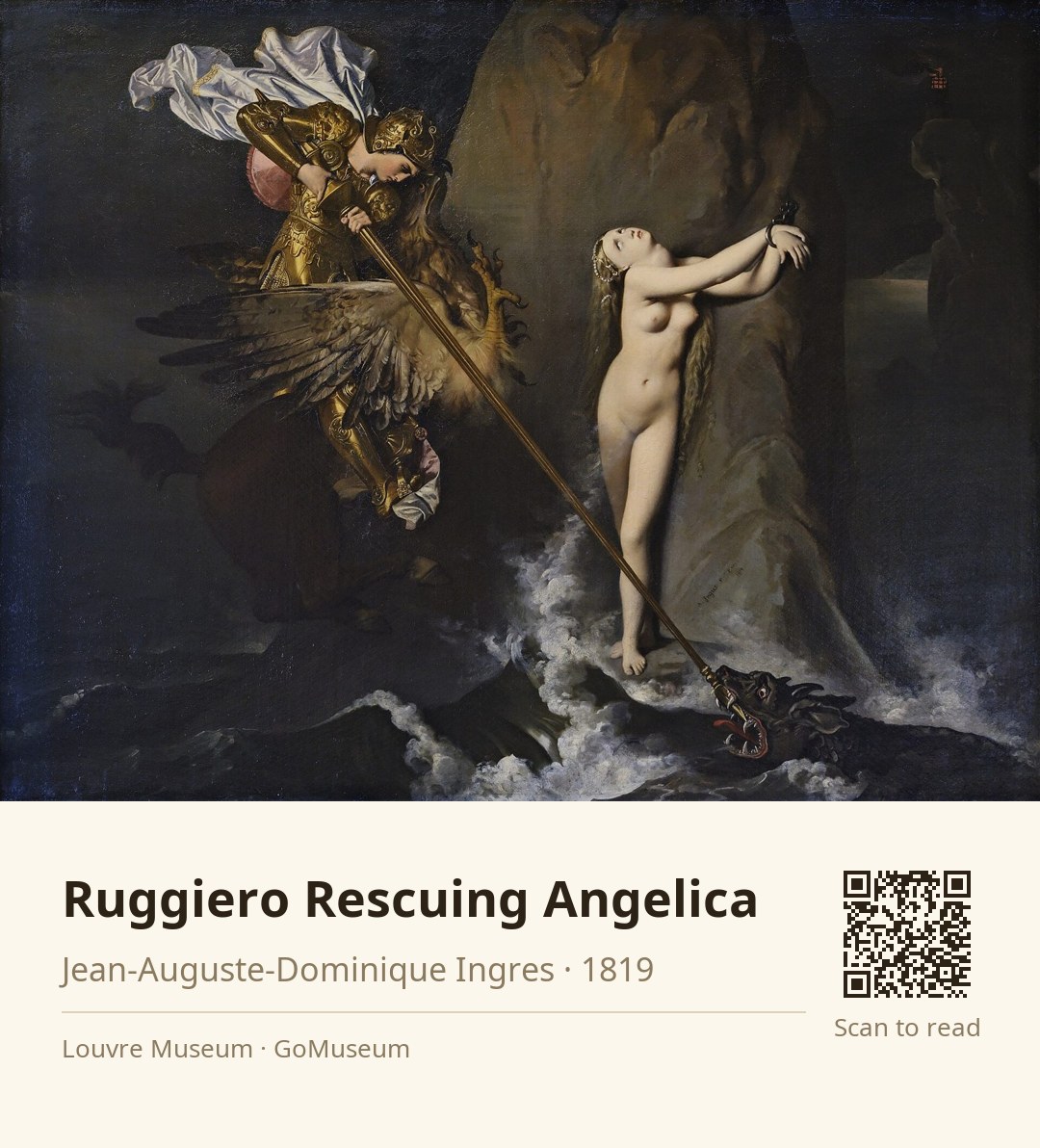
Ruggiero Rescuing Angelica
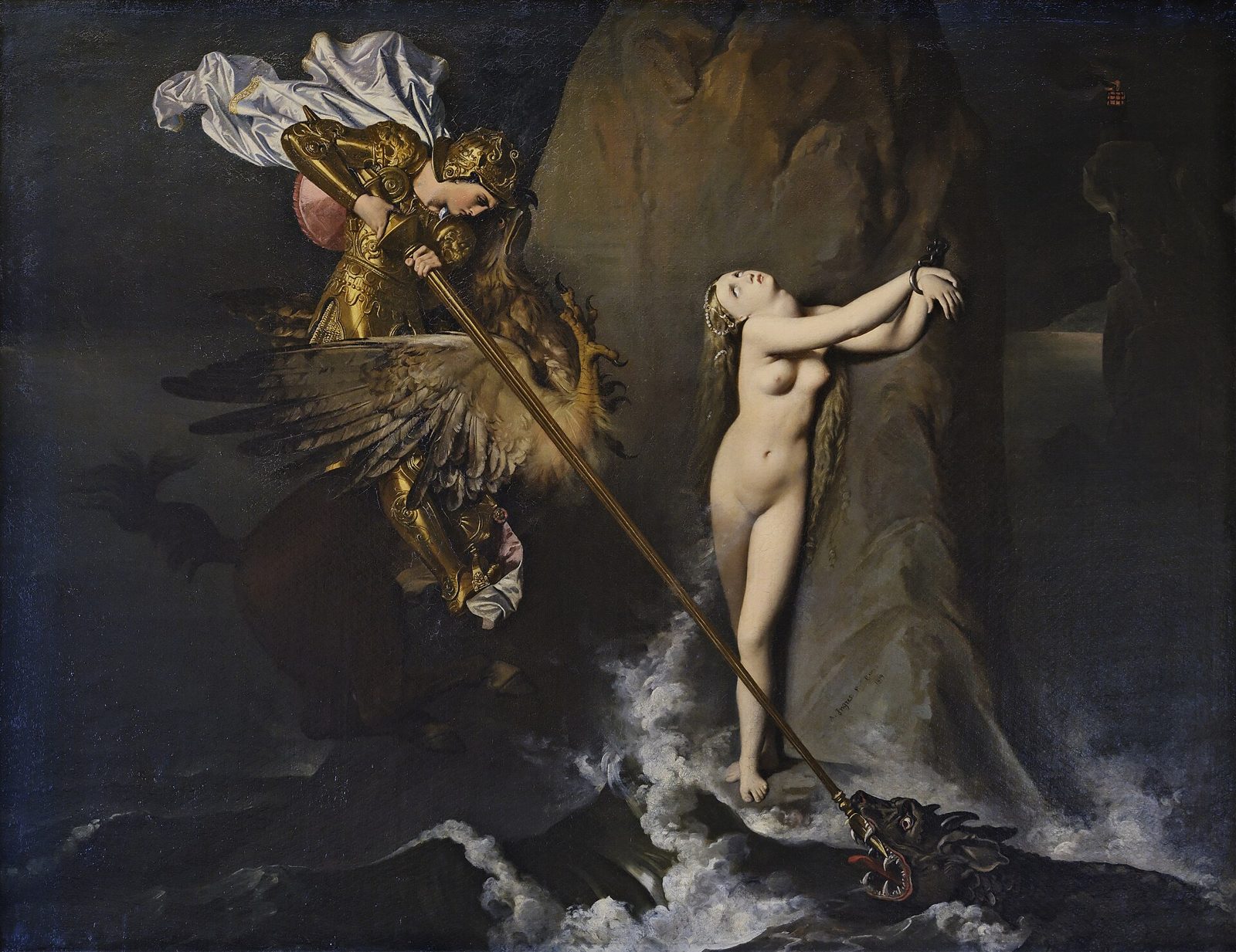
🎧 This work has audio narration — listen in the appTake a moment to really absorb the drama unfolding in front of you. In Jean-Auguste-Dominique Ingres' "Ruggiero Rescuing Angelica," the tension is palpable as the knight, Ruggiero, charges forth on his magnificent hippogriff, lance poised to strike. Notice how Ingres captures the raw emotion in Angelica's expression—her fear and vulnerability are almost tangible, contrasting sharply with Ruggiero's fierce determination.
These details matter because they highlight the central theme of heroism and rescue, a timeless narrative that resonates through art and literature. Ingres was inspired by Ariosto's "Orlando Furioso," a tale that intertwines love, bravery, and the supernatural. The way Angelica is depicted, chained and exposed, speaks to the societal views of women during Ingres' time, reflecting both their objectification and the idealization of their beauty.
Painted in 1819, this piece was one of Ingres' first major works to enter a public collection, setting the stage for his future acclaim. Despite initial criticism regarding Angelica's form, the painting has endured, captivating viewers with its emotional depth and technical mastery.
As you stand here, consider: what does this scene of rescue evoke for you? How does the interplay of strength and vulnerability resonate in your own life?
Jean-Auguste-Dominique Ingres was a pivotal figure in French Neoclassicism, born on August 29, 1780, in Montauban. He was the son of a versatile artist, which nurtured his early artistic inclinations. Ingres studied under Jacques-Louis David in Paris, where he developed a commitment to academic traditions, aspiring to elevate history painting above all genres. His early career was marked by struggles, as critics dismissed his style as archaic, yet he persevered, achieving recognition with works like "The Vow of Louis XIII" in 1824.
His portraits, characterized by expressive distortions, became his most celebrated contributions, influencing modern artists such as Matisse and Picasso. Ingres's time in Italy, from 1806 to 1824, was crucial; he immersed himself in the study of Renaissance masters, which shaped his distinctive style. Despite facing criticism for his meticulous approach, he remained steadfast in his vision of beauty, emphasizing drawing over color.
Later in life, he returned to Paris, where he continued to create significant works, including "The Turkish Bath." Ingres's legacy endures as a bridge between classical traditions and modern art, embodying the tension between adherence to established norms and the evolving landscape of artistic expression. He passed away on January 14, 1867, leaving behind a profound impact on the art world.
In 1817, Jean-Auguste-Dominique Ingres received the commission for 'Ruggiero Rescuing Angelica,' and by 1819, he had completed this captivating piece. When it debuted at the Paris Salon that same year, it was shown alongside his other notable work, 'Grande Odalisque.' However, the reception was mixed; critics were harsh, particularly regarding Angelica's portrayal. One art historian mockingly referred to her as 'Angelica with goitres,' while another called her 'triple-breasted Angelica.' Despite this rocky start, the painting caught the eye of Comte de Blacas, the French ambassador to the Vatican, who acquired it for King Louis XVIII. It was displayed prominently above a doorway in the throne room of Versailles until 1823, before moving to the Musée du Luxembourg. This marked a significant milestone as it was Ingres' first major work to enter a public collection. Notably, Ingres created several variants of this composition, showcasing his ongoing fascination with the narrative and characters.
As you gaze at 'Ruggiero Rescuing Angelica,' take a moment to appreciate Ingres' meticulous brushwork and the way he handles paint. The figures are rendered with a precision that speaks to his academic training, yet there's a fluidity in their poses that brings them to life. Notice how the light dances across the scene, illuminating Ruggiero's armor and casting shadows that enhance the drama. The composition is carefully structured; Ruggiero's dynamic pose contrasts with Angelica's vulnerable stance, drawing your eye across the canvas. The scale of the painting, nearly life-sized, allows you to feel the intensity of the moment. Ingres’ choice of colors, particularly the rich blues and reds, adds to the emotional weight, evoking a sense of urgency and passion. The way he captures the textures of the hippogriff’s feathers and the softness of Angelica’s skin showcases his mastery of detail, making the entire scene feel almost tangible.
This 1819 masterpiece, inspired by Ariosto's 'Orlando Furioso', not only showcases Ingres' meticulous attention to form and detail but also influenced a generation of artists who followed him. Critics initially derided Angelica's portrayal, but this very controversy sparked discussions about the representation of the female form in art. Remember, this painting is not just a visual feast; it's a conversation starter that challenged norms and inspired future artistic movements.
Interestingly, Ingres created several variants of 'Ruggiero Rescuing Angelica,' including a reduced vertical copy and an oval format version. One of these later versions, painted in 1859, features Angelica prominently but nearly eliminates Ruggiero, with only his shield visible at the edge.
The painting received a mixed reception at the Paris Salon in 1819, with critics harshly mocking Angelica's portrayal, leading to derogatory nicknames like 'Angelica with goitres' and 'triple-breasted Angelica.' This criticism highlighted the tensions between Ingres' artistic vision and contemporary standards of beauty.
Born into a modest family, Ingres was encouraged by his father, a painter and musician, which fostered his early artistic talent. His education was disrupted by the French Revolution, leaving him with a sense of insecurity that drove his determination to excel as a history painter, a genre he aspired to elevate.