Portrait of Pope Pius VII
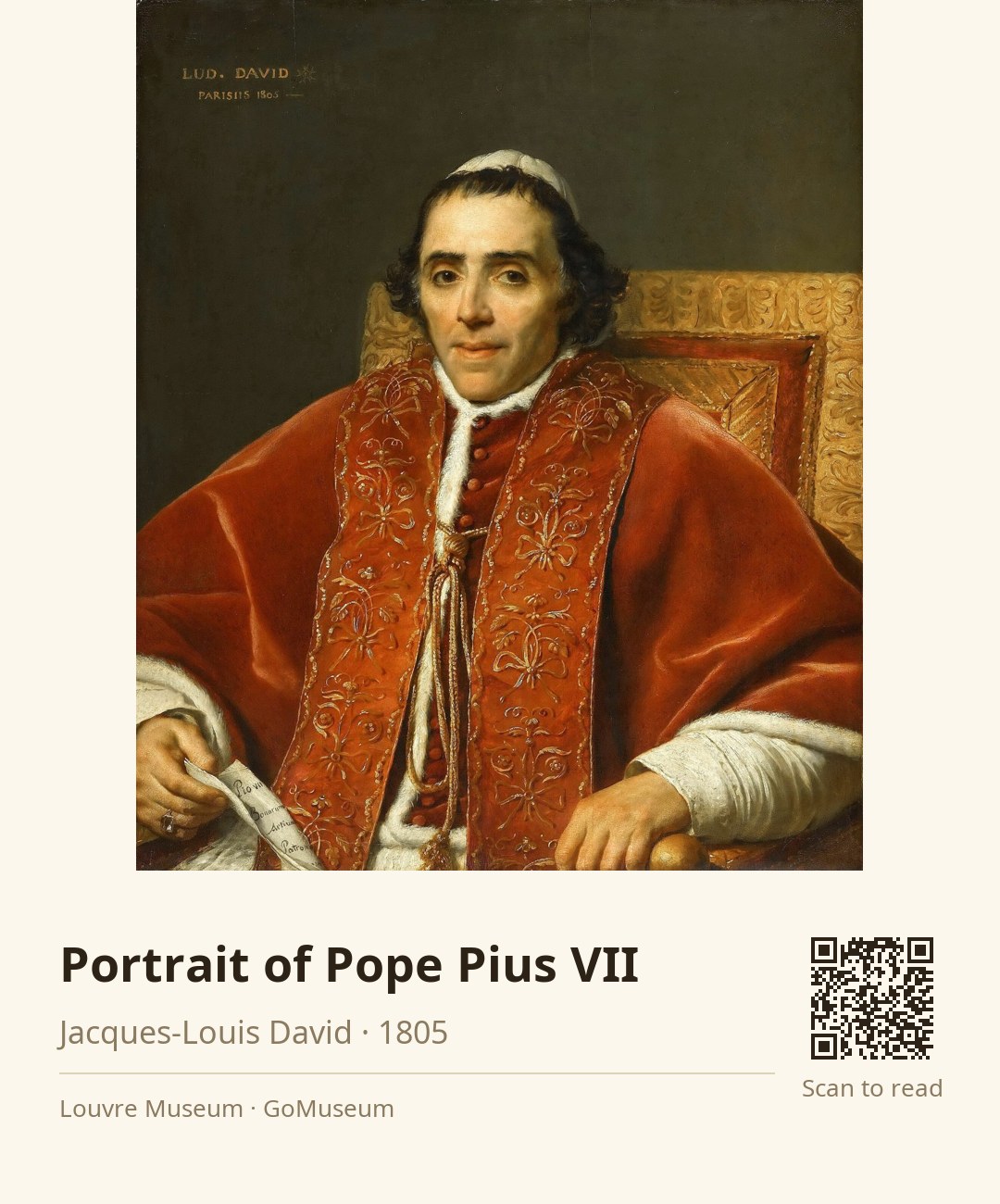
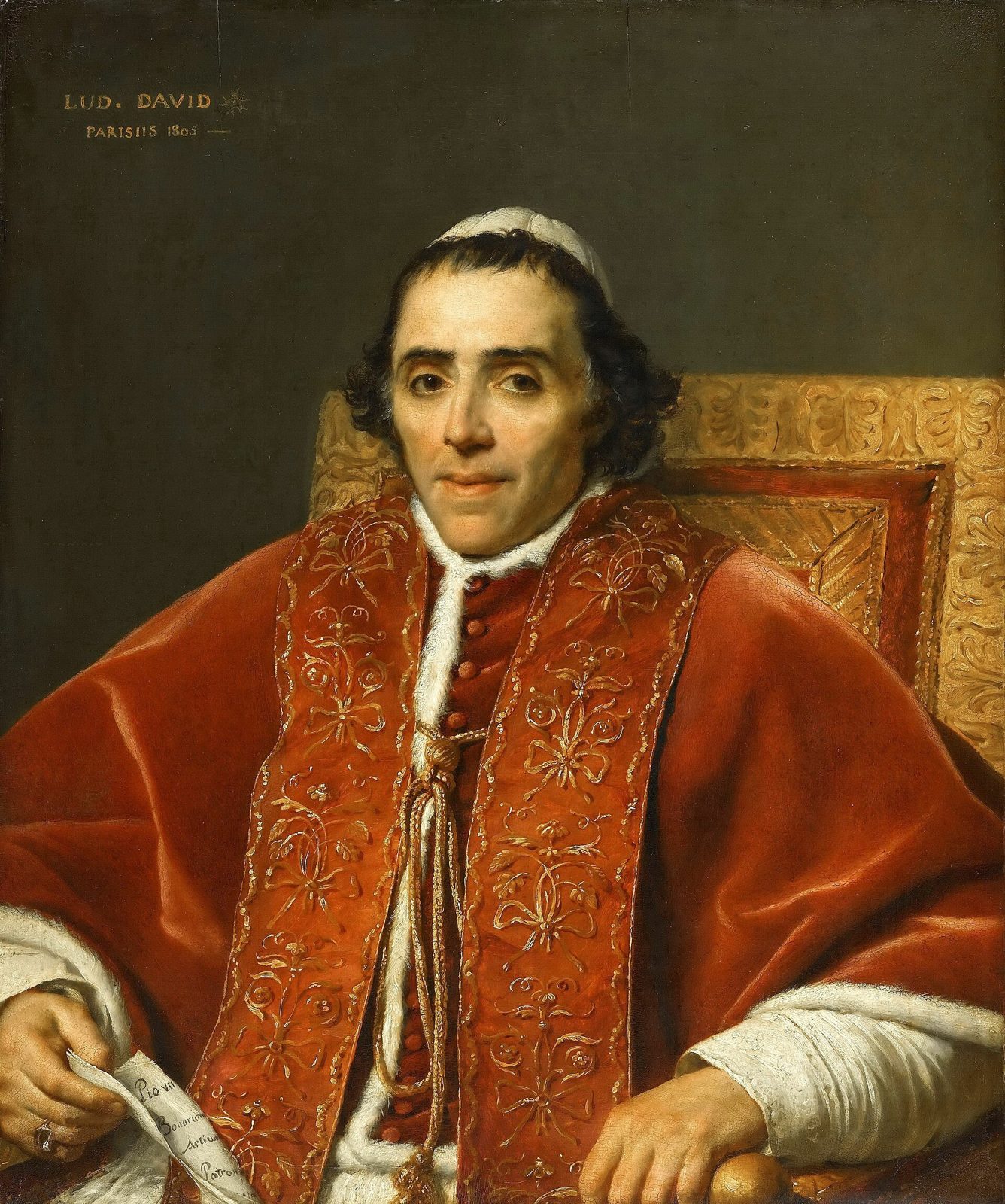
🎧 This work has audio narration — listen in the appTake a moment to really look at this portrait of Pope Pius VII by Jacques-Louis David. Notice how the pope's peaceful expression contrasts with the rich, red velvet of his chair and the deep brown background. His serene demeanor invites you in, doesn’t it?
David chose to depict Pius not as a powerful figure but as a humble, introspective leader. This choice reflects the artist’s admiration for the pope’s simplicity and humanity, especially significant given that Pius was a mere spectator during the grand coronation of Napoleon, despite being portrayed as a blessing figure in that scene.
Painted in 1805, this work was commissioned to thank Pius for his presence at Napoleon's coronation. David, a revolutionary artist turned imperial painter, captured the essence of a man who navigated the complexities of faith and power with grace.
As you stand here, consider how this portrait speaks to the nature of leadership and humility. What do you think it says about the relationship between power and simplicity?
Jacques-Louis David was a pivotal French painter born on August 30, 1748, in Paris. He emerged as the leading figure of the Neoclassical movement, marking a significant shift in artistic taste from the frivolity of Rococo to a more austere and emotionally charged classical style. His early life was marked by personal tragedy, losing his father at a young age, which shaped his character and determination to pursue art against familial expectations.
David's career flourished during the tumultuous political landscape of France, where he became an ardent supporter of the French Revolution, aligning himself with figures like Robespierre. His political engagement influenced his art, producing iconic works such as "The Death of Marat" and "The Coronation of Napoleon," which reflect both historical narratives and his personal convictions. After the fall of Napoleon, David faced exile but continued to influence generations of artists, establishing a legacy that shaped academic painting in the early 19th century. His works remain celebrated in major museums, particularly the Louvre, solidifying his status as a cornerstone of Western art history. David's life and art were inextricably linked to the evolving identity of France, embodying the spirit of revolution and the quest for artistic integrity.
Painted in the Tuileries in February 1805, David captured Pius from life, reflecting the artist's admiration for the pope's simplicity. The portrait was first exhibited in the Gallery of the French Senate and later moved to the Musée Napoléon, now the Louvre. David was paid 10,000 francs for this work, a significant sum at the time. The painting sparked mixed reactions; some critics felt the severe cropping made the pope appear cramped. David created three copies, with two commissioned by Napoleon himself, while the third, which he kept, was lost during his exile in Brussels.
Notice how David's brushwork creates a sense of intimacy and depth. The rich red of the pope's chair contrasts beautifully with the deep brown background, drawing your eye to Pius's serene expression. David's choice of a three-quarter pose allows the viewer to engage with the pope directly, almost as if he's looking right at you. The light falls softly on Pius's face, highlighting his peaceful demeanor, while the intricate details of his garments—like the gold embroidery on his stole—speak to the artist's meticulous paint handling. The overall composition is vertical, which lends a sense of dignity and stature to the figure, yet the simplicity of the setting emphasizes the humility of the subject.
Interestingly, David was so taken by Pope Pius VII's character that he later remarked on the pope's 'beautiful head' and simplicity, suggesting that he felt a genuine connection to the man behind the papal robes. This admiration was not merely professional; it reflected a deep respect for Pius's humanity, which David sought to immortalize in this portrait.
David's deep respect for Pius's character led him to depict the pope in a humble and introspective manner, emphasizing his humanity rather than his authority, which was a departure from typical portrayals of religious leaders.
The third copy, which David took with him during his exile in Brussels, is now lost, but it was noted in an inventory after his death, indicating its significance to the artist.