Portrait of Madame Marie-Louise Trudaine
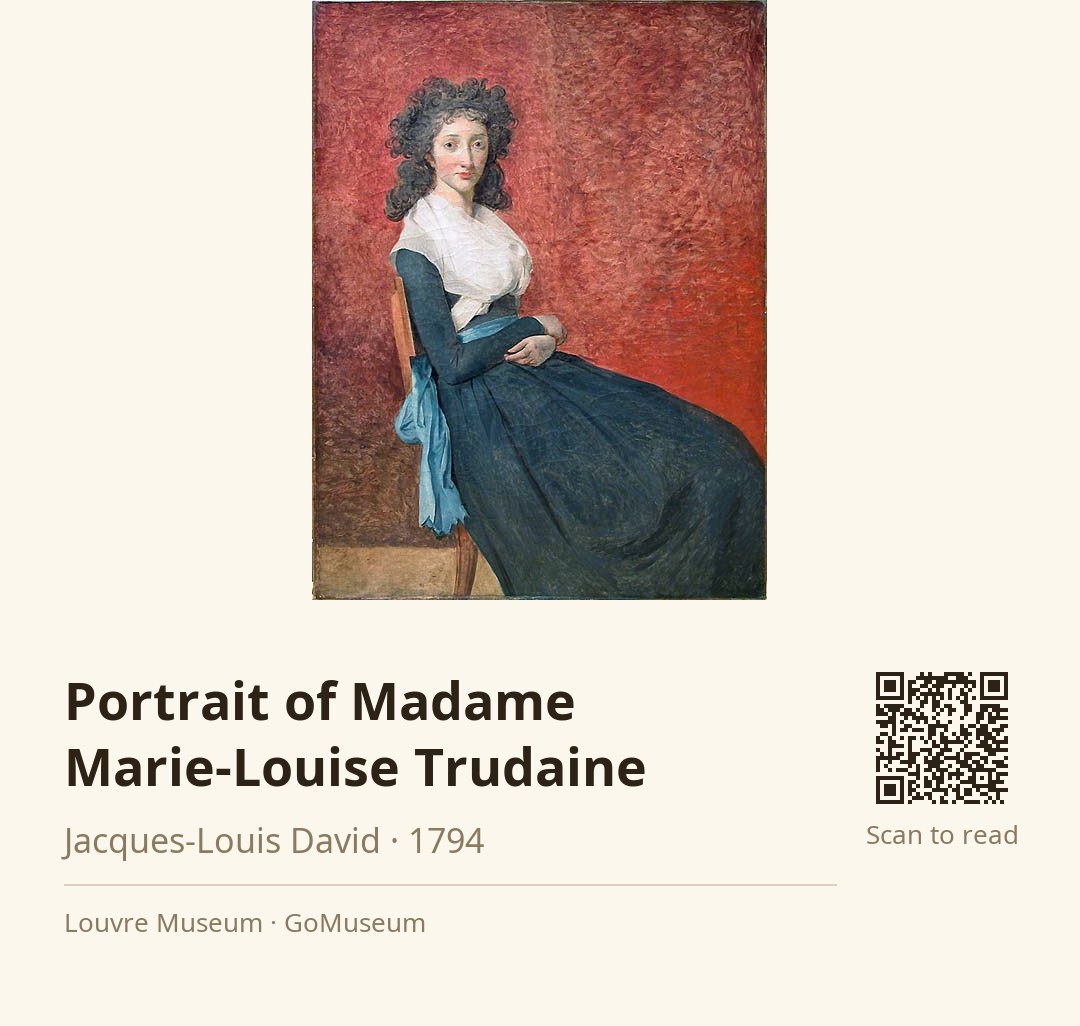
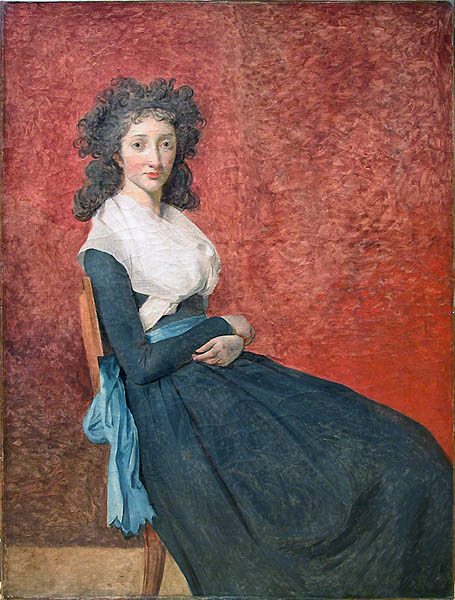
🎧 This work has audio narration — listen in the appTake a moment to really look at the Portrait of Madame Marie-Louise Trudaine. Notice how she sits, hands crossed in her lap, her expression a mix of worry and contemplation. The simplicity of her dark dress, accented by a blue sash and white collar, stands out against the tumultuous red background. It’s almost as if the chaos of the world around her is seeping into her very being.
These details matter because they reflect not just her personal state, but the broader turmoil of France during the late 18th century.
As you stand here, think about what it must have been like for Madame Trudaine, caught between her aristocratic roots and the revolutionary tide. What emotions do you think she felt as she posed for this portrait?
Jacques-Louis David was a pivotal French painter born on August 30, 1748, in Paris. He emerged as the leading figure of the Neoclassical movement, marking a significant shift in artistic taste from the frivolity of Rococo to a more austere and emotionally charged classical style. His early life was marked by personal tragedy, losing his father at a young age, which shaped his character and determination to pursue art against familial expectations.
David's career flourished during the tumultuous political landscape of France, where he became an ardent supporter of the French Revolution, aligning himself with figures like Robespierre. His political engagement influenced his art, producing iconic works such as "The Death of Marat" and "The Coronation of Napoleon," which reflect both historical narratives and his personal convictions. After the fall of Napoleon, David faced exile but continued to influence generations of artists, establishing a legacy that shaped academic painting in the early 19th century. His works remain celebrated in major museums, particularly the Louvre, solidifying his status as a cornerstone of Western art history. David's life and art were inextricably linked to the evolving identity of France, embodying the spirit of revolution and the quest for artistic integrity.
Commissioned by her brothers-in-law, the Trudaine brothers, this portrait reflects the connections of the Trudaine family, known for their significant roles in French civil service since the 17th century. David, a prominent figure in the Parisian art scene, was welcomed into their salon, a hub for artists and intellectuals. However, as the French Revolution unfolded, David's political views shifted dramatically, leading him to become an extremist and a deputy in the National Convention, distancing him from his aristocratic patrons like the Trudaines. The portrait itself remains unfinished, capturing a moment of tension in both the artist's life and the turbulent times of the Revolution. It eventually found its way to the Louvre in 1890, after passing through various collections, including that of the painter Léon Cogniet and later the marquis de Gouvello.
As you gaze at this portrait, pay attention to the brushwork that David employs. The strokes are both deliberate and expressive, particularly in the chaotic red background that seems to swirl around Madame Trudaine. This choice of color not only heightens the emotional tension but also reflects the turmoil of the era. Notice how her dark dress, with its simple lines, contrasts sharply with the vibrant backdrop, drawing your eye to her worried expression. The composition is striking; she is seated at an angle, hands crossed in her lap, which creates a sense of intimacy and vulnerability. David's decision to leave the painting unfinished adds to its haunting quality, inviting you to ponder what might have been if the world had not been in such disarray.
David's radical approach and emotional depth influenced a generation of artists who followed, steering them away from the frivolity of Rococo towards a more serious, neoclassical style. His work not only captured the essence of his subjects but also reflected the broader societal changes, making him a pivotal figure in the transition to modern art. The unfinished nature of this portrait speaks volumes about the uncertainty of the time, leaving a legacy that resonates with themes of fragility and resilience.
Did you know that this portrait was left unfinished? Jacques-Louis David, the artist, was deeply involved in the political upheaval of the French Revolution during the time he worked on it. As he became more radicalized, he distanced himself from his aristocratic patrons, including the Trudaine family who commissioned this piece. The portrait captures a moment of tension, not just in the subject's expression but also in David's life, as he navigated the stormy waters of revolution and personal ambition.
The Trudaine family's salon at Place des Vosges was a cultural hub where influential artists and intellectuals, including Jacques-Louis David and poet André Chénier, gathered, fostering a vibrant exchange of ideas during a tumultuous period in French history.
As the French Revolution intensified, David became radicalized and distanced himself from his aristocratic patrons, including the Trudaine family, who chose to retreat from the political turmoil, highlighting the stark contrast between their fates.
Marie-Louise Trudaine died at the young age of 33 in Geneva in 1802, leaving no children, and her life was marked by the upheaval of the Revolution, which claimed the lives of her husband and brother-in-law shortly after the portrait was commissioned.