Portrait of Madame Emilie Seriziat and her Son
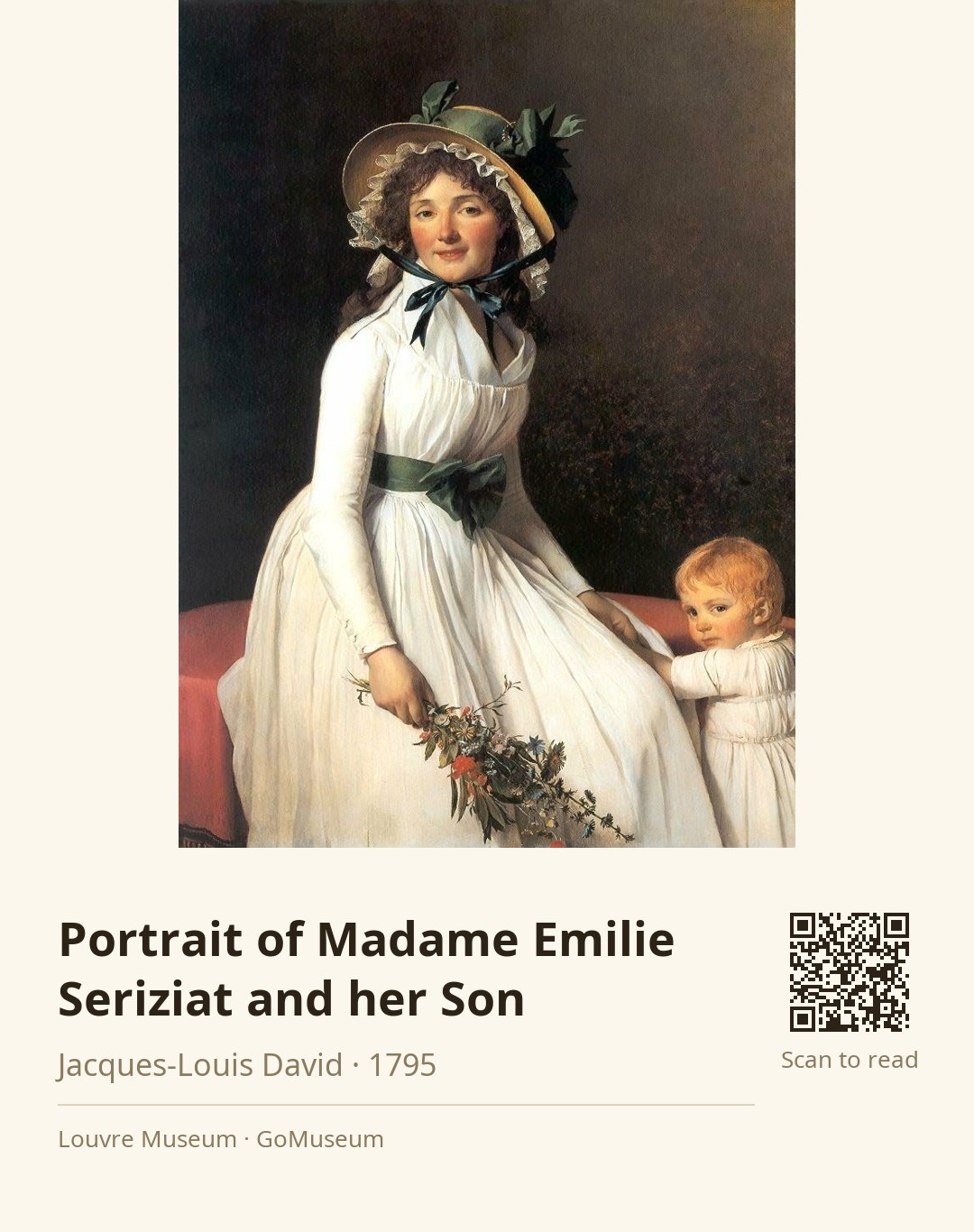
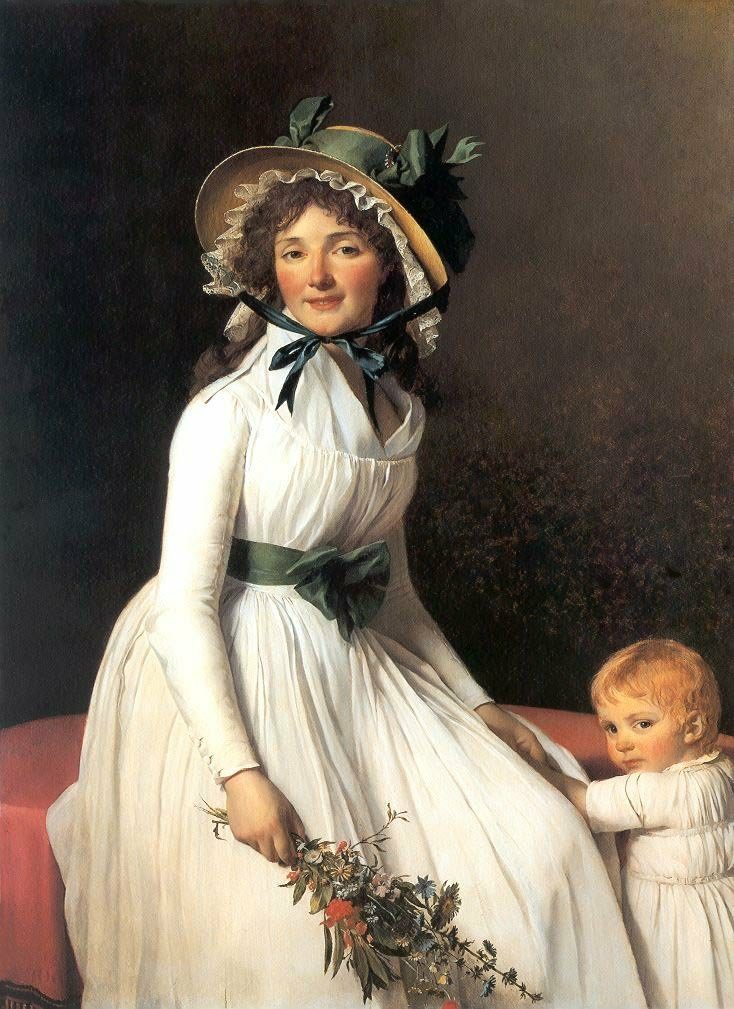
🎧 This work has audio narration — listen in the appMadame Émilie Sériziat sits elegantly in a white gown, her calm demeanor captured by Jacques-Louis David in 1795. A wide-brimmed hat adorned with green ribbons frames her face, while she holds a delicate bouquet of flowers in her left hand, a symbol of grace and maternal affection. Beside her, her son Émile, dressed in white, clings to her dress, his gaze directed outward, suggesting a moment of connection between mother and child.
This portrayal is not merely a depiction of a family; it reflects the intimate bond and the societal roles of women in the late 18th century. David’s choice to present Émilie in a serene pose, with her direct gaze engaging the viewer, emphasizes her strength and presence in a time of political upheaval. The simplicity of the dark background serves to highlight the figures, allowing their expressions and attire to take center stage, reinforcing the importance of personal identity amidst the broader historical context.
David painted this work during a tumultuous period in his life, having recently been released from imprisonment for his political affiliations. He found refuge with Émilie’s family, which deepened his connection to them, as he also created a companion portrait of her husband, Pierre. The dual portraits were exhibited at the Salon of 1795, showcasing not only David's artistic prowess but also his ability to weave personal narratives into the fabric of his work.
Jacques-Louis David was a pivotal French painter born on August 30, 1748, in Paris. He emerged as the leading figure of the Neoclassical movement, marking a significant shift in artistic taste from the frivolity of Rococo to a more austere and emotionally charged classical style. His early life was marked by personal tragedy, losing his father at a young age, which shaped his character and determination to pursue art against familial expectations.
David's career flourished during the tumultuous political landscape of France, where he became an ardent supporter of the French Revolution, aligning himself with figures like Robespierre. His political engagement influenced his art, producing iconic works such as "The Death of Marat" and "The Coronation of Napoleon," which reflect both historical narratives and his personal convictions. After the fall of Napoleon, David faced exile but continued to influence generations of artists, establishing a legacy that shaped academic painting in the early 19th century. His works remain celebrated in major museums, particularly the Louvre, solidifying his status as a cornerstone of Western art history. David's life and art were inextricably linked to the evolving identity of France, embodying the spirit of revolution and the quest for artistic integrity.
Jacques-Louis David painted the 'Portrait of Madame Émilie Sériziat and her Son' in 1795, a time when he was navigating the aftermath of his imprisonment due to his political affiliations. The painting, along with a companion piece of Pierre, was first exhibited at the Salon des artistes français in Paris that same year, where it received considerable attention. The dual portraits were significant not only for their artistic merit but also for their personal connections, reflecting David's own life circumstances. After the Salon, the works traveled through various exhibitions, including the 1863 show at Boulevard des Italiens and the 1900 Exposition Universelle in Paris. The painting's provenance traces back to Sosthène Moreau, highlighting its journey through the art world and its enduring legacy.
In this portrait, David employs oil on wood to create a striking visual impact. The brushwork is meticulous, with smooth, almost velvety textures that enhance the elegance of Madame Sériziat’s gown. The use of color is particularly noteworthy; the stark contrast between her white dress and the dark background serves to elevate her figure, drawing the viewer's focus to her serene expression and the delicate bouquet she holds. David's choice of a simple composition, with both figures placed prominently in the foreground, creates a sense of intimacy and connection. The scale of the painting, measuring 131 by 96 centimeters, allows for detailed representation while maintaining an inviting presence. The careful arrangement of the figures, with Émile clinging to his mother, reinforces the theme of familial bonds, making the emotional resonance of the piece palpable.
Émilie Sériziat was Jacques-Louis David's sister-in-law, as she was the sister of his wife, Marguerite Charlotte David.
Émile, the child in the portrait, was born in 1793 but unfortunately died at a young age.
David's personal life influenced the creation of the dual portraits as they were painted during a time when he was staying with Émilie's family after his imprisonment, deepening his connection to them.