Portrait of Doña Isabel de Requesens y Enríquez de Cardona-Anglesola
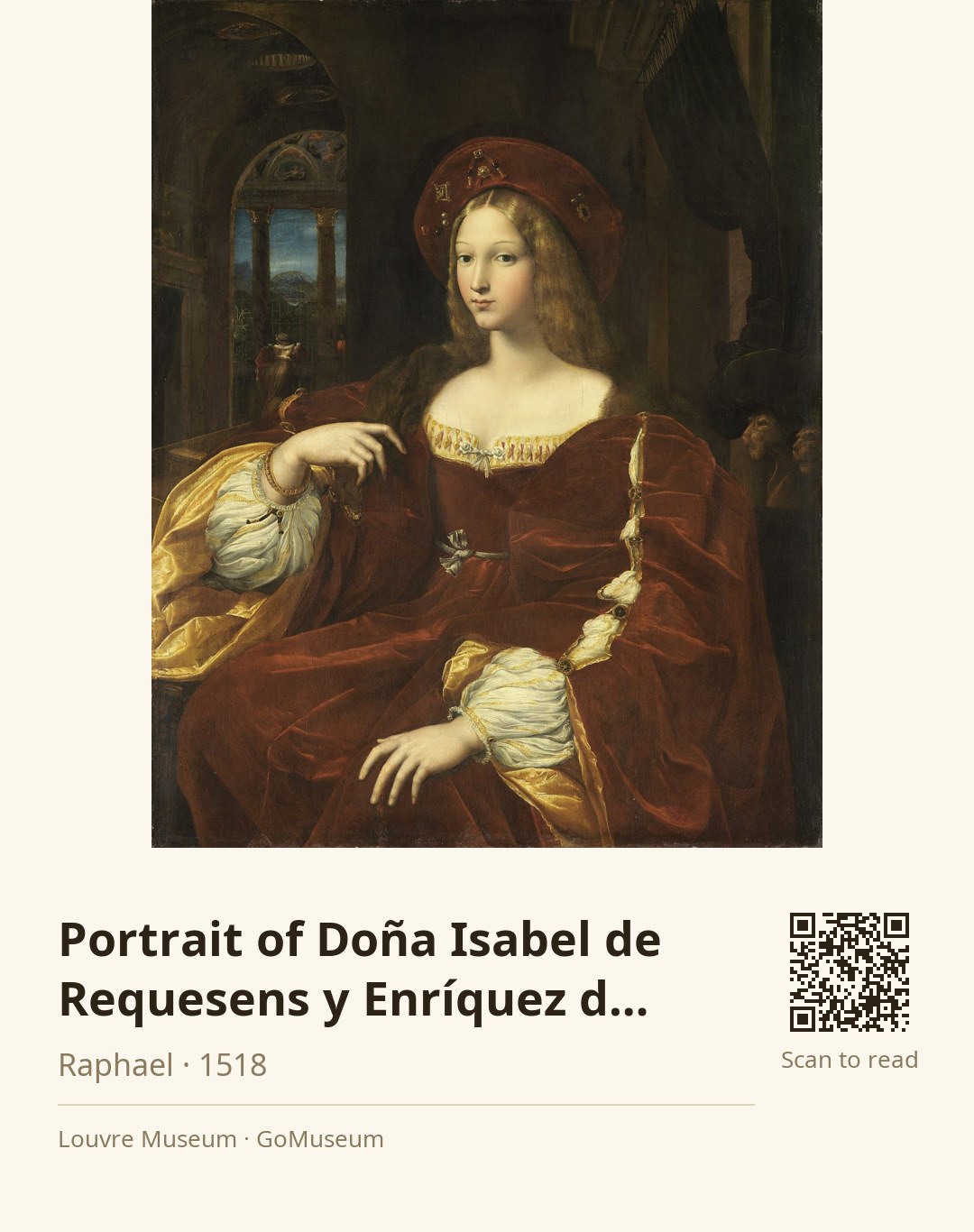
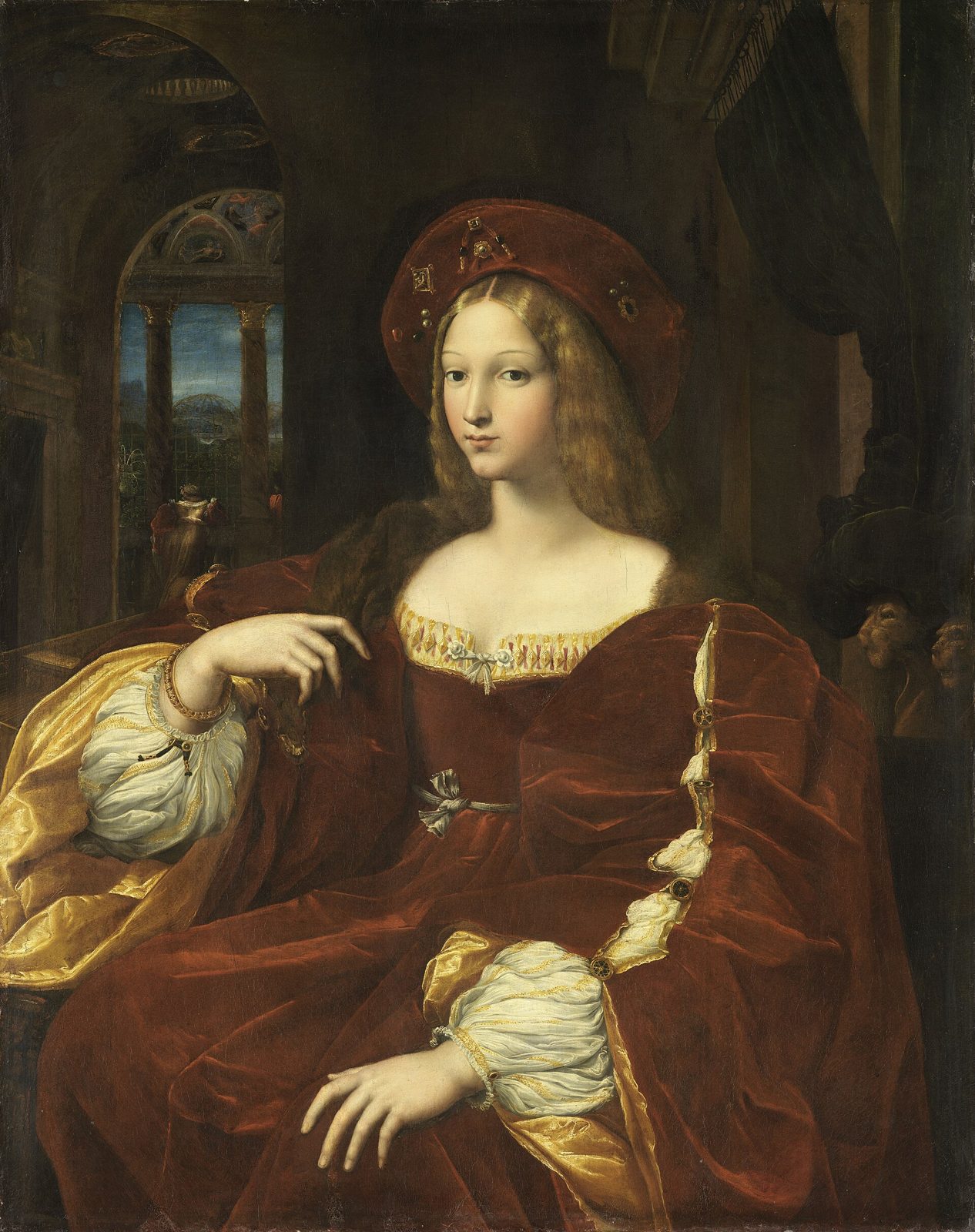
🎧 This work has audio narration — listen in the appTake a moment to really look at the Portrait of Doña Isabel de Requesens y Enríquez de Cardona-Anglesola. Notice how she gazes directly at you, her deep red velvet dress shimmering with gold trim. The way the sleeves are slashed to reveal the cream fabric beneath adds a touch of sensuality, inviting you into her world.
These details matter because they speak to the era’s ideals of beauty and power. Doña Isabel was not just a noblewoman; she was the vicereine of Naples, and this portrait captures her authority and allure. The vibrant red of her dress symbolizes love and passion, while the way she holds her fur suggests both elegance and confidence.
Commissioned by Cardinal Bibbiena for Pope Leo X, this painting was meant as a diplomatic gift to King Francis I of France, who had a penchant for portraits of beautiful women. It’s a fascinating blend of Raphael’s vision and the skill of his assistant, Giulio Romano, who painted most of it under Raphael’s guidance.
As you stand here, consider what it must have been like to be a woman of such stature in the 16th century. What stories might she have told if she could speak? What power did her beauty hold in a world dominated by men? Let her gaze linger in your mind as you ponder the complexities of beauty and authority.
Raffaello Sanzio da Urbino, known as Raphael, was an Italian painter and architect of the High Renaissance, born in Urbino in 1483. Orphaned by age eleven, he managed his family's workshop and trained under Pietro Perugino, establishing himself as a master by 1500. His move to Rome in 1508 marked the beginning of a prolific period, where he received significant commissions, including the renowned frescoes in the Vatican's Raphael Rooms. His art is celebrated for its clarity, harmonious composition, and embodiment of Neoplatonic ideals. Raphael's influence was profound, shaping the trajectory of Western art and serving as a model for academies until the 19th century. His legacy, characterized by serenity and grace, was later revived in the 18th and 19th centuries, contrasting with the dramatic styles of his rival Michelangelo. Despite his early death at 37, Raphael's extensive body of work and innovative techniques left an indelible mark on the art world, influencing generations of artists and extending into contemporary culture.
The Portrait of Doña Isabel de Requesens y Enríquez de Cardona-Anglesola was commissioned in 1518 by Cardinal Bibbiena on behalf of Pope Leo X, intended as a diplomatic gift for King Francis I of France. Initially, it was believed to depict Giovanna d'Aragona, but a study in 1997 confirmed it was actually Isabel de Requesens, the wife of the viceroy of Naples. The painting showcases the collaborative effort between Raphael and his assistant, Giulio Romano. While Raphael painted the face, Giulio executed the rest, a common practice during Raphael's later years when he was overwhelmed with commissions. The artwork was restored in the mid-16th century by Francesco Primaticcio and transferred from wood to canvas, ensuring its preservation. Over time, several copies were made, with one noted by the historian Brantôme as being displayed in the king's apartments at Fontainebleau.
Notice how the artist plays with light and shadow to create a striking contrast between Doña Isabel's fair skin and her deep red velvet dress. The bold color of her attire dominates the canvas, drawing your eye immediately. The slashed sleeves not only reveal the cream fabric beneath but also add a sense of movement and sensuality. The composition is carefully structured, adhering to a musical ratio that gives it a harmonious balance. Isabel's gaze is direct and commanding, inviting you into her world, while her relaxed posture, with one hand delicately fingering the fur around her shoulders, suggests both confidence and elegance. The background, featuring a woman leaning against a railing, adds depth and context, hinting at a narrative beyond the portrait itself.
Did you know that this painting, once thought to be a portrait of Giovanna d'Aragona, was actually commissioned for a French king? Cardinal Bibbiena, acting on behalf of Pope Leo X, wanted to impress Francis I of France, who had a penchant for collecting portraits of beautiful women. It was painted by Giulio Romano, Raphael's assistant, who was sent to Naples to capture the likeness of Isabel de Requesens while Raphael himself painted her face from a distance.
In the background, there is a woman leaning against a railing, which adds depth to the composition and hints at a narrative beyond Doña Isabel herself, suggesting a social context that might be missed at first glance.
The slashed sleeves of her dress reveal the cream fabric beneath, a technique that not only adds sensuality but also showcases the intricate craftsmanship and fashion of the period, highlighting the artist's attention to detail.