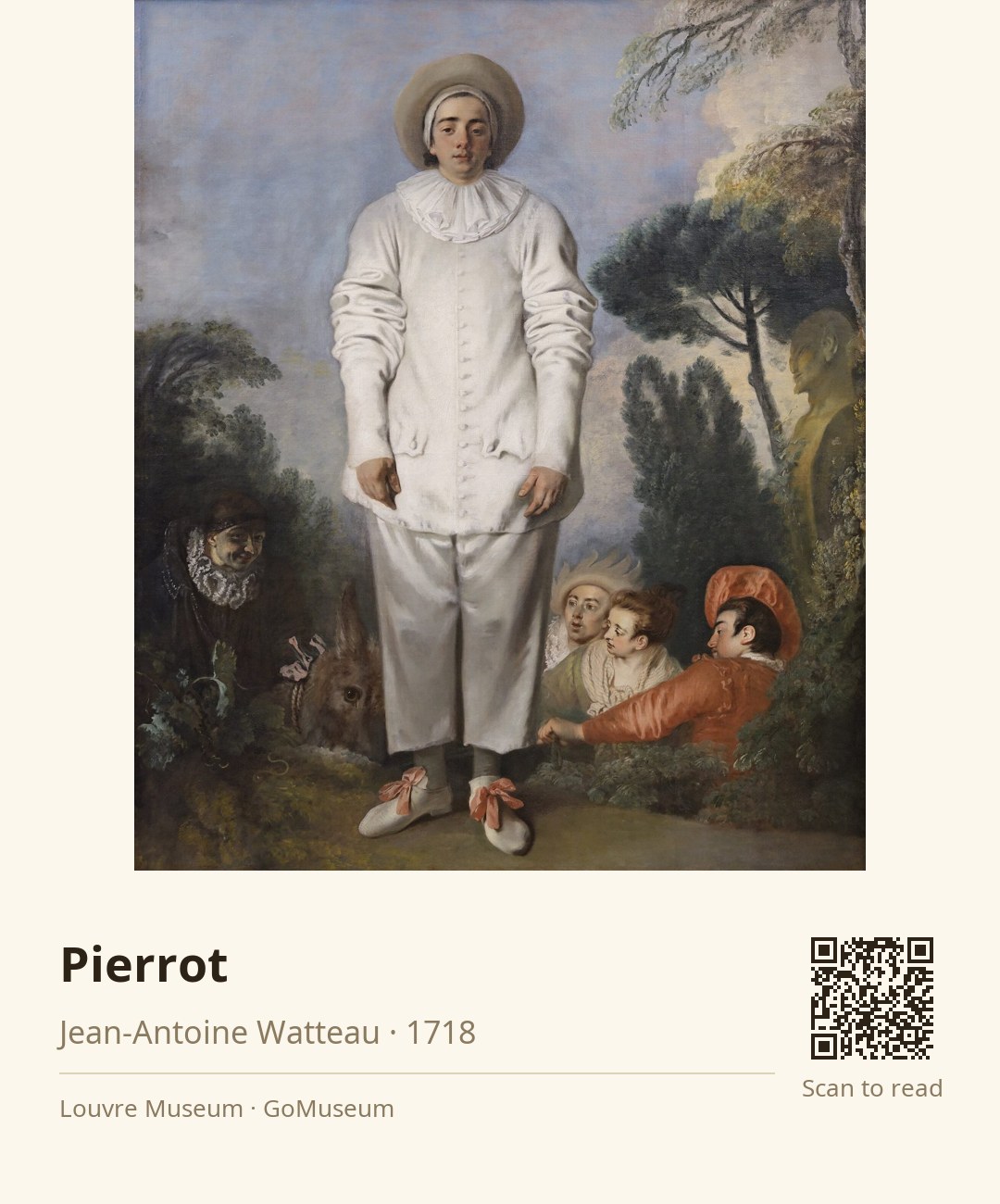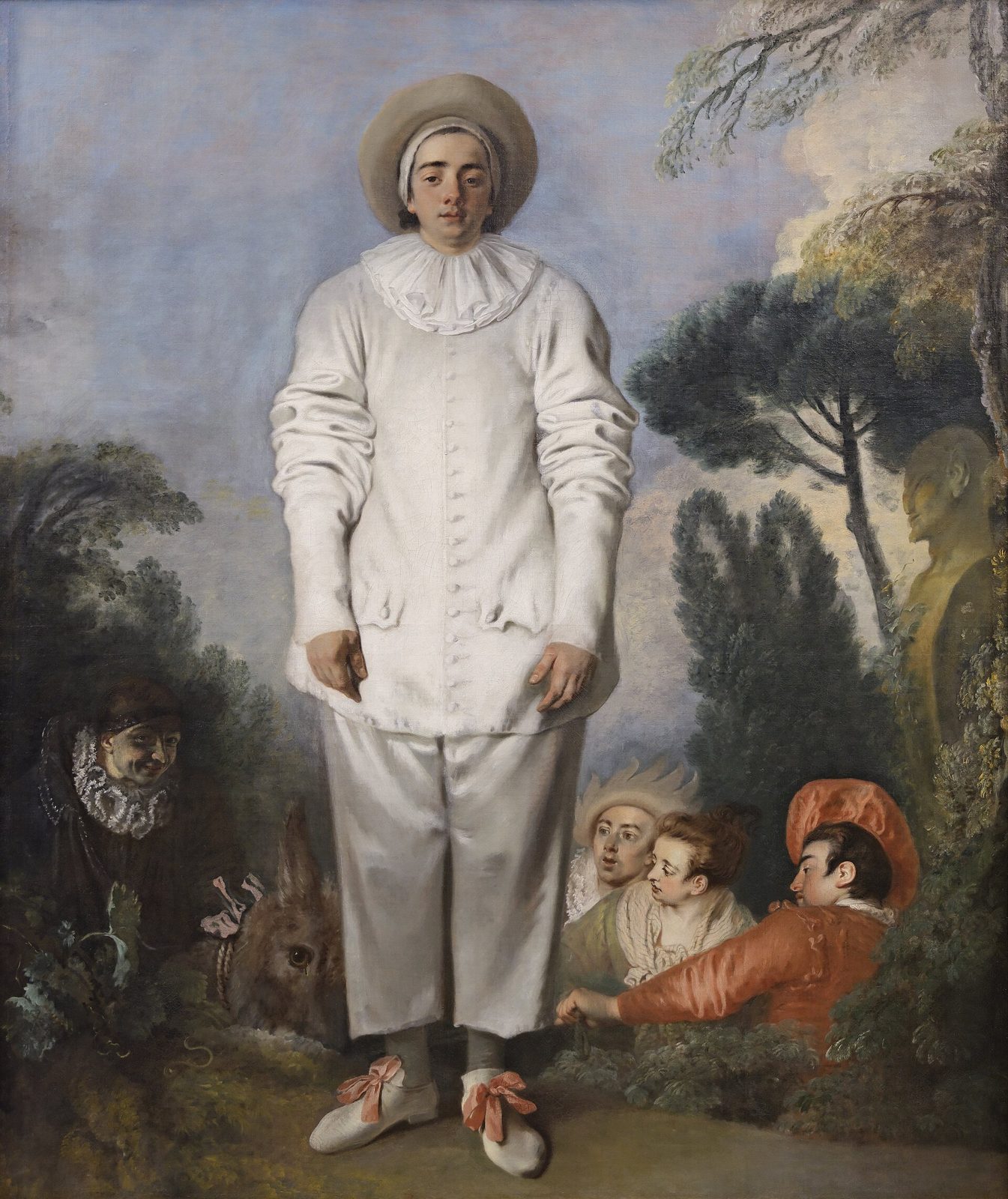
Take a moment to really look at Pierrot. Notice how he stands there, almost frozen, in his oversized white costume. Those exaggerated sleeves and comically short pants make him look both foolish and oddly poignant, don’t they? This isn’t just a clown; it’s a reflection of the human condition, a snapshot of melancholy wrapped in humor.
Watteau, the artist, painted this life-size figure in 1718, capturing not just the character of Pierrot from the commedia dell'arte, but perhaps something of himself too. Scholars argue about Pierrot’s expression—some see stupidity, others a deeper sadness. This ambiguity is crucial; it invites you to ponder what lies beneath the surface.
Watteau was known for his vibrant scenes of life and theater, and Pierrot stands out as his only life-size figure, emphasizing his isolation amidst a backdrop of lively companions. The other actors seem to engage with one another, while Pierrot remains detached, accentuating his role as the “sad clown.”
As you stand here, think about the layers of meaning in this painting. What emotions does Pierrot evoke in you? Is he merely a fool, or is there a deeper story of longing and solitude hidden beneath that oversized ruff?
Jean-Antoine Watteau, born in Valenciennes in 1684, was a pivotal French painter whose brief but impactful career transformed the Baroque style into the more playful Rococo. He is renowned for pioneering the genre of fêtes galantes, which depicted charming, idyllic scenes infused with theatricality, often inspired by the commedia dell'arte. Watteau's early life was marked by a tumultuous family environment, which likely influenced his introspective nature and artistic sensibilities.
After moving to Paris in 1702, he honed his skills under various influences, notably Claude Gillot and Claude Audran III, before establishing his unique style characterized by vibrant colors and fluid movement. His masterpieces, including "Pilgrimage to Cythera" and "Pierrot," reflect his fascination with love and leisure, capturing the essence of 18th-century French society.
Despite his struggles for recognition, Watteau achieved success during his lifetime, becoming a full member of the Académie Royale in 1717. His legacy endures through his extensive body of work, which continues to inspire artists and collectors alike, solidifying his place in art history as a master of color and emotion. Watteau passed away in 1721, leaving behind a rich artistic heritage that would influence generations to come.
The history of 'Pierrot' is as intriguing as the painting itself. Created by Jean-Antoine Watteau between 1718 and 1719, this life-size oil-on-canvas work was not widely recognized until the 19th century. It was notably absent from the 18th-century Recueil Jullienne, a significant catalog of Watteau's work. The first mention of it in written records came in 1826, leading to speculation about its origins. Some scholars believe it may have been commissioned as a shop sign for the retired actor Belloni, who was known for his portrayal of Pierrot. The painting eventually found its way to the Louvre in 1869, thanks to Dr. Louis La Caze, who bequeathed it to the museum. Its journey through various hands, including a picture dealer who once wrote a whimsical note about Pierrot's longing for approval, adds layers to its narrative.
When you look closely at 'Pierrot,' the craftsmanship leaps out at you. Watteau's brushwork is both delicate and deliberate, creating a sense of stillness that contrasts sharply with the lively characters surrounding Pierrot. The oversized sleeves of his costume seem to weigh him down, a clever choice that enhances his isolation. The composition is masterfully structured; Pierrot stands rigidly in the foreground, while the background actors engage in a dynamic dance of poses, emphasizing his emotional detachment. The muted palette, punctuated by the bright red of the man beside him, draws your eye to Pierrot's somber figure, making his foolishness feel even more poignant. The light falls softly, highlighting the textures of his costume and the expressions of the other actors, creating a visual tension that invites you to explore the deeper meanings behind that frozen facade.
It not only influenced contemporaries but also left a lasting legacy on future artists, including the likes of Picasso and Henri Rousseau. Watteau's portrayal of Pierrot as a melancholic figure paved the way for the 'sad clown' archetype, resonating through literature and visual arts alike. The painting's impact extended beyond its time, inspiring poets like Paul Verlaine and even influencing cinematic works such as the film 'Les Enfants du Paradis.' Today, it serves as a benchmark for depictions of Pierrot, with museums often measuring their own interpretations against Watteau's iconic representation.
One curious tidbit about 'Pierrot' is that it was once used as a shop sign for an art dealer in Paris. The dealer, struggling to sell the painting, wrote a playful note at the bottom, suggesting that Pierrot would be much happier if he could charm the viewers.
Some scholars speculate that 'Pierrot' may have been commissioned as a shop sign for the retired actor Belloni, who was known for his portrayal of the character, indicating its initial role in the theatrical world.
The painting's melancholic portrayal of the character Pierrot inspired the 'sad clown' archetype, influencing not only visual artists like Picasso and Henri Rousseau but also poets such as Paul Verlaine, who wrote works reflecting its themes.
In the early 19th century, a struggling picture dealer added a whimsical note to the painting, suggesting that Pierrot would be happier if he could charm viewers, highlighting the painting's perceived emotional depth even before it gained widespread recognition.