Unfinished Portrait of General Bonaparte
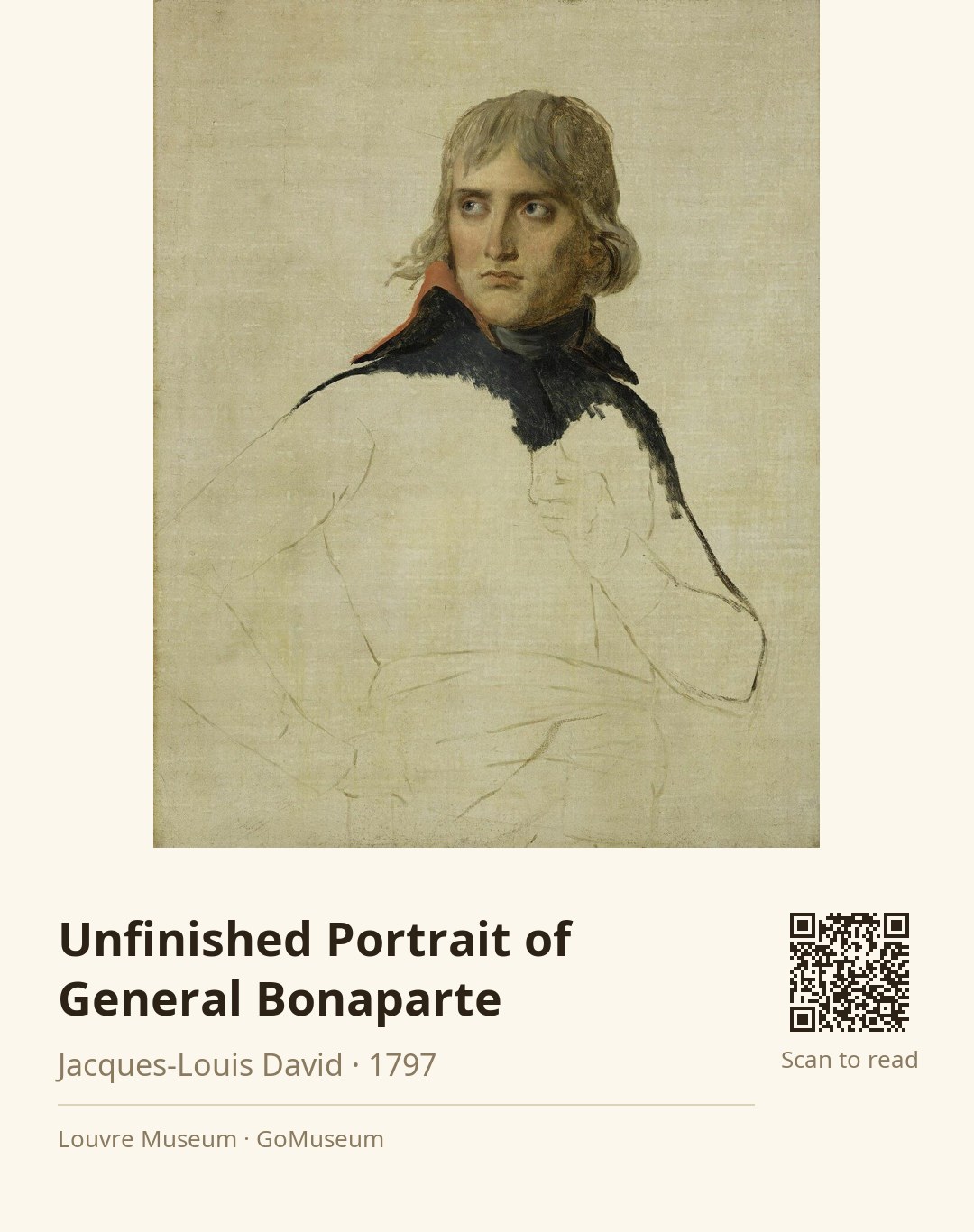
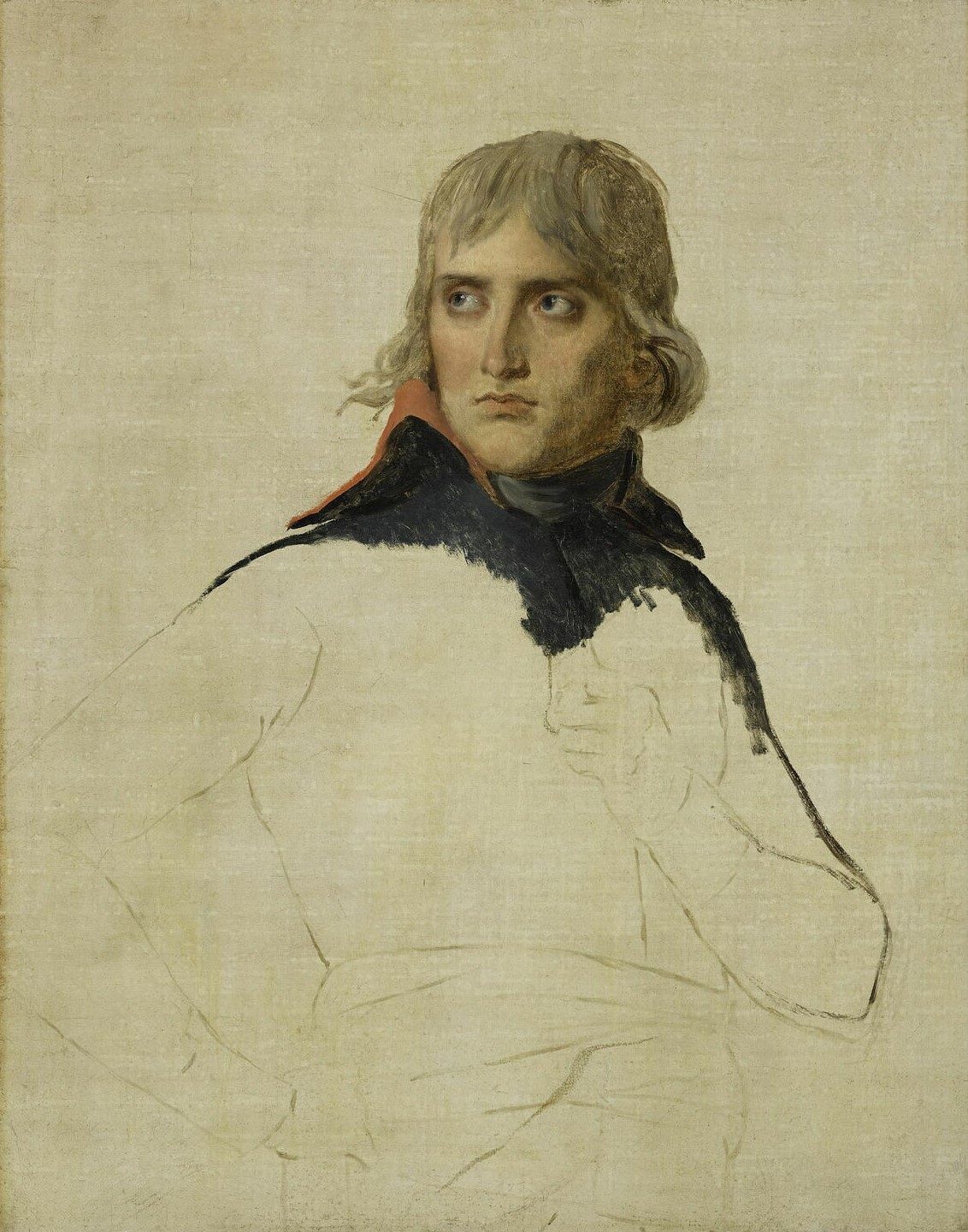
🎧 This work has audio narration — listen in the appAs you stand before the Unfinished Portrait of General Bonaparte by Jacques-Louis David, take a moment to really look at Bonaparte’s gaze. Notice how his eyes are slightly lifted, as if he’s peering into the future, embodying the ambition and determination that would define his legacy. The wind tousles his light-colored hair, giving him an almost heroic quality, while his dark uniform hints at the military might he commanded.
David’s choice to leave the painting incomplete adds a layer of intrigue, suggesting that Bonaparte’s story was still being written, much like the turbulent times they were living in.
David, a key figure in the Neoclassical movement, was inspired by the grandeur of ancient Rome and Greece, aiming to elevate the art of his time. His connection with Bonaparte was not just artistic; it was deeply political, as both were navigating the shifting tides of the French Revolution.
So, as you absorb this striking image, think about what it means to capture someone on the brink of greatness. What do you think Bonaparte was feeling in that moment? What ambitions lay ahead for him, and how do they resonate with the world today?
Jacques-Louis David was a pivotal French painter born on August 30, 1748, in Paris. He emerged as the leading figure of the Neoclassical movement, marking a significant shift in artistic taste from the frivolity of Rococo to a more austere and emotionally charged classical style. His early life was marked by personal tragedy, losing his father at a young age, which shaped his character and determination to pursue art against familial expectations.
David's career flourished during the tumultuous political landscape of France, where he became an ardent supporter of the French Revolution, aligning himself with figures like Robespierre. His political engagement influenced his art, producing iconic works such as "The Death of Marat" and "The Coronation of Napoleon," which reflect both historical narratives and his personal convictions. After the fall of Napoleon, David faced exile but continued to influence generations of artists, establishing a legacy that shaped academic painting in the early 19th century. His works remain celebrated in major museums, particularly the Louvre, solidifying his status as a cornerstone of Western art history. David's life and art were inextricably linked to the evolving identity of France, embodying the spirit of revolution and the quest for artistic integrity.
The Unfinished Portrait of General Bonaparte was painted by Jacques-Louis David between December 1797 and April 1798, during a time when Bonaparte was returning to France as a celebrated hero after his military successes in Italy. This work was commissioned following David's first encounter with Bonaparte at a reception hosted by the secretary of the Directoire, Lagarde. David made a quick sketch of Bonaparte's profile, which sparked the idea for this portrait. However, the painting remained unfinished as David shifted his focus to another major work, Les Sabines. The canvas was later cut by Vivant Denon, who preserved only the painted portion of Bonaparte's face and bust.
As you gaze at this portrait, pay attention to the way David handles the paint. The brushwork is both deliberate and expressive, capturing the essence of Bonaparte's character. Notice how the light falls on Bonaparte's face, creating a striking contrast against the darker tones of his uniform. David's choice to leave the lower part of the painting unfinished adds a sense of immediacy and tension, as if the general is still stepping into his future. The composition is carefully structured, with Bonaparte's elevated gaze drawing your eyes upward, suggesting ambition and destiny. The colors are rich yet restrained, reflecting the Neoclassical ideals David championed, while the unfinished areas evoke a feeling of anticipation, as if Bonaparte's story is still unfolding.
This painting not only showcases David's mastery of portraiture but also reflects the political climate of the time, capturing Bonaparte's rise as a national hero. Its unfinished state speaks volumes about the artist's process and the fleeting nature of power. David's influence extended far beyond this canvas; he shaped the visual language of an era, inspiring generations of artists who sought to blend art with political narrative. Remember, this portrait is more than just a depiction of a man; it's a symbol of an age where art and politics intertwined, forever changing the landscape of portrait painting.
Interestingly, the Unfinished Portrait of General Bonaparte served as a model for the effigy of Napoleon that appeared on French banknotes, specifically the 10,000 franc and later the 100 new franc notes. This connection between art and currency highlights how deeply intertwined Bonaparte's image became with the national narrative of France.
After Vivant Denon cut the canvas to preserve only the painted portion, the artwork changed hands multiple times, eventually being acquired by the Duke of Bassano in 1826 and remaining in his family until the 1930s, highlighting its journey through various collectors before reaching the Louvre.