Philosopher in Meditation
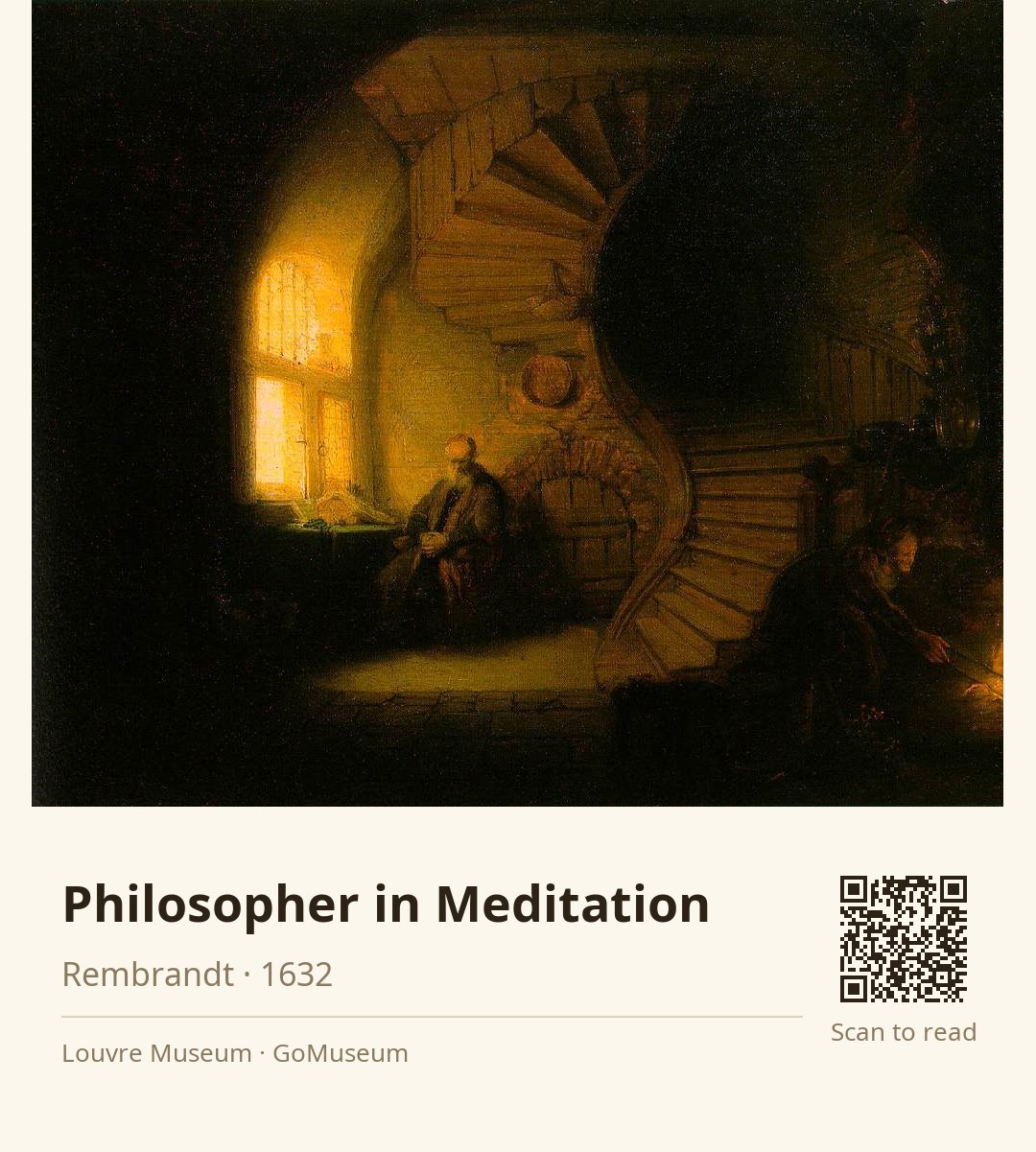
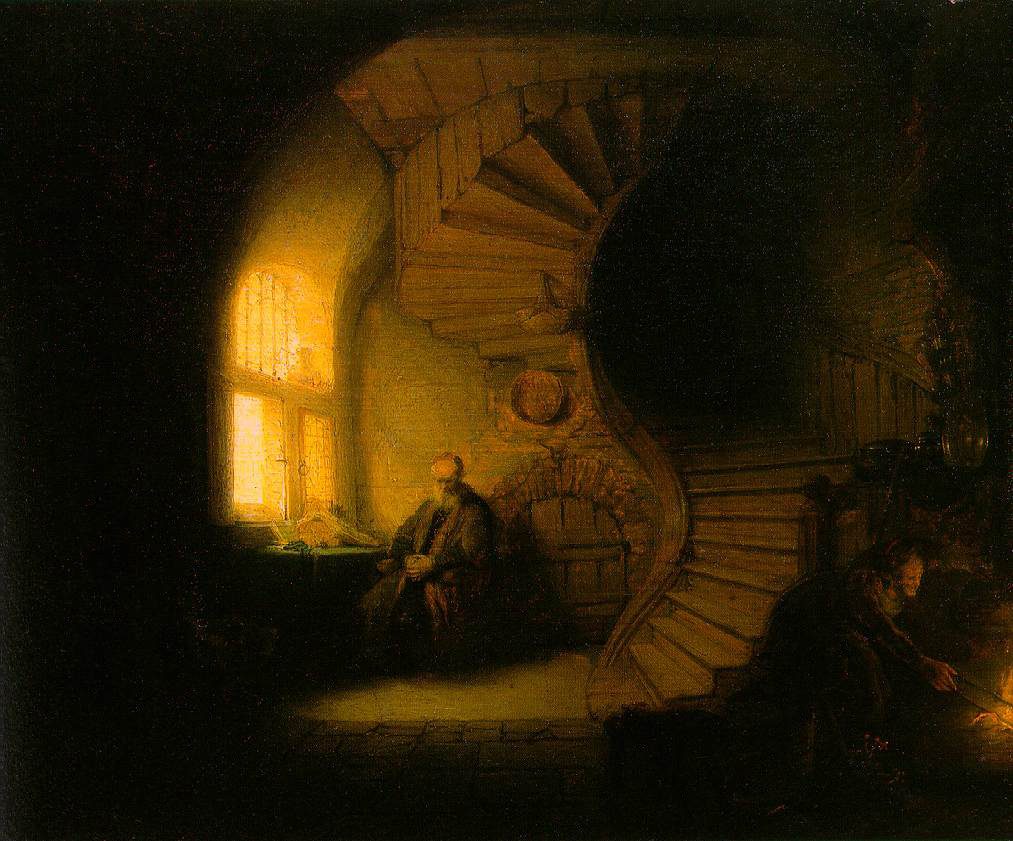
🎧 This work has audio narration — listen in the appTake a moment to really look at "Philosopher in Meditation." Notice how the old man is seated at a table, his head bowed and hands folded, bathed in a warm light that spills in from the window. Now, look closely at the intricate details of the wooden spiral staircase behind him. The way the light dances off the curves and shadows creates a sense of depth and invites you into this intimate space.
These details matter because they reflect Rembrandt's mastery of chiaroscuro, the technique of using light and shadow to convey emotion and atmosphere. This painting, created in 1632, captures a moment of quiet contemplation, perhaps symbolizing the search for wisdom or understanding. The staircase, often seen as a metaphor for life's journey, adds layers of meaning, suggesting that knowledge is a path we must navigate.
Rembrandt was transitioning from Leiden to Amsterdam during this period, a time when he was exploring new themes and techniques. This painting, originally thought to depict a biblical scene, evolved into a representation of philosophical meditation, showcasing how art can transform over time.
As you stand here, think about what wisdom the old man might be contemplating. What thoughts or questions come to your mind when you see him in this moment of stillness?
Rembrandt Harmenszoon van Rijn, born on July 15, 1606, in Leiden, was a pivotal figure of the Dutch Golden Age and is celebrated as one of the greatest artists in Western art history. His oeuvre includes around three hundred paintings, three hundred etchings, and numerous drawings, showcasing a remarkable range of styles and subjects, from intimate portraits to grand historical and biblical scenes.
Rembrandt's artistic journey began in Leiden, where he was influenced by both Dutch and Italian masters. He opened his studio in 1625 and quickly gained recognition for his portrait work. His move to Amsterdam marked a significant turning point, as he became a sought-after portraitist and married Saskia van Uylenburgh, a union that brought both joy and tragedy. The couple faced immense personal losses, including the deaths of their children and Saskia's own passing in 1642, which deeply affected his work.
Despite financial struggles later in life, Rembrandt's innovative techniques, particularly in etching, transformed the medium into a respected art form. His mastery of light and shadow, known as chiaroscuro, and his empathetic portrayal of human experience set him apart from his contemporaries. Rembrandt's legacy endures through his profound ability to capture the complexities of the human condition, making him a cornerstone of art history.
Rembrandt's "Philosopher in Meditation," painted in 1632, has a fascinating history that traces its journey from a Dutch biblical scene to a celebrated philosophical image. Originally attributed to depict Tobit and Anna waiting for their son Tobias, the painting was first referenced in a 1738 auction catalogue. It was sold by Willem Lormier, a notable art dealer in The Hague, to the French collector Marc-René Voyer, marquis d'Argenson, who helped shift its narrative towards philosophical contemplation. By the mid-18th century, it had made its way to Paris, where it became part of the royal collections at the Louvre. The painting's intricate chiaroscuro and composition garnered admiration from many literary figures in the 19th and 20th centuries, solidifying its place in art history. Its significance has only grown, becoming an emblem of philosophical thought in modern interpretations.
As you gaze at "Philosopher in Meditation," take note of Rembrandt's masterful use of chiaroscuro, the interplay of light and shadow that breathes life into the scene. The warm, subdued lighting creates an intimate atmosphere, drawing your eye to the old man's contemplative pose. Notice how the light spills in from the window, illuminating his face while casting deep shadows around him, enhancing the emotional weight of the moment. The composition is carefully structured, with the spiral staircase serving as a dynamic backdrop that guides your gaze upward, suggesting a journey of thought. The use of curved and straight lines throughout the architecture adds a rhythmic quality to the painting, creating a sense of movement that contrasts with the stillness of the figures. This careful orchestration of elements not only invites you into the scene but also evokes a profound sense of introspection.
Interestingly, the painting's signature, 'RHL-van Rijn,' is quite elusive. It's painted in light pigment against a dark background, making it difficult to spot. The last digit of the date is obscured, but scholars believe it to be 1632, a year when Rembrandt used this specific signature style.
The signature 'RHL-van Rijn' is painted in light pigment against a dark background, making it difficult to spot, and the last digit of the date is obscured, leading scholars to believe it could be a '0', '1', or '2'.
Originally thought to depict a biblical scene, the painting's narrative shifted to that of philosophical meditation, particularly influenced by its association with a companion piece that represented a scholar, which helped redefine its interpretation.
The 1738 auction catalogue was the first known reference to the painting, describing it as depicting Tobit and Anna, which contributed to its evolving narrative from a biblical scene to a philosophical image.