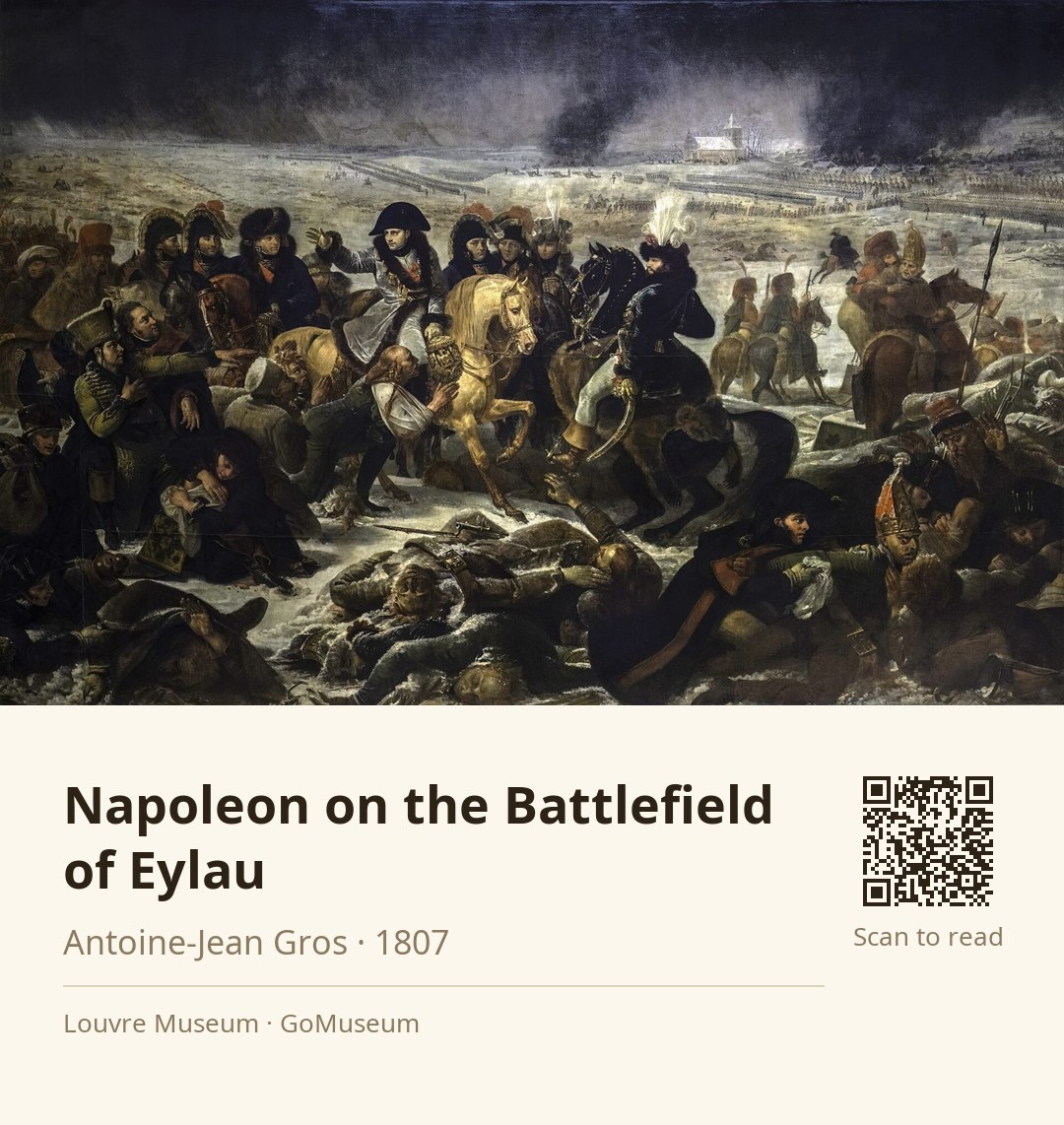
Napoleon on the Battlefield of Eylau
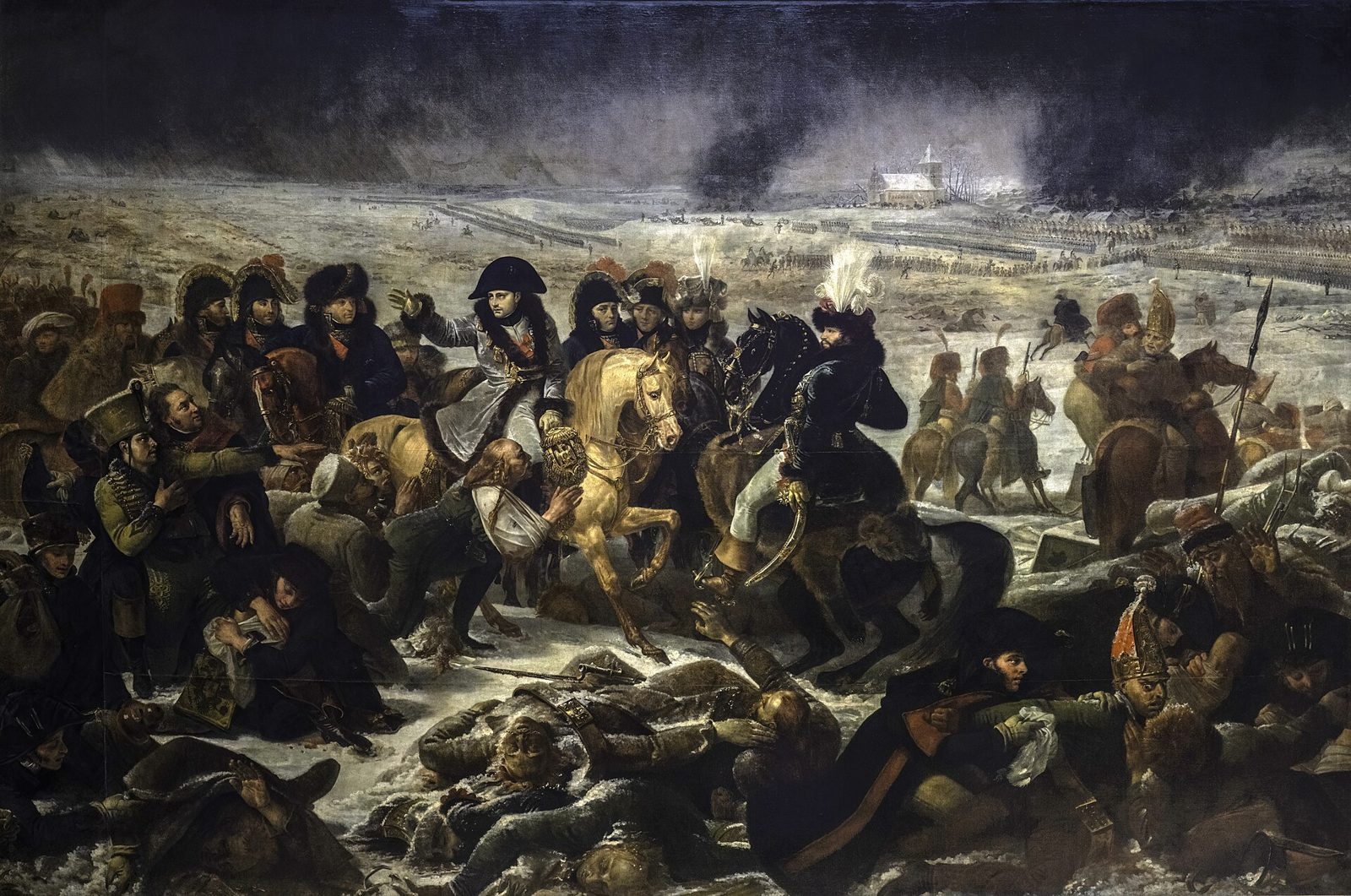
🎧 This work has audio narration — listen in the appTake a moment to really look at "Napoleon on the Battlefield of Eylau." Notice how the pile of corpses in the foreground draws your eye, their faces rendered in haunting detail, larger than life. This stark imagery isn’t just for shock; it’s a powerful reminder of the brutal cost of war.
Antoine-Jean Gros painted this scene in 1807, capturing Napoleon surveying the aftermath of a bloody battle. The Emperor, mounted on his horse, extends his hand as if to bless the wounded soldiers around him, embodying both authority and compassion amidst the chaos. This moment, frozen in time, serves as a poignant commentary on the duality of leadership—glory intertwined with sacrifice.
Commissioned shortly after the battle, Gros’s work was part of a larger campaign to shape public perception of Napoleon. It was meant to instill a sense of respect for peace while acknowledging the horrors of conflict.
As you stand here, think about the emotions this painting evokes. What do you feel when you see the juxtaposition of Napoleon’s calm demeanor against the backdrop of devastation?
Antoine-Jean Gros was a prominent French painter born on March 16, 1771, in Paris. He was a student of Jacques-Louis David, and his early life was marked by artistic promise, nurtured by a family of painters. Gros gained fame during the French Revolution, particularly for his portrait of Napoleon Bonaparte at the Battle of Arcole, which led to a close relationship with the emperor. His works often depicted historical events, blending neoclassicism with emerging romanticism, showcasing both grandeur and emotional depth.
After spending time in Genoa, where he painted portraits, Gros returned to Paris and became a celebrated artist. His notable works include "Bonaparte Visiting the Plague Victims of Jaffa," which served to counter negative propaganda against Napoleon. Despite his success, Gros struggled with the changing artistic landscape, feeling overshadowed by the rise of Romanticism. His later years were marked by personal turmoil, culminating in his tragic suicide in 1835. Gros's legacy lies in his ability to capture the complexities of his subjects, securing his place in art history as a bridge between neoclassicism and romanticism.
In the wake of the bloody Battle of Eylau in February 1807, Napoleon Bonaparte sought to immortalize this costly victory through art. Commissioned by the Louvre's director, Vivant Denon, Gros's painting was part of a broader propaganda effort to shape public perception of Napoleon. A competition was held, and Gros's winning sketch was selected among 26 submissions. He completed the painting during the winter of 1807-1808, and it was first exhibited at the Paris Salon in 1808. Initially, there were concerns among politicians that the painting might cast Napoleon in an unfavorable light, but he personally approved of Gros's work, even awarding him the Légion d'honneur at the ceremony. This painting not only reflects the aftermath of a significant military engagement but also serves as a crucial piece in the narrative of Napoleon's legacy.
Gros's technique in 'Napoleon on the Battlefield of Eylau' is strikingly bold and visceral. The monumental scale of the painting, measuring over 5 meters wide, allows for life-sized figures that draw you into the scene. Notice how the corpses in the foreground are rendered with haunting realism, their faces exaggerated to twice their normal size, creating an almost surreal impact. The brushwork is broad and expressive, breaking away from the subtlety of Neoclassicism and embracing a raw, Romantic style. The composition is carefully structured, with Napoleon at the center, his outstretched hand echoing a gesture of blessing amidst the chaos. This central positioning, combined with the cut-off figures at the edges, immerses you in the moment, as if you are witnessing a fragment of history. The cold, snowy landscape adds to the somber mood, contrasting with the warmth of Napoleon's compassion, emphasizing the duality of glory and horror in warfare.
One intriguing detail about Gros's painting is how it was born out of a competitive spirit. After the bloody Battle of Eylau, Napoleon wanted to immortalize this costly victory and commissioned a public competition for artists to depict the scene. Imagine the pressure! Twenty-six artists submitted their sketches, each vying for a chance to capture a moment that would resonate through history. Gros emerged victorious, but not without a twist: the director of the Louvre, Vivant Denon, dictated many aspects of the painting, including the grim details of the battlefield. This wasn't just an artistic endeavor; it was a calculated move in a larger propaganda campaign to shape public perception of war and leadership.
Gros's earlier painting, 'Bonaparte Visiting the Plague Victims of Jaffa,' shares compositional similarities with 'Napoleon on the Battlefield of Eylau,' but this later work displays a more brutal realism, marking a significant evolution in his artistic style.
Upon its exhibition at the Paris Salon in 1808, some politicians feared that the painting might portray Napoleon unfavorably due to its stark depiction of war's horrors, reflecting the contentious atmosphere surrounding Napoleon's image at the time.