Bathsheba at Her Bath
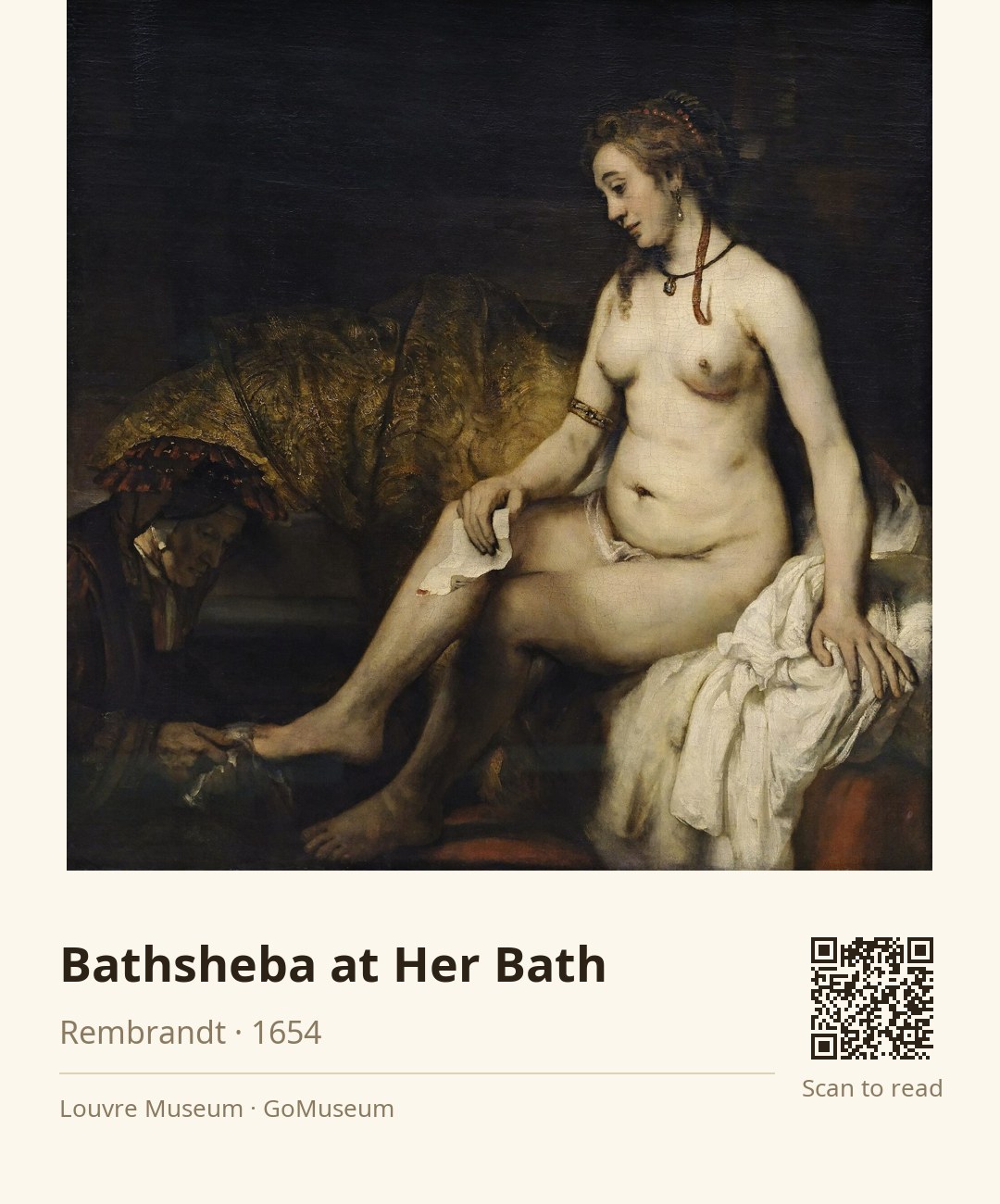
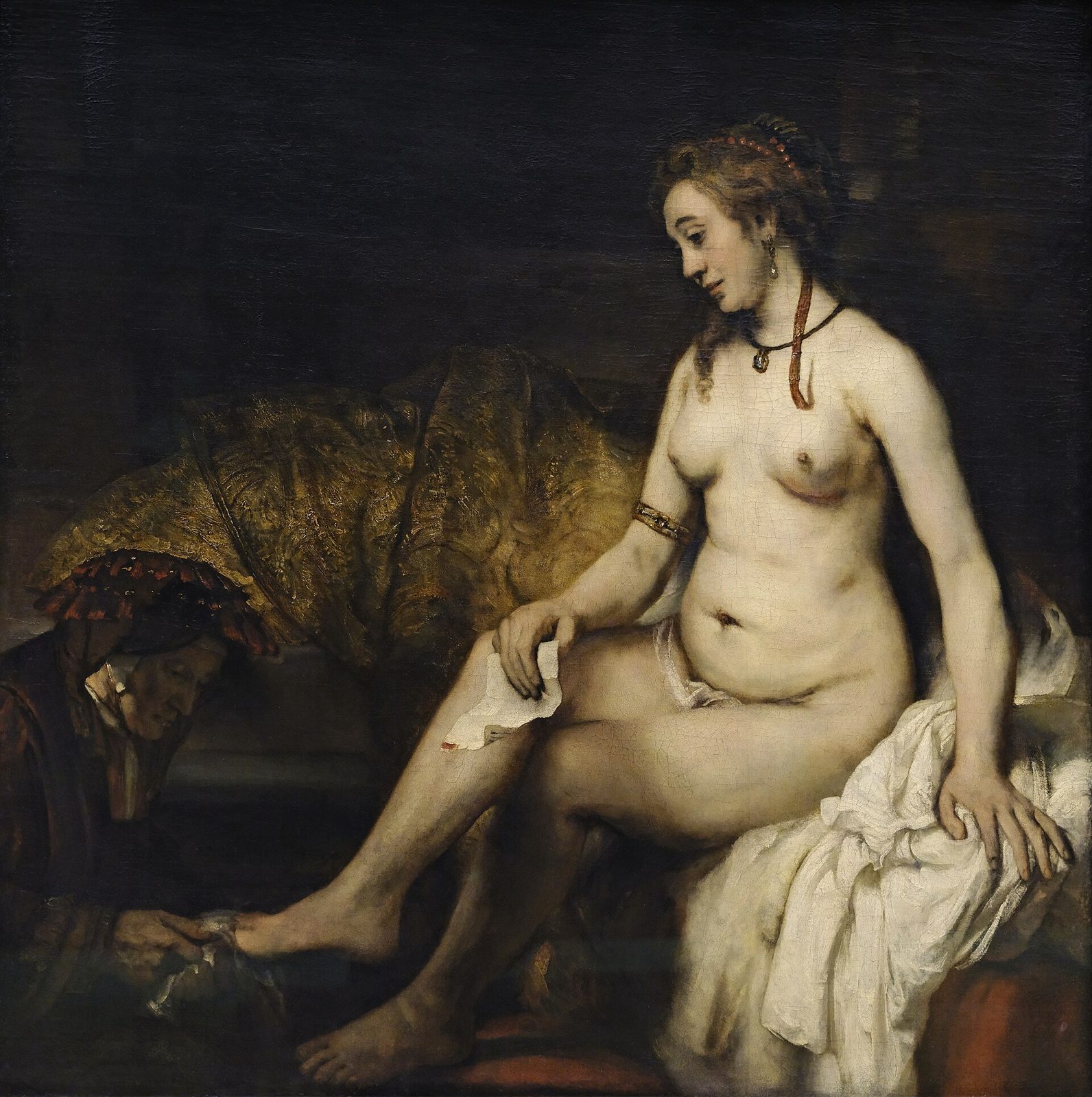
🎧 This work has audio narration — listen in the appAs you stand before Rembrandt's "Bathsheba at Her Bath," take a moment to really absorb the scene. Notice how Bathsheba's gaze is directed slightly downward, lost in thought, as she holds a letter from King David. This isn't just a moment of beauty; it’s a pivotal moment of moral conflict.
Look closely at the way Rembrandt captures the texture of her skin and the soft folds of her chemise. The broad brushstrokes and rich colors create a palpable sense of intimacy, drawing you into her world. This detail matters because it transforms Bathsheba from a mere subject of desire into a complex character grappling with the weight of her choices.
Painted in 1654, this work diverges from earlier depictions by focusing solely on Bathsheba, eliminating the voyeuristic presence of David. Instead, you feel her isolation and the gravity of her situation. Rembrandt’s choice to portray her in such a vulnerable state reflects a deep empathy, inviting you to consider her perspective rather than simply viewing her as an object of lust.
As you take in this powerful image, think about the moral implications of Bathsheba’s decision. What would you do in her place?
Rembrandt Harmenszoon van Rijn, born on July 15, 1606, in Leiden, was a pivotal figure of the Dutch Golden Age and is celebrated as one of the greatest artists in Western art history. His oeuvre includes around three hundred paintings, three hundred etchings, and numerous drawings, showcasing a remarkable range of styles and subjects, from intimate portraits to grand historical and biblical scenes.
Rembrandt's artistic journey began in Leiden, where he was influenced by both Dutch and Italian masters. He opened his studio in 1625 and quickly gained recognition for his portrait work. His move to Amsterdam marked a significant turning point, as he became a sought-after portraitist and married Saskia van Uylenburgh, a union that brought both joy and tragedy. The couple faced immense personal losses, including the deaths of their children and Saskia's own passing in 1642, which deeply affected his work.
Despite financial struggles later in life, Rembrandt's innovative techniques, particularly in etching, transformed the medium into a respected art form. His mastery of light and shadow, known as chiaroscuro, and his empathetic portrayal of human experience set him apart from his contemporaries. Rembrandt's legacy endures through his profound ability to capture the complexities of the human condition, making him a cornerstone of art history.
Initially displayed in various locations, it eventually found its home in The Louvre, thanks to Dr. Louis La Caze, who donated it along with 582 other works in 1869. The reception of 'Bathsheba' was mixed; while some praised its emotional depth and innovative portrayal of the female form, others were shocked by its raw sensuality. This painting marked a significant departure from earlier interpretations of the biblical story, focusing solely on Bathsheba and her internal struggle, rather than the voyeurism of King David. Rembrandt's choice to eliminate David from the scene was revolutionary, allowing viewers to engage with Bathsheba's moral dilemma directly.
As you gaze at 'Bathsheba at Her Bath,' notice the way Rembrandt's brushwork creates a sense of intimacy and immediacy. The thick, expressive strokes convey both the softness of Bathsheba's skin and the weight of her contemplation. The rich color palette, dominated by warm browns and ochers, envelops her in a golden glow, suggesting both vulnerability and allure. The composition is strikingly unconventional; Bathsheba is placed in a shallow space that feels both intimate and monumental. The dark background contrasts sharply with her pale chemise, making her figure almost leap from the canvas. Rembrandt's decision to lower her gaze enhances her introspection, inviting you to ponder her thoughts and emotions. This painting is not just about the physical beauty of the figure; it's about the emotional weight she carries, rendered through a masterful interplay of light and shadow that draws you into her world.
Unlike previous depictions that often presented Bathsheba as an object of desire, Rembrandt imbues her with a sense of introspection and moral complexity. This shift from mere voyeurism to a more empathetic representation influenced countless artists who followed, encouraging them to explore the emotional depth of their subjects. The painting's intimate focus and rich, tactile brushwork invite viewers to engage with Bathsheba's dilemma, making it a pivotal moment in the evolution of Western art. Remember, this isn't just a nude; it's a profound exploration of humanity and vulnerability.
One intriguing aspect of 'Bathsheba at Her Bath' is that it is believed Rembrandt may have initially painted Bathsheba's head at a different angle, making her appear more aware of David's gaze. In the final version, her softened gaze and downward position evoke a profound sense of introspection, transforming the narrative from one of seduction to one of moral contemplation.
Originally, Bathsheba's head was painted at a different angle, making her appear more aware of King David's gaze. This change to a more downward position enhances her introspection and shifts the focus from seduction to contemplation.
Unlike earlier depictions that included King David and other narrative elements, Rembrandt's painting focuses solely on Bathsheba, presenting her in a vulnerable and intimate moment. This radical shift allows viewers to engage directly with her emotional and moral struggle.
In 2014, 'Bathsheba at Her Bath' underwent an eight-month restoration at The Louvre, which likely helped preserve its intricate details and rich color palette, ensuring that Rembrandt's masterful brushwork continues to be appreciated by future generations.