The Three Graces
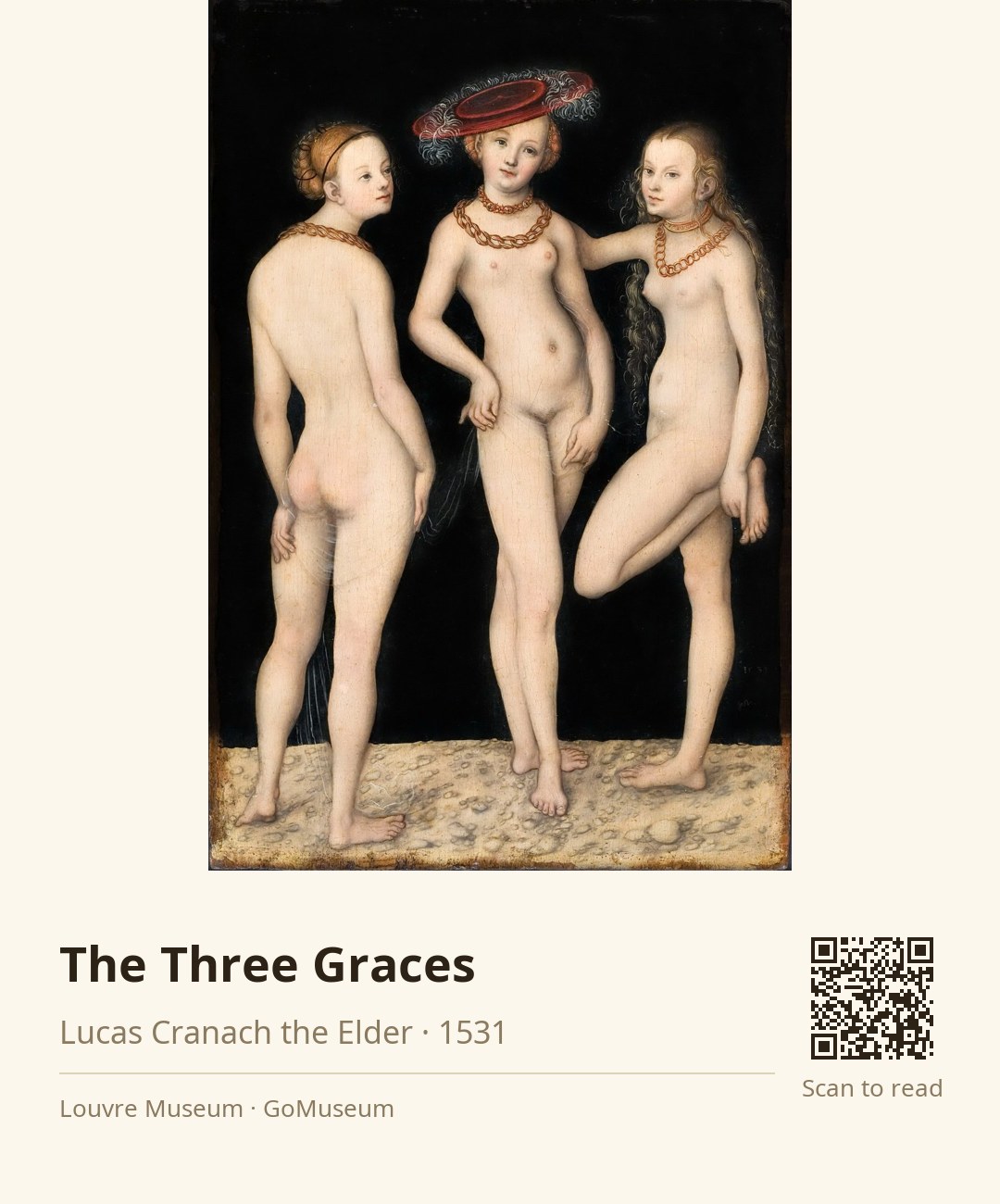
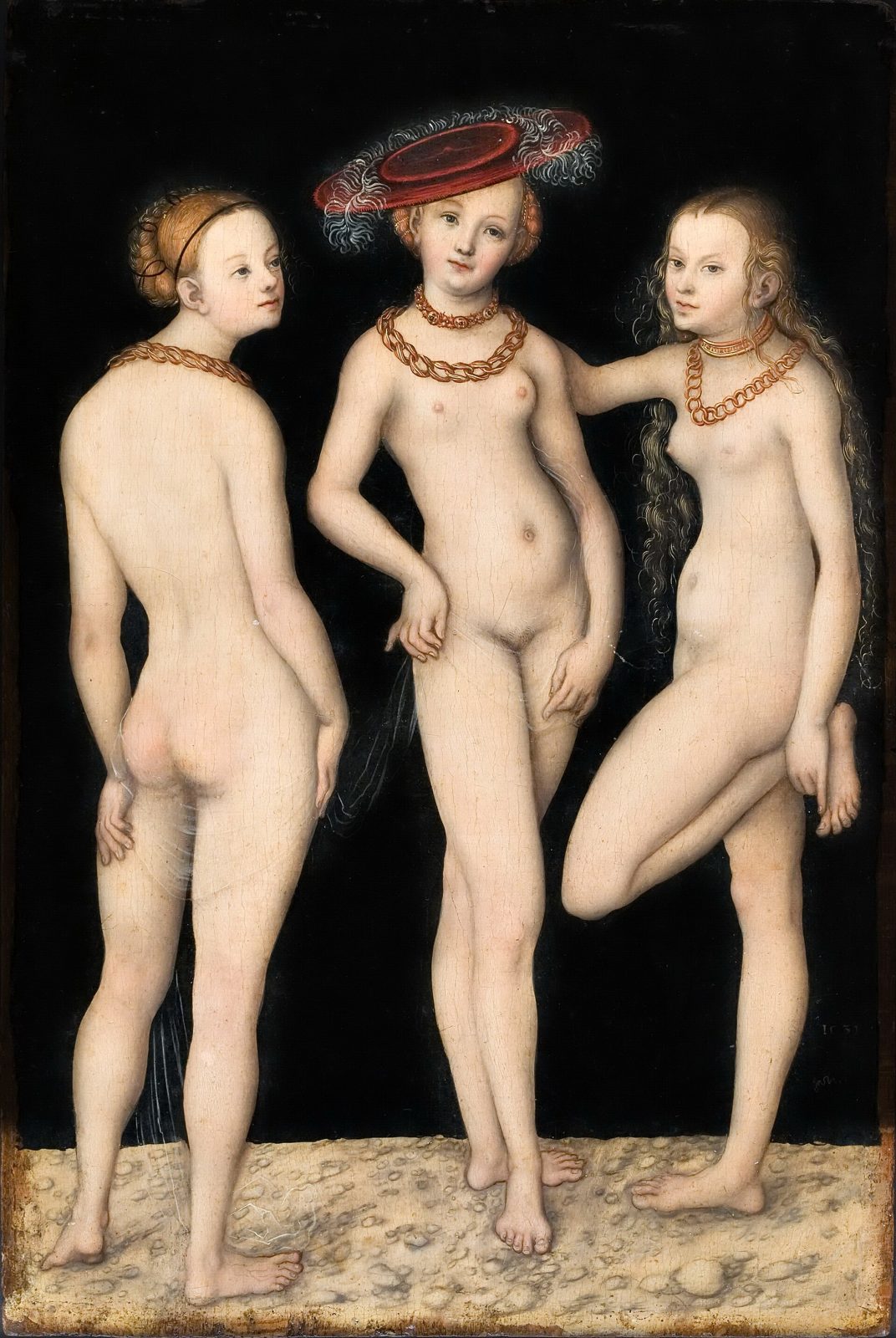
🎧 This work has audio narration — listen in the appAs you stand before "The Three Graces," take a moment to really absorb the scene. Notice how the three figures are intertwined, their bodies forming a delicate dance of unity and grace. Look closely at their expressions; there’s a playful yet serene quality that invites you into their world.
These details matter because they reflect not just beauty, but also the Renaissance ideals of harmony and balance. Cranach’s interpretation of the Graces—traditionally symbols of charm, beauty, and creativity—adds a layer of irony and sensuality that challenges the viewer to consider deeper themes of femininity and allure.
Created in 1531, this painting is part of a broader tradition that Cranach explored throughout his career, often blending mythological subjects with contemporary social commentary. It remained hidden from public view until 2011, when it was acquired by the Louvre after a successful fundraising campaign, highlighting its cultural significance.
So, as you take in this artwork, think about what the Graces represent for you. Do they embody an ideal, or do they provoke questions about the roles of women in art and society? Let their elegance linger in your mind as you continue your journey through the museum.
Lucas Cranach the Elder, born around 1472 in Kronach, was a pivotal figure of the German Renaissance, renowned for his portraits and religious works. As the court painter for the Electors of Saxony, he embraced the Protestant Reformation, forging a close friendship with Martin Luther and producing numerous portraits of the reformer. His art evolved from Catholic themes to innovative representations of Lutheran ideals, reflecting the changing religious landscape of his time.
Cranach's workshop was prolific, allowing him to create multiple versions of his works, often with the help of his sons, including Lucas Cranach the Younger. His style, characterized by vibrant colors and intricate details, drew inspiration from nature and mythology, while his portraits captured the essence of his subjects with psychological depth. He was not only a master painter but also a skilled printmaker, contributing significantly to the spread of Reformation ideas through his art.
His legacy endures as one of the most successful German artists of his era, influencing generations with his unique blend of realism and idealism, and his ability to adapt to the cultural shifts of the Renaissance. Cranach's work remains a testament to the intersection of art and faith during a transformative period in history.
Lucas Cranach the Elder's 'The Three Graces' was painted in 1531, a time when Cranach was firmly established as the court painter for the Electors of Saxony. This painting, like many of his works, remained in private collections for centuries, hidden from public view until it was declared a national treasure in France. The urgency to keep it from being sold abroad led to a fundraising campaign that raised 4 million Euros by December 2010, just in time for the Louvre to acquire it. The campaign, titled 'Tous mécènes', saw contributions from around 7,000 individuals, showcasing a collective appreciation for art. It was first publicly displayed in 2011, marking a significant moment in the painting's long history.
As you gaze at 'The Three Graces', pay attention to Cranach's masterful brushwork. The figures appear almost alive, their skin tones glowing with a warmth that contrasts beautifully against the cooler background. Notice how the light dances across their bodies, highlighting the curves and contours in a way that feels both sensual and serene. The composition is tight, drawing your eye to the interwoven forms of the Graces, creating a sense of intimacy. Cranach's choice of a small scale—just 24 by 37 centimeters—invites you to come closer, to engage with the details. The use of color is particularly striking; the reds and greens pop against the softer hues, adding a vibrancy that enhances the playful yet elegant mood of the scene.
This painting not only showcases the artist's mastery of oil on beech panel but also reflects a shift in how mythological subjects were approached. Cranach's interpretation introduces a layer of irony to the expected sensuality of the Graces, influencing later artists to explore more complex narratives within traditional themes. Its recent acquisition by the Louvre, following a successful public fundraising campaign, highlights its cultural significance and the collective effort to preserve art as a shared heritage. This work reminds us that art can unite communities and spark conversations about beauty, mythology, and the human experience.
Did you know that 'The Three Graces' was once at risk of leaving France forever? In 2010, the painting was declared a national treasure, which meant it couldn't be exported. The Louvre had to raise a whopping 4 million Euros to keep it in the country. They launched a campaign called 'Tous mécènes,' encouraging the public to contribute. Remarkably, around 7,000 people rallied together, and within just a month, they raised the final million needed. Talk about a community coming together to save a piece of art!
Cranach painted other versions of 'The Three Graces' in 1530 and 1535, with one of them currently held in a private collection and another at the Nelson-Atkins Museum of Art in Kansas City.
The campaign, titled 'Tous mécènes', saw around 7,000 individuals contribute to raise the necessary funds, showcasing a remarkable collective effort and appreciation for cultural heritage among the public.
Cranach operated a large workshop where his sons and apprentices helped create multiple versions of his works, allowing for a more efficient production process and the ability to meet high demand for his art.