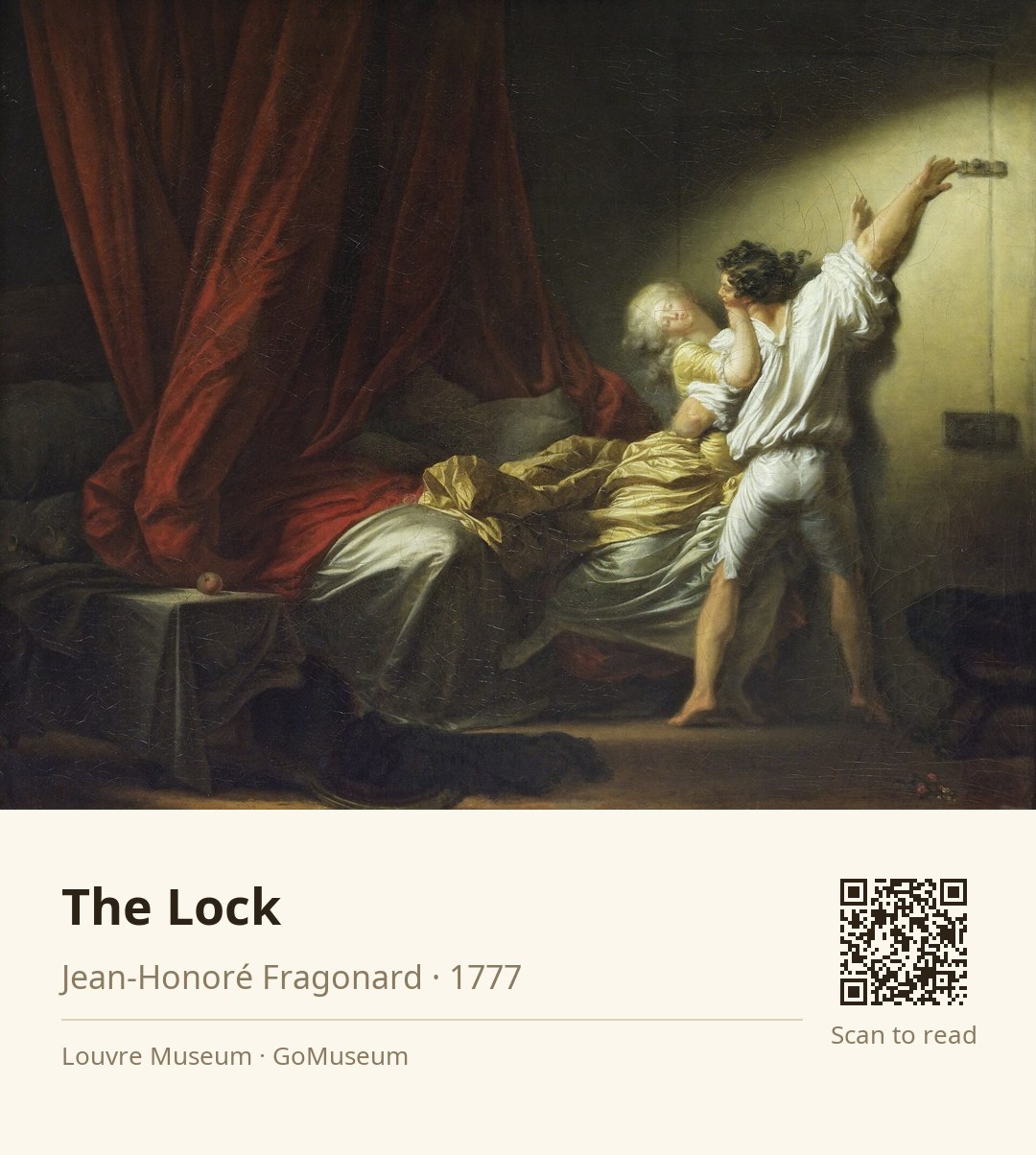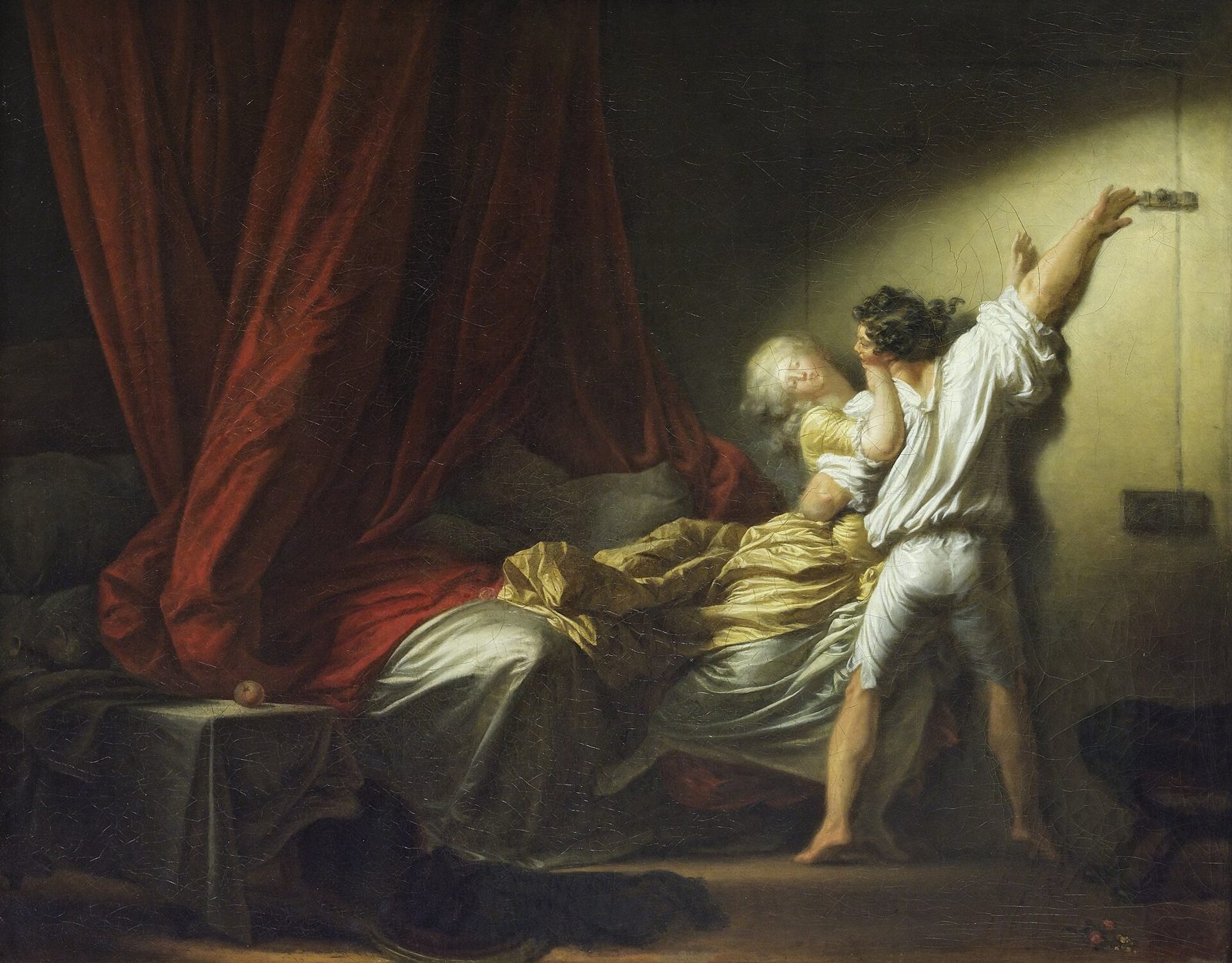
Take a moment to really absorb the scene in front of you. Fragonard’s "The Lock" is a captivating dance of intimacy and tension, where a man and woman are caught in a moment that feels both passionate and precarious. Notice how the man’s hand reaches toward the door bolt, while the woman, dressed in a shimmering golden gown, appears to be both drawn in and trying to escape.
The bolt symbolizes not just physical closure but also the complex emotions at play—desire, consent, and perhaps coercion. The disarray of the room, with the unmade bed and overturned chair, hints at a story that is not just romantic but fraught with deeper implications. Are we witnessing a playful rendezvous or something darker?
Fragonard painted this in 1777, a time when the libertine spirit was alive in France, reflecting the era's fascination with love and seduction. His works often tread the line between playful and provocative, making "The Lock" a perfect example of the Rococo style that he mastered under the influence of François Boucher.
As you stand here, think about what this moment captures. Is it a celebration of love, or a cautionary tale? What emotions does it stir in you?
Jean-Honoré Fragonard, born on April 5, 1732, in Grasse, France, was a prominent French painter and printmaker known for his exuberant Rococo style. The only child of a glover, he moved to Paris at six, where his artistic talent was nurtured under the guidance of François Boucher. Fragonard won the prestigious Prix de Rome in 1752, allowing him to study in Italy, where he developed a love for romantic landscapes and the works of masters like Tiepolo.
His career flourished in the 1760s, creating intimate and often erotic genre paintings that captivated the court of Louis XV. Notable works include "The Swing" and "The Bolt," characterized by vibrant colors and fluid brushwork. Despite his success, Fragonard struggled with official commissions, preferring the freedom of private patronage. He married Marie-Anne Gérard in 1769, and their family included several artists.
The French Revolution disrupted his career, leading him to retreat to Grasse, where he continued to paint. Although largely forgotten after his death on August 22, 1806, Fragonard's influence resurfaced in the 19th century, particularly impacting Impressionists like Renoir and Morisot. Today, he is celebrated as a master of French painting, embodying the spirit of the Rococo era.
Fragonard's 'The Lock' was commissioned in 1773 by Louis-Gabriel Véri-Raionard, a prominent marquis known for his discerning taste. This painting, created in 1777, was part of a collection that reflected the libertine spirit of 18th-century France, a time when the Enlightenment was beginning to shift societal norms. Initially, Fragonard had envisioned a companion piece titled 'The Contract,' which, along with 'The Lock' and another work called 'The Armoire,' was thought to narrate a romantic saga. The painting was well-received, becoming a symbol of the era's artistic exploration of intimacy and desire. After Véri's death, the painting changed hands several times, eventually finding its home in the Louvre, where it remains a highlight of the 18th-century French painting collection.
As you gaze at 'The Lock,' pay attention to the dynamic brushwork that Fragonard employs. The figures are enveloped in a soft, almost ethereal light, creating a sense of intimacy. Notice how the light dramatically highlights the couple, while the chaotic elements of the room—the unmade bed and overturned chair—add to the tension. The composition is masterfully structured; every gesture and glance seems to converge on the door bolt, drawing your eye to the pivotal moment of choice. The rich colors, especially the shimmering gold of the woman's gown, contrast with the darker tones of the room, enhancing the emotional stakes. Fragonard's technique captures not just the physicality of the scene but also the underlying psychological drama, making you feel the weight of the moment.
This painting not only showcases Fragonard's skillful brushwork and vibrant color palette but also ignites a debate that resonates through art history: is this a scene of passionate love or a troubling act of coercion? Its dual interpretations challenge viewers and artists alike, influencing later movements, especially the Impressionists, who admired Fragonard's expressive handling of color and light. Remember, this painting isn't just about a moment captured in time; it's a reflection of societal norms and the complexities of desire, making it a cornerstone in understanding the evolution of romantic themes in art.
Did you know that 'The Lock' was originally commissioned by a prominent figure, Louis-Gabriel Véri-Raionard, who had a taste for the erotic and the exquisite? This painting was part of a larger collection that included works meant to capture the spirit of 18th-century French society, a time when the Enlightenment was just beginning to stir. Interestingly, Fragonard had initially paired 'The Lock' with another painting called 'The Contract,' creating a narrative arc about a couple's passionate affair. This trio of works was thought to represent different stages of their relationship, from the heat of desire to the consequences of discovery and ultimately, reconciliation. It's a fascinating glimpse into how art was not just about beauty, but also about storytelling and the complexities of love and desire.
An apple is subtly placed in the light of the chiaroscuro, which can symbolize temptation and desire, adding layers to the narrative of the scene.