The Tennis Court Oath
🎧 This work has audio narration — listen in the appTake a moment to really look at Jacques-Louis David's "The Tennis Court Oath." Notice how the figures are all turned toward one man, Bailly, their faces alive with determination and fervor. This isn’t just a gathering; it’s a pivotal moment in history, captured in paint.
The details matter here. Look closely at the expressions—each face is distinct, each person recognizable, reflecting the unity of the Third Estate as they vow not to disband until a new constitution is established. This collective oath symbolizes the birth of the French Revolution, a moment when ordinary citizens stood together against royal authority.
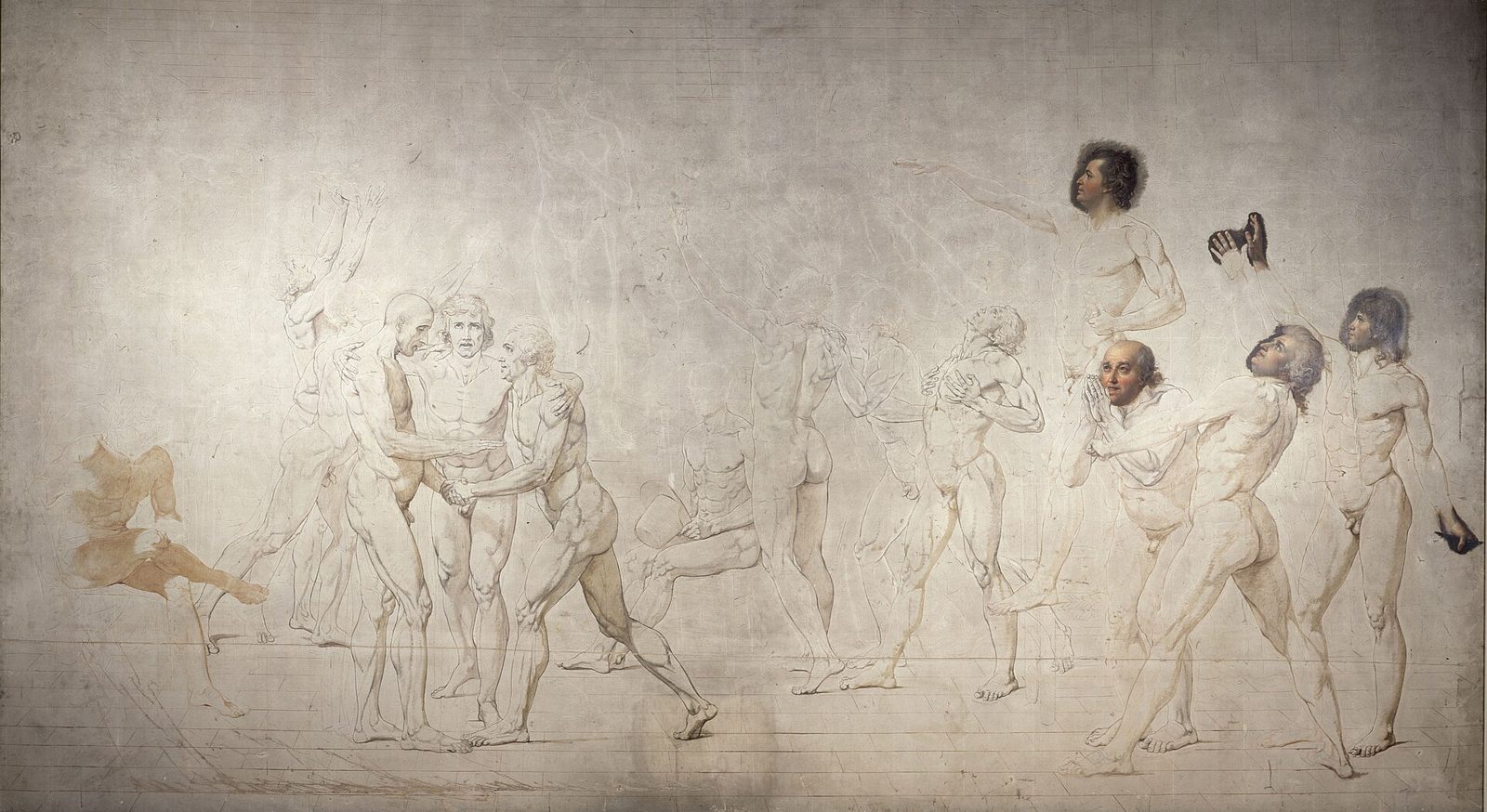
David painted this scene in 1791, during a time when the very fabric of France was unraveling. The unfinished canvas hints at the chaos of the era; political turmoil interrupted his work, and he never completed it. Yet, the energy of the scene speaks volumes about the hope and determination of the people.
As you stand here, think about the significance of this oath. It wasn’t just about politics; it was a declaration of national sovereignty, a promise that the power of the state comes from the will of the people.
What emotions does this evoke for you? Can you feel the weight of their commitment, and how it resonates with struggles for freedom even today?
Jacques-Louis David was a pivotal French painter born on August 30, 1748, in Paris. He emerged as the leading figure of the Neoclassical movement, marking a significant shift in artistic taste from the frivolity of Rococo to a more austere and emotionally charged classical style. His early life was marked by personal tragedy, losing his father at a young age, which shaped his character and determination to pursue art against familial expectations.
David's career flourished during the tumultuous political landscape of France, where he became an ardent supporter of the French Revolution, aligning himself with figures like Robespierre. His political engagement influenced his art, producing iconic works such as "The Death of Marat" and "The Coronation of Napoleon," which reflect both historical narratives and his personal convictions. After the fall of Napoleon, David faced exile but continued to influence generations of artists, establishing a legacy that shaped academic painting in the early 19th century. His works remain celebrated in major museums, particularly the Louvre, solidifying his status as a cornerstone of Western art history. David's life and art were inextricably linked to the evolving identity of France, embodying the spirit of revolution and the quest for artistic integrity.
Jacques-Louis David's 'The Tennis Court Oath' is an incomplete masterpiece, painted between 1790 and 1794, that captures a defining moment in the French Revolution. Initially commissioned in 1790, David aimed to immortalize the event where the Third Estate vowed not to disband until a new constitution was established. The first engravings of the painting appeared in 1790, but financial struggles led to a lack of funds for completion. The National Constituent Assembly eventually stepped in, funding the project from the public treasury. David set up his studio in the former Les Feuillants Convent, where he held sittings with deputies. However, by 1793, political turmoil and his own duties as a deputy hindered his progress. The painting remained unfinished, and the subscribers who had funded it reclaimed their engravings. The canvas, measuring an impressive 400 by 660 cm, was acquired by the royal museums in 1836, later exhibited at the Louvre from 1880 onward.
Notice how he uses light to create a dramatic atmosphere; the rays streaming through the large windows illuminate the figures, enhancing their expressions of fervor and unity. Each face is rendered with meticulous detail, allowing viewers to recognize individual deputies, which adds a personal touch to the collective oath. The composition is structured around Bailly, the central figure, with all eyes directed toward him, creating a sense of focus and intensity. The billowing curtains symbolize the winds of change, while the contrasting stillness of Martin-Dauch, the lone dissenter, provides a counterpoint to the enthusiasm of the others. This dynamic interplay of movement and stillness amplifies the emotional weight of the scene.
Interestingly, the initial subscription to fund 'The Tennis Court Oath' only garnered a mere 10% of the required amount, prompting the National Constituent Assembly to step in and finance the project through public funds. This reflects not only the political climate of the time but also the challenges David faced in realizing his ambitious vision.
David began by drawing the figures in the nude, adhering to academic methods of the time, which allowed him to focus on the movement and expressions of the deputies before dressing them in their formal attire.
As political tensions escalated, David became increasingly involved in revolutionary politics, which diverted his attention from the painting, leaving it unfinished as he struggled with the changing landscape of French governance.
Among the deputies depicted, notable figures include Mirabeau, who was once a hero of the Revolution but later became viewed as a traitor, illustrating the shifting allegiances and sentiments during this tumultuous period.