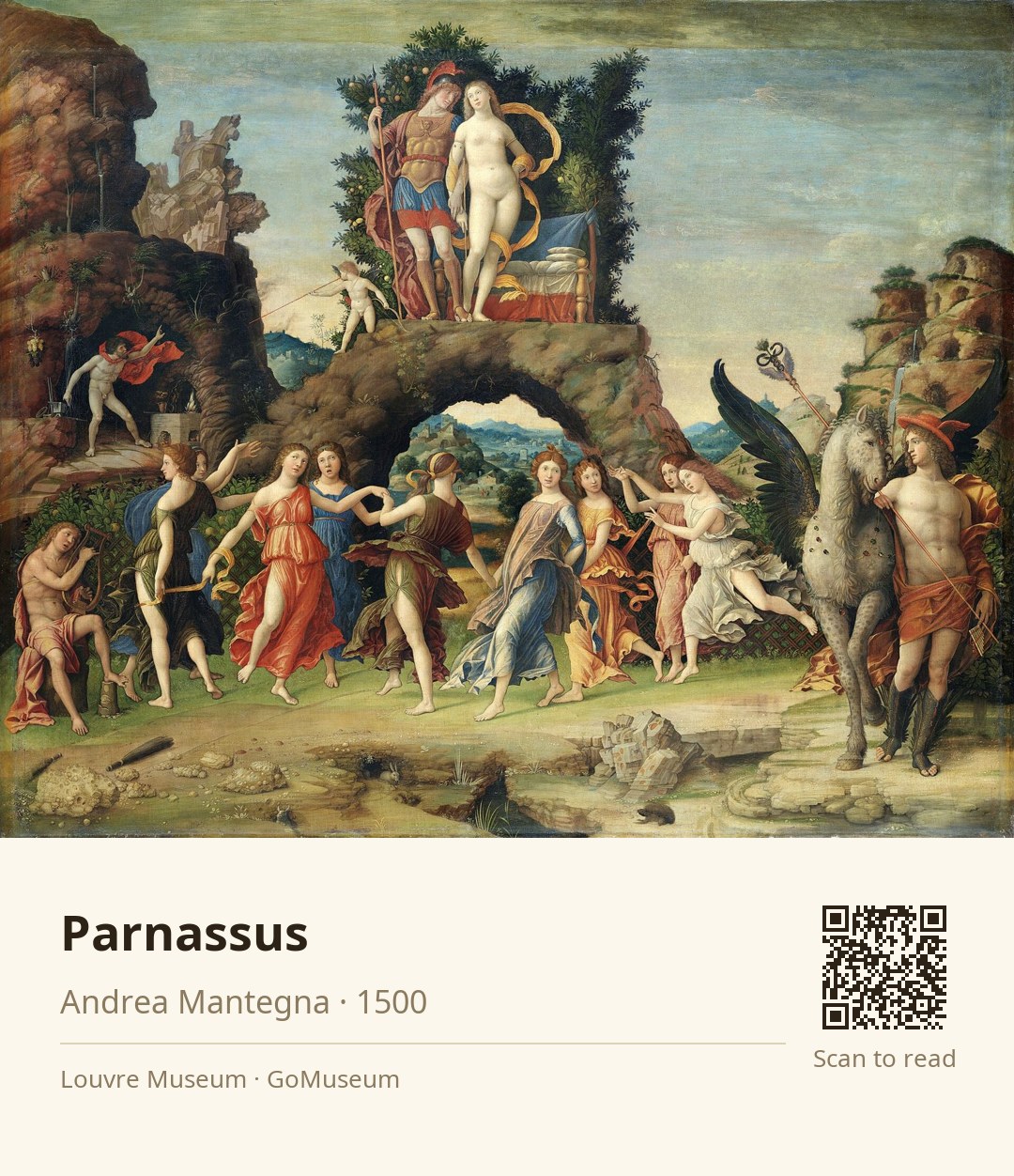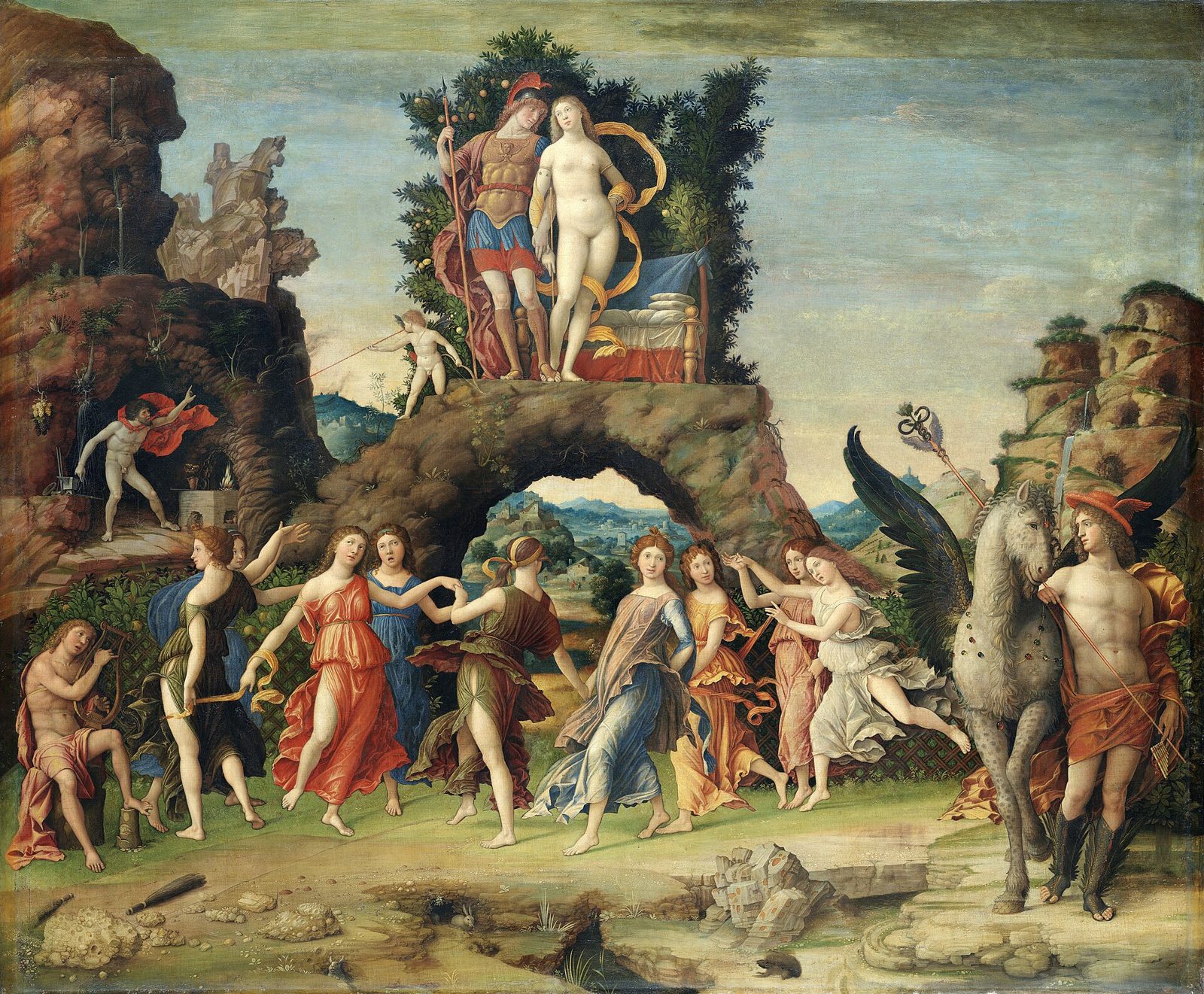
Take a moment to really soak in the vibrant scene of "Parnassus" by Andrea Mantegna. Notice how the figures seem to dance across the canvas, especially the Muses, who embody creativity and inspiration. Look closely at their flowing garments and the way they interact with Apollo, who plays his lyre nearby.
These details matter because they capture the essence of artistic harmony and the celebration of the arts during the Renaissance. Mantegna was not just painting a mythological scene; he was creating a visual symphony that reflects the ideals of his time, where art and beauty were revered.
Commissioned by Isabella d'Este for her studiolo, this piece was meant to inspire and elevate the viewer, showcasing the connection between love, creativity, and divine inspiration. Mantegna's meticulous attention to detail and use of perspective draw you into this world, making it feel almost tangible.
As you stand here, think about the stories these figures tell and the emotions they evoke. What does this celebration of art and love mean to you today?
Andrea Mantegna, born around 1431 in Isola di Carturo, was a pivotal figure in the Italian Renaissance, renowned for his innovative approach to perspective and his sculptural style. Apprenticed to Francesco Squarcione, he absorbed a passion for classical antiquity, which profoundly influenced his artistic vision. Mantegna's early works, including the frescoes in the Ovetari Chapel, showcased his mastery of dramatic perspectives and detailed architectural elements, although many were tragically lost during World War II.
His marriage to Nicolosia, daughter of Jacopo Bellini, further anchored him in the vibrant artistic community of Venice. Mantegna's distinct style, characterized by flinty landscapes and statuesque figures, often drew criticism for its rigidity, yet it marked a significant departure from Gothic traditions. He was instrumental in elevating the status of the artist in society, embodying the Renaissance ideal of the creative genius. Mantegna's legacy endures, influencing generations of artists and cementing his place in art history as a master of both painting and printmaking. He passed away in 1506, leaving behind a rich body of work that continues to inspire.
The painting 'Parnassus' was commissioned by Isabella d'Este for her studiolo in the Ducal Palace of Mantua, marking a significant moment in the Renaissance. Mantegna began this work in 1497, and there are documented letters confirming its progress. Isabella, a powerful patron of the arts, sought to create a space that would inspire creativity and reflect her own status. After Mantegna's death in 1506, the painting underwent some alterations to adapt it to the oil technique that was becoming popular. This was likely done by Lorenzo Leonbruno, who updated the heads of the Muses and other figures. The painting eventually made its way into the royal collections of France, gifted to Cardinal Richelieu by Duke Charles I of Mantua in 1627, and is now housed in the Louvre Museum, where it continues to captivate viewers with its intricate details and allegorical richness.
The painting employs a dynamic arrangement of figures that seem to dance across the canvas, creating a sense of movement and harmony. Notice how the Muses are positioned in a circular formation, drawing your eye around the scene. The use of vibrant colors, especially the reds and blues, enhances the emotional intensity of the work. Mantegna's brushwork is meticulous, with a sculptural quality that gives the figures a three-dimensional presence. The way he captures light and shadow adds depth, making the figures appear to emerge from the background. The landscape behind them, with its cascading waterfalls and lush vegetation, is rendered with a keen attention to detail, inviting you to explore the mythological world he has created. This careful handling of paint and perspective not only showcases Mantegna's skill but also immerses you in a narrative that feels almost alive.
One intriguing aspect of 'Parnassus' is that it was not just a standalone piece; it was part of a larger ensemble of artworks commissioned for Isabella d'Este's studiolo. This space was designed as a private retreat for her, filled with paintings that celebrated the arts and her own identity as a patron. The interconnectedness of these works illustrates the Renaissance ideal of art as a means of personal expression and cultural dialogue, making the studiolo a unique testament to Isabella's influence and vision.
The theme of 'Parnassus' was suggested by Paride da Ceresara, a court poet, highlighting the collaborative nature of art during the Renaissance where poets and artists often worked together to create a cohesive cultural vision.
After Mantegna's death, the painting was partially repainted to adapt it to the oil technique that was gaining popularity, likely by Lorenzo Leonbruno, who updated the heads of the Muses and other figures to align with contemporary artistic trends.