The Hundred-Horse Chestnut on the Slopes of Etna
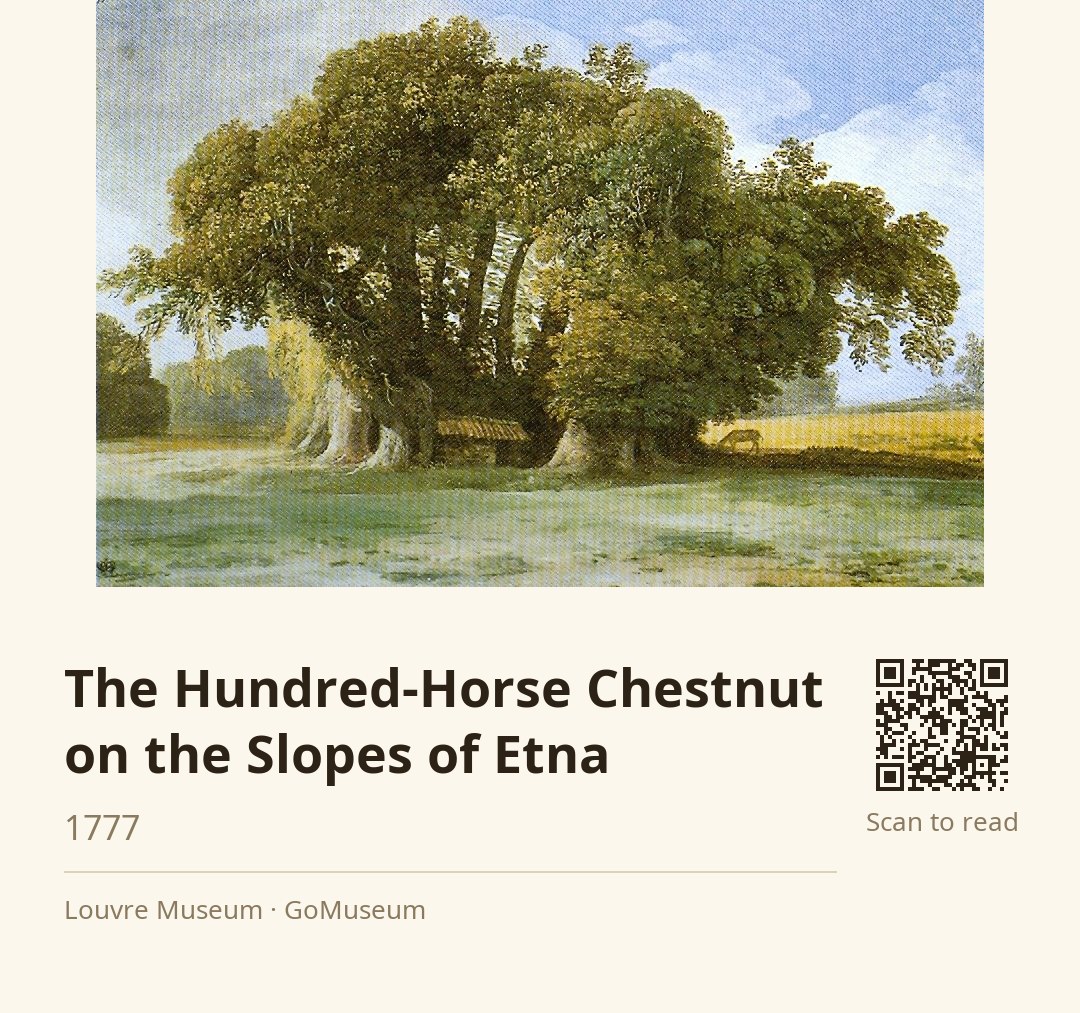
🎧 This work has audio narration — listen in the appWhat catches your eye first? Perhaps it’s the majestic chestnut tree, known as the "châtaignier des cent chevaux," standing tall against the backdrop of Mount Etna. Notice how the artist captures the intricate textures of the tree’s bark and the vibrant greens of its leaves.
Houël’s delicate brushwork and use of light bring this ancient giant to life, inviting you to ponder its long existence.
Created during a time when Europe was fascinated with the natural world, this piece is part of a larger series documenting Houël’s travels through Sicily. His work reflects not only the beauty of the landscape but also the Enlightenment spirit of exploration and appreciation for nature.
As you stand here, think about the stories this tree could tell if it could speak. What do you imagine it has seen over the centuries?
Jean-Pierre-Louis-Laurent Houël was a notable French painter, engraver, and draftsman born on June 28, 1735, in Rouen. Coming from a family of prosperous artisans, he displayed an early passion for drawing, which led him to the local drawing academy at fifteen. His exposure to early Dutch and Flemish art profoundly influenced his specialization in landscape painting. In 1758, he published a book of landscape engravings, and by 1769, he had created significant works for the Duc de Choiseul.
His career flourished after receiving a scholarship to the French Academy in Rome, where he was captivated by Italian culture and landscapes. His travels across southern Italy and later to Sicily and Malta resulted in a series of illustrated travel books published between 1782 and 1787, showcasing his delicate watercolor techniques and mastery of light. His works gained recognition, with significant purchases by Louis XVI and Catherine II of Russia.
During the French Revolution, Houël remained politically engaged, documenting events through sketches and participating in cultural reforms. He continued to produce art until his death on November 14, 1813, leaving behind a legacy that reflects the transition from the Rococo to the Neoclassical style in art history. His contributions to landscape painting and travel literature remain influential, marking him as a significant figure of his time.
As you gaze at this piece, notice the delicate brushwork that Houël employs to bring the chestnut tree to life. The layers of gouache create a rich texture, allowing the bark to appear almost tactile, inviting you to reach out and touch it. The vibrant greens of the leaves contrast beautifully with the earthy tones of the trunk, drawing your eye across the composition. The play of light is masterful; it dances across the foliage, suggesting a gentle breeze rustling through the leaves. Houël's choice of scale—measuring just under a meter in height—allows for an intimate connection with the viewer, making you feel as if you could step into the scene and stand beneath the ancient tree. The overall composition is balanced yet dynamic, with the tree commanding attention against the backdrop of the imposing Mount Etna, creating a sense of harmony between nature and the landscape.
Houël's use of gouache allows for a vibrant interplay of color and texture, which is particularly evident in the way he captures the light filtering through the leaves of the chestnut tree, creating a sense of depth and realism.
His extensive travels through Italy and Sicily exposed him to diverse landscapes and cultures, which enriched his understanding of light and atmosphere, ultimately shaping his distinctive approach to landscape painting.