 Image: Wilfredor
Blessing Christ
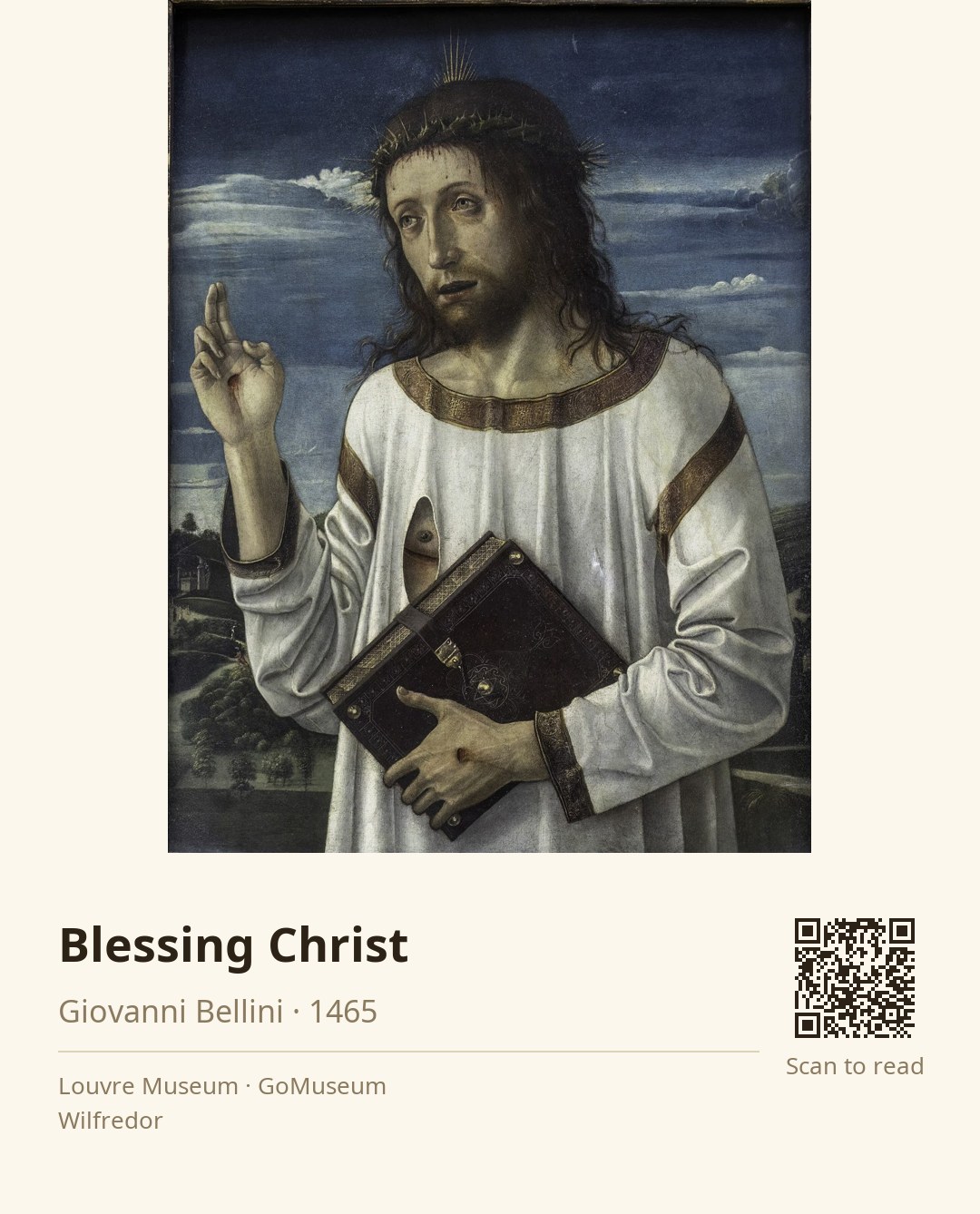
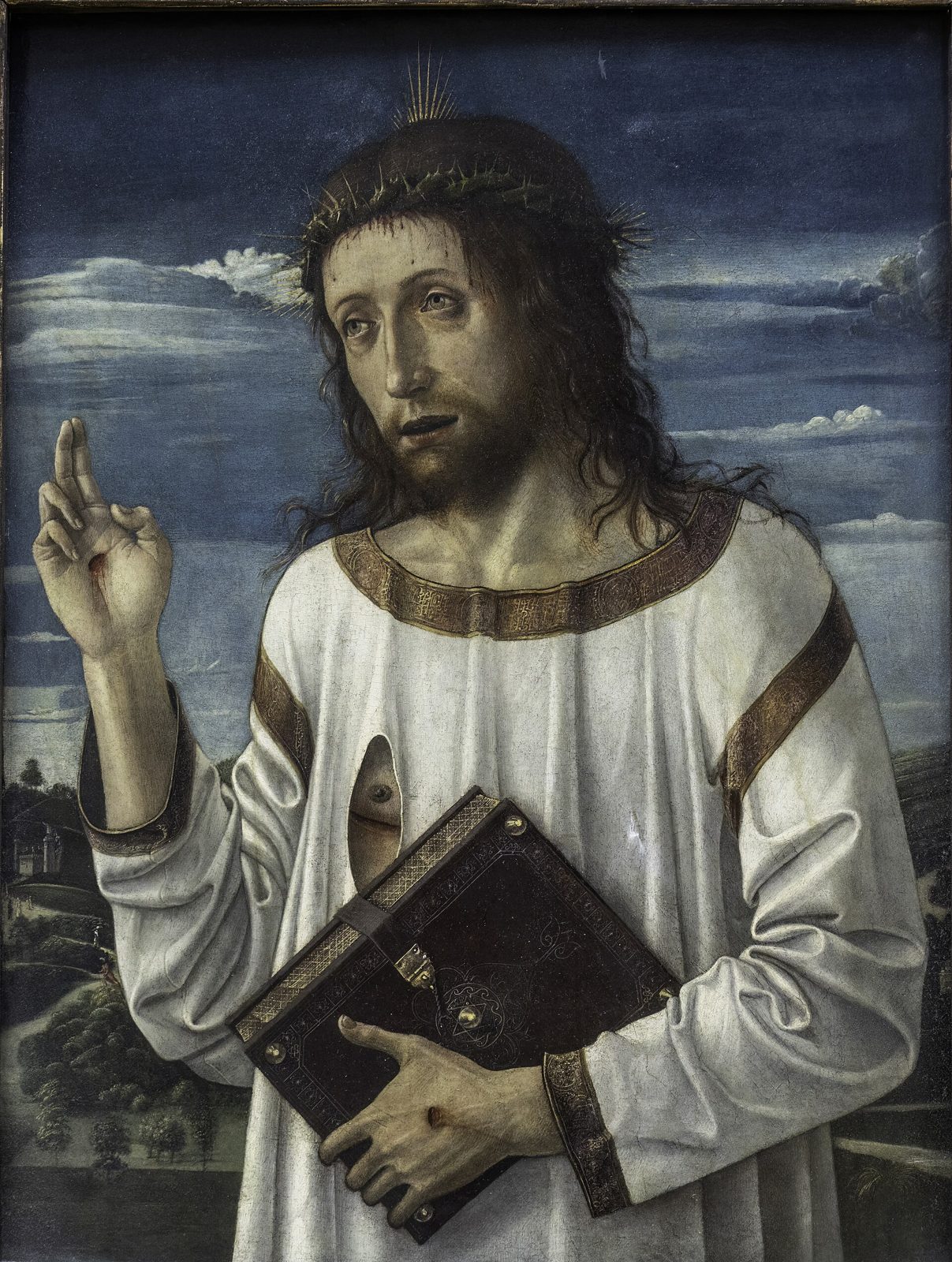
🎧 This work has audio narration — listen in the appTake a moment to really look at Giovanni Bellini's "Blessing Christ." Notice how Christ's right hand is raised, fingers poised in a gesture of blessing. It’s not just a simple wave; it’s a powerful symbol of divine grace reaching out to the world. Now, focus on the intricate details of his garment, especially the golden hem that mimics Arabic script. This isn’t just decorative; it reflects the cultural exchanges of the time, blending Christian iconography with influences from the East.
Bellini painted this piece around 1465, during a period when Venice was a melting pot of ideas and styles. The pseudo-kufic decoration on Christ’s robe hints at the rich tapestry of trade and interaction that defined the city. This painting captures a moment of spiritual connection, inviting viewers to contemplate their own relationship with the divine.
As you stand here, think about the significance of Christ’s visible wounds, a reminder of sacrifice and redemption. What feelings does this evoke in you? How does this blend of beauty and meaning resonate with your own experiences?
Giovanni Bellini, born around 1430 in Venice, was a pivotal figure in the Italian Renaissance and a key member of the renowned Bellini family of painters. Initially thought to be the son of Jacopo Bellini, recent scholarship suggests he may have been a half-brother. His early career was marked by collaboration with his brother Gentile and the influence of his brother-in-law, Andrea Mantegna. Bellini's transition from tempera to oil paints allowed him to create rich colors and atmospheric landscapes, setting a new standard in Venetian painting.
Throughout his life, Bellini's work evolved, reflecting a shift from the Gothic style to a more serene and harmonious approach. His masterpieces, such as the "Transfiguration" and various altarpieces, showcase his mastery of color and form, impacting future artists like Giorgione and Titian. Despite the loss of many of his public works, his surviving pieces demonstrate a profound understanding of light and emotion, blending sacred and secular themes. Bellini's legacy endures, as he is celebrated as a precursor to the Venetian school, embodying the spirit of the Renaissance while remaining rooted in local tradition. He passed away in 1516, leaving an indelible mark on art history.
Giovanni Bellini's 'Blessing Christ' was likely commissioned for the Augustinian monastery of Santo Stefano in Venice, where it was first documented by historian Carlo Ridolfi. This painting, often referred to as an 'Effigy of the Saviour,' was part of a vibrant religious community. Over the years, it changed hands several times, notably owned by the prince Orlov and later by art dealer François Kleinberger. In 1912, it found its home in the Louvre, Paris, after being bequeathed to the museum.
As you gaze at 'Blessing Christ,' notice the meticulous brushwork that Bellini employs. The tempera medium allows for a delicate layering of colors, creating a luminous quality that seems to breathe life into the figure of Christ. The folds of his garment are rendered with a fluidity that draws your eye, while the pseudo-kufic decoration on the hem adds an exotic touch, hinting at the cultural exchanges of the time. The composition is structured with Christ at the center, his raised hand commanding attention, while the serene landscape behind him provides a tranquil backdrop. This careful balance between figure and setting enhances the painting's spiritual message, inviting you to reflect on the divine presence.
After its time in the monastery, 'Blessing Christ' was owned by notable figures such as Prince Orlov and art dealer François Kleinberger before being bequeathed to the Louvre in 1912.
Bellini's use of tempera allows for a delicate layering of colors, which contributes to the painting's luminous quality and enhances the fluidity of the garment's folds.