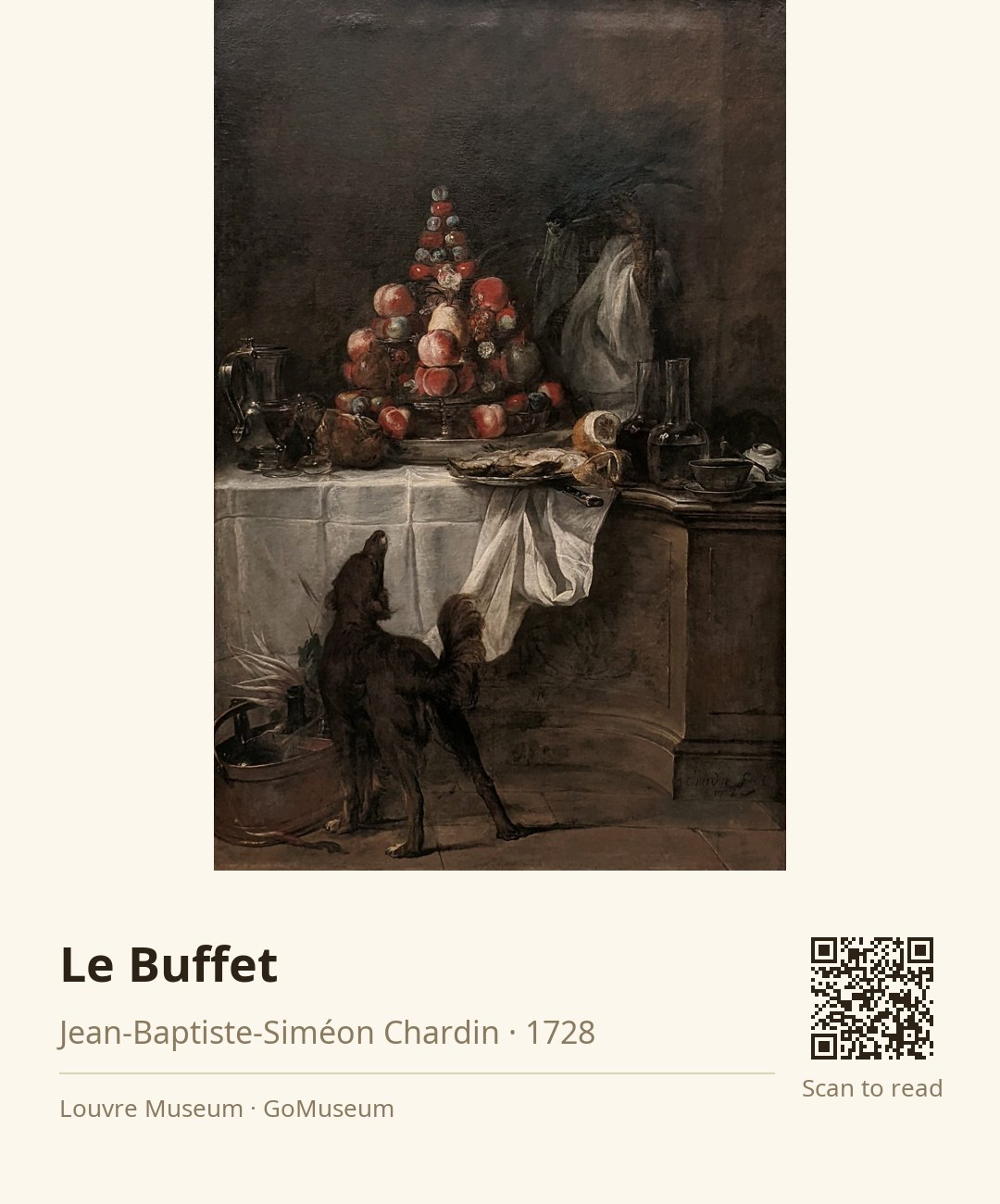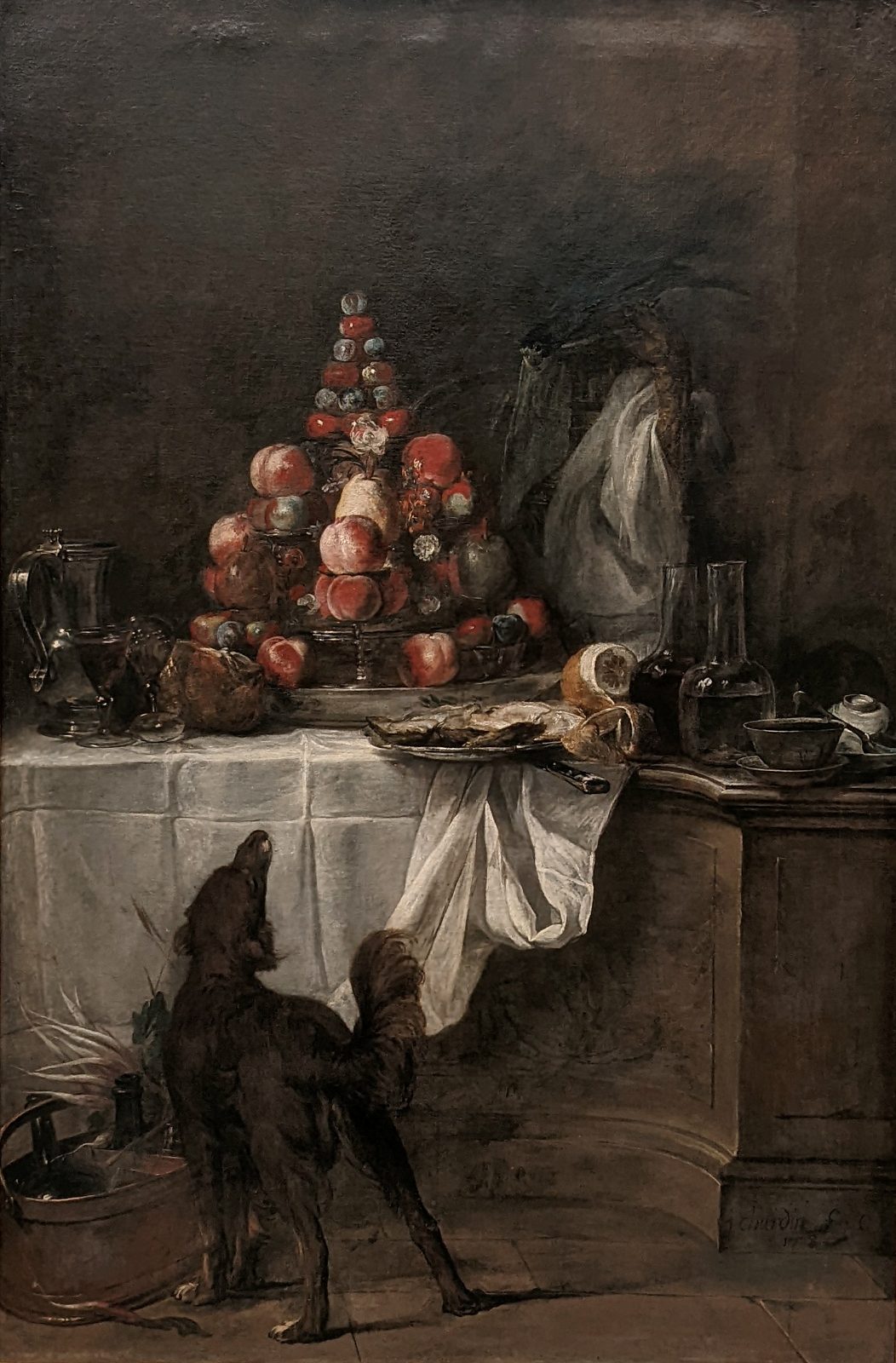
Take a moment to really look at "Le Buffet." Notice how the light dances across the surfaces of the objects, illuminating the textures of the fruit and the gleam of the metal. The way Chardin captures the subtle play of light and shadow invites you to reach out and touch these items, as if they might be real.
Now, focus on the rich colors and the careful arrangement of the items. The fruit is not just there for decoration; it’s a celebration of abundance and the beauty of everyday life. Chardin’s meticulous attention to detail elevates these simple objects into something profound, reflecting the values of 18th-century France, where still life was often seen as a humble yet significant genre.
Created in 1728, this painting was one of Chardin's reception pieces for the Académie Royale de Peinture et de Sculpture, a pivotal moment in his career. It marked his recognition as a master of still life, a genre that was often overlooked compared to grand historical narratives. Chardin’s choice to focus on the ordinary speaks volumes about his artistic vision and the changing tastes of his time.
As you stand here, think about how this painting invites you to appreciate the beauty in the mundane. What everyday objects in your life might hold a similar beauty if you took the time to notice them?
Jean Siméon Chardin, born in Paris on November 2, 1699, and passing away on December 6, 1779, is celebrated as a master of still life and genre painting in the 18th century. The son of a cabinetmaker, Chardin's artistic journey began with apprenticeships under prominent history painters, leading to his recognition at the Académie Royale de Peinture et de Sculpture in 1728. His work, characterized by balanced compositions, soft light, and textured surfaces, diverged from the Rococo style prevalent in his time, focusing instead on the beauty of everyday objects and domestic scenes.
Chardin's life was marked by personal tragedies, including the deaths of his first wife and daughter, which deeply affected him. Despite these hardships, he found success and stability through his second marriage and the support of influential patrons. His paintings gained popularity through engravings, providing him with a steady income. Chardin's meticulous approach resulted in a modest oeuvre of around 200 works, reflecting his dedication to quality over quantity.
His legacy endures as he is recognized for elevating still life and genre subjects to a respected status in art history, influencing future generations of artists. Chardin's ability to capture the essence of human experience and the beauty of the mundane continues to resonate, securing his place as a pivotal figure in the evolution of European art.
In 1728, Jean-Baptiste-Siméon Chardin presented 'Le Buffet' as one of his reception pieces to the Académie Royale de Peinture et de Sculpture, a significant milestone in his career. This event took place at the Salon de la Jeunesse, where Chardin's work was first noticed by influential figures in the art world. Alongside 'The Ray,' these paintings marked his entry into the esteemed academy, where he was recognized for his mastery of still life—a genre often overshadowed by grand historical paintings. Both works are now housed in the Louvre, a testament to their enduring impact and Chardin's legacy. Interestingly, he was admitted to the academy on the same day he presented these pieces, a rare honor that highlighted the immediate acclaim he received.
Notice the way he employs soft, diffused light that gently caresses the surfaces of the objects, creating a sense of depth and realism. The brushwork is meticulous yet spontaneous, with a granular impasto that adds texture to the fruit and metal. This choice not only enhances the visual appeal but also invites you to feel the weight and presence of these everyday items. The composition is carefully balanced, drawing your eye across the canvas and encouraging you to linger on each detail. The rich colors are not just vibrant; they evoke a sense of warmth and abundance, transforming simple objects into a celebration of domestic life. Chardin's deliberate choices in scale and arrangement elevate the ordinary, making you appreciate the beauty in the mundane.
By presenting everyday objects with such meticulous attention and a sense of dignity, Chardin shifted the perception of still lifes from mere decorative art to a respected genre worthy of academic recognition. His work influenced generations of artists, encouraging them to explore the beauty in the mundane. This painting, along with 'The Ray', secured his admission into the Académie Royale de Peinture et de Sculpture, marking a significant moment in art history where the focus began to shift from grand historical narratives to the intimate and personal, paving the way for modern realism. Remember, it’s not just a painting of a table; it’s a celebration of life’s simple pleasures.
Here's a fascinating tidbit: when Chardin presented both 'Le Buffet' and 'The Ray' to the Académie royale de peinture et de sculpture in 1728, he was not only accepted but did so on the same day! Imagine the thrill of being recognized for your talent in such a prestigious setting, and doing it all in one go. It’s a rare feat that speaks to the impact of his work right from the start of his career.
Chardin experienced significant personal losses, including the deaths of his first wife and daughter, which may have deepened the emotional resonance in his later works, reflecting a more profound appreciation for the beauty of everyday life.
Despite his talent, Chardin struggled with the perception of still life as a lesser genre compared to historical painting, which made it difficult for him to gain the same level of prestige as his contemporaries who focused on grand narratives.