Madonna of Jacob Floreins
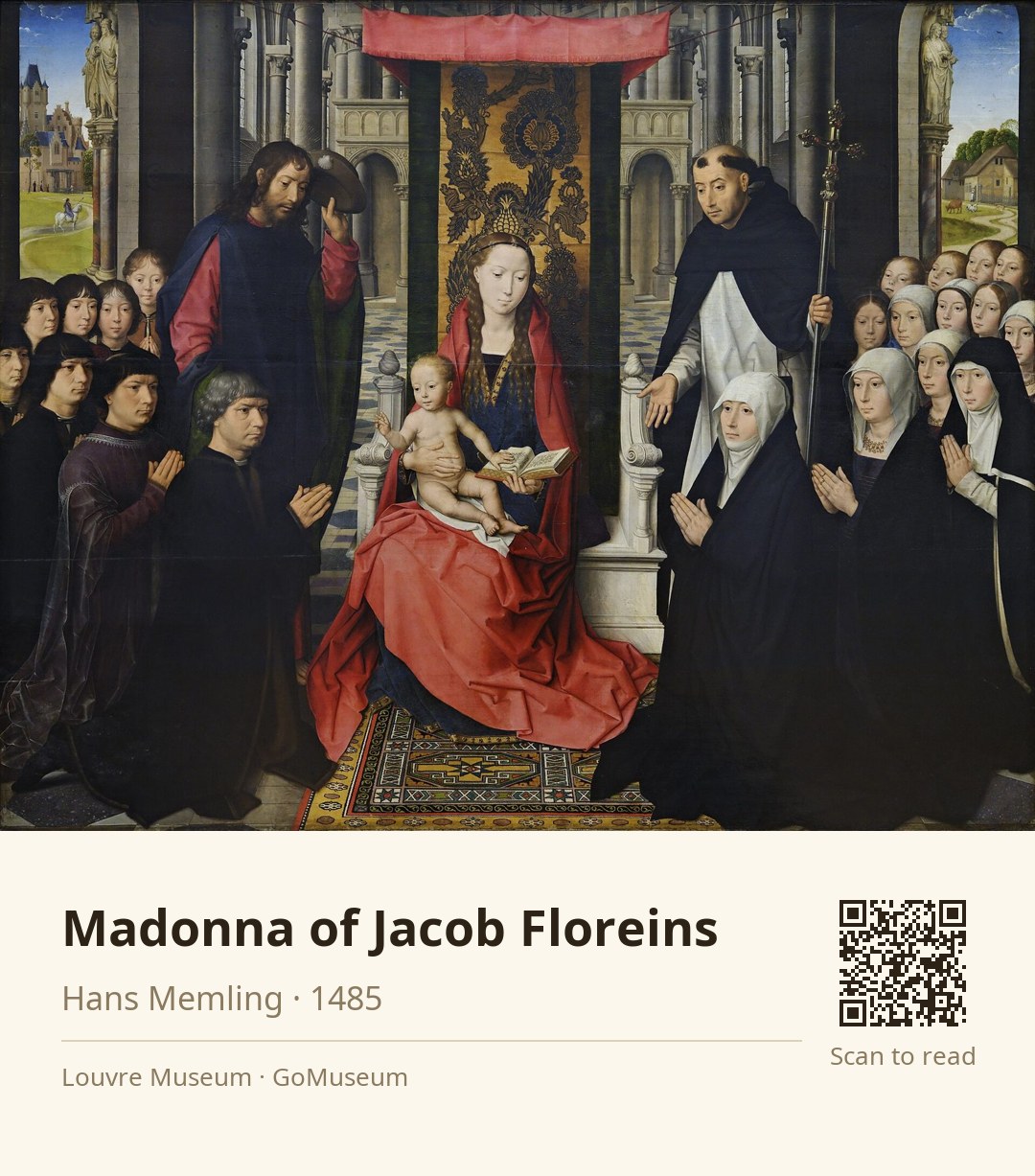
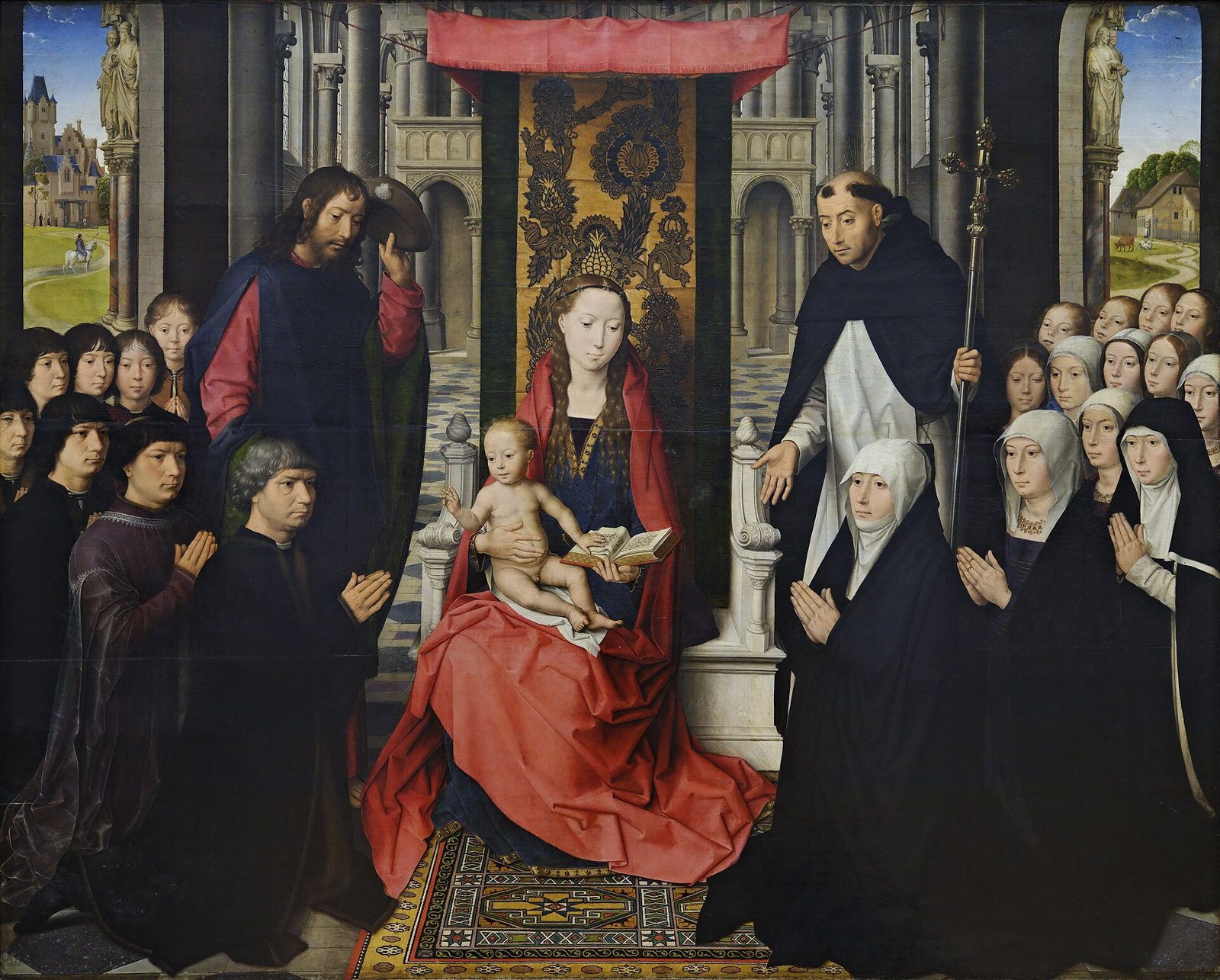
🎧 This work has audio narration — listen in the appAs you stand before the "Madonna of Jacob Floreins," let your gaze linger on the serene expression of the Virgin Mary. Notice how she sits regally on a richly adorned throne, her flowing hair framing a face that radiates compassion. The intricate golden embroidery on her seat and the vibrant carpet beneath her feet draw you into this sacred moment.
Jacob Floreins, a spice merchant, sought to immortalize his family in a divine context, surrounded by their patron saints. The presence of Saint James, representing Jacob, and Saint Dominic, likely chosen for his daughter, ties the artwork to personal stories of faith and legacy.
Created around 1485 by Hans Memling, a master of Early Netherlandish painting, this piece was likely finished after Floreins' death, as his widow is depicted in mourning attire. The painting not only serves as a memorial but also showcases the emerging trend of sacred conversations in art, a theme that was gaining popularity in Northern Italy.
As you take in this scene, think about the lives of those depicted here. What stories do you imagine they shared in this chapel, surrounded by their saints?
Hans Memling, a German-Flemish painter born around 1430 in Seligenstadt, became a pivotal figure in Early Netherlandish art. After training under Rogier van der Weyden in Brussels, he settled in Bruges by 1465, where he established a successful workshop and gained citizenship. Memling's works, characterized by serene compositions and intricate detail, often featured donor portraits that reflected the status of his patrons, including clergymen and aristocrats. His distinctive portraiture, integrating landscape backgrounds, influenced later Italian artists, including Raphael. Memling's notable pieces include the Last Judgment and the Madonna and Saints, showcasing his mastery in religious themes. Rediscovered in the 19th century, his art remains celebrated for its emotional depth and technical precision, solidifying his legacy as one of the foremost painters of the 15th century. He passed away in Bruges in 1494, leaving behind a rich body of work that continues to resonate in art history.
The 'Madonna of Jacob Floreins,' painted by Hans Memling around 1485, was commissioned for the family chapel of spice merchant Jacob Floreins in Bruges. After Floreins' death in 1488, the painting likely continued to be completed, depicting his widow and children alongside the Madonna and Child. This work is a striking example of the sacred conversation theme, popular in Northern Italy but less common in Northern European art. The painting was later taken to Spain, possibly at the request of Floreins' Spanish widow, before being looted during the French occupation in 1808. It eventually found its way to Count Duchâtel, who donated it to the Louvre in 1878, where it remains today.
As you examine the 'Madonna of Jacob Floreins,' pay attention to the masterful brushwork that Hans Memling employs. The delicate strokes create a sense of texture, particularly in the intricate golden embroidery on the throne and the vibrant carpet beneath the Virgin's feet. Notice how the light falls gently on Mary and the Child, enhancing their serene expressions. The composition is structured with a clear division of space: the church setting opens to a contrasting urban landscape on one side and a rural scene on the other. This choice not only adds depth but also invites viewers to contemplate the connection between the sacred and the everyday. The figures are arranged in a way that emphasizes their relationships, with the saints flanking the family, creating a protective aura around them. Memling's careful handling of color and light draws your eye to the central figures while grounding the scene in a rich, detailed environment.
Memling's work influenced later artists, particularly in the realm of portraiture, where the integration of landscape backgrounds became a hallmark of the style. His ability to blend personal narratives with religious themes set a precedent for future generations, making him a pivotal figure in the development of Northern Renaissance art. This painting, in particular, inspired works like Hans Holbein the Younger's 'Darmstadt Madonna,' showcasing its lasting impact on the art world.
The background is divided into three distinct parts, featuring a church setting that opens out to contrasting urban and rural landscapes, a choice that invites contemplation of the relationship between the sacred and everyday life.
The painting was left to the Louvre in 1878 by Countess Duchâtel, after having been acquired from General Jean Barthélemy Darmagnac, who looted it during the French occupation of Spain.