Madonna and Child with Saints John the Baptist and Catherine of Alexandria
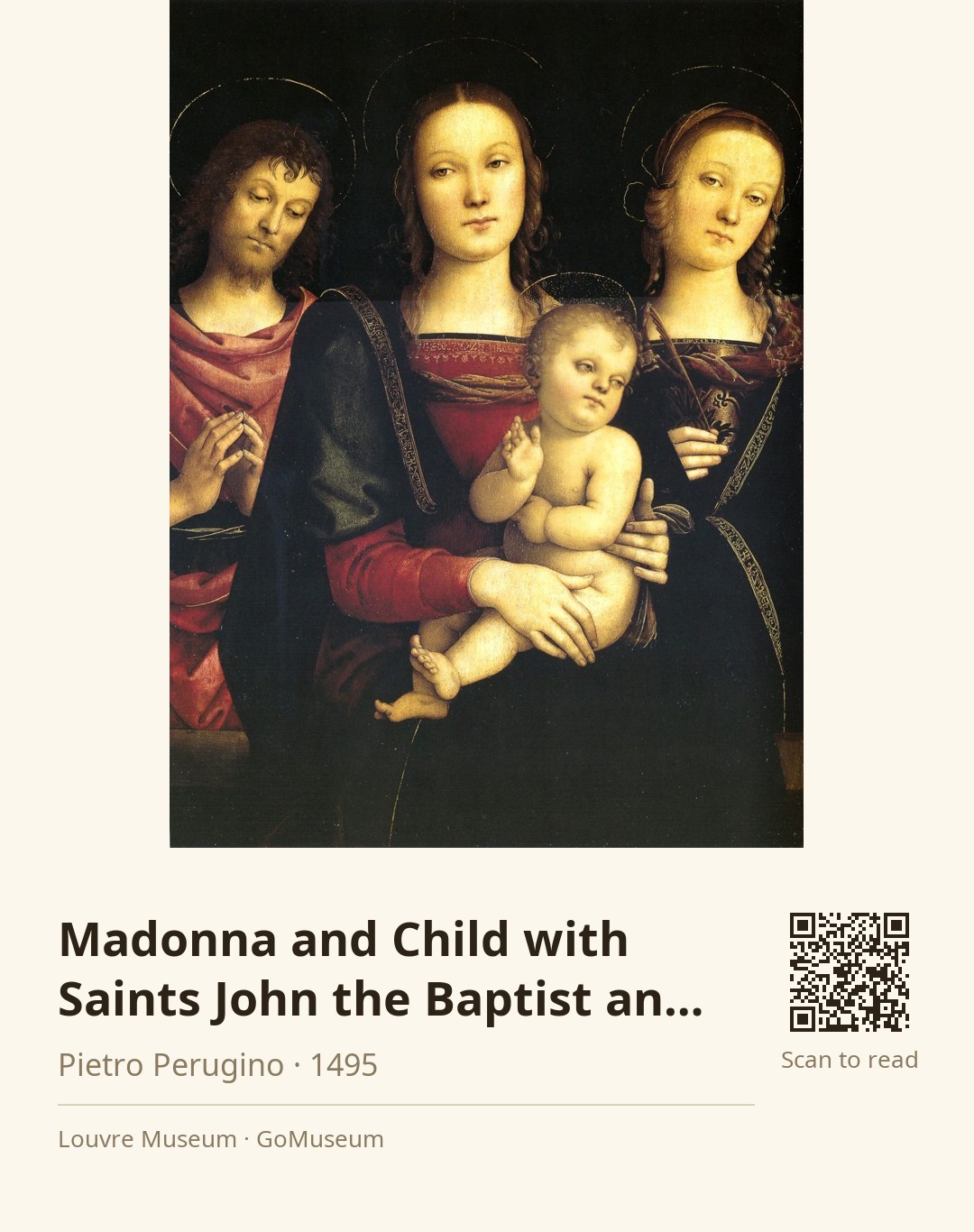
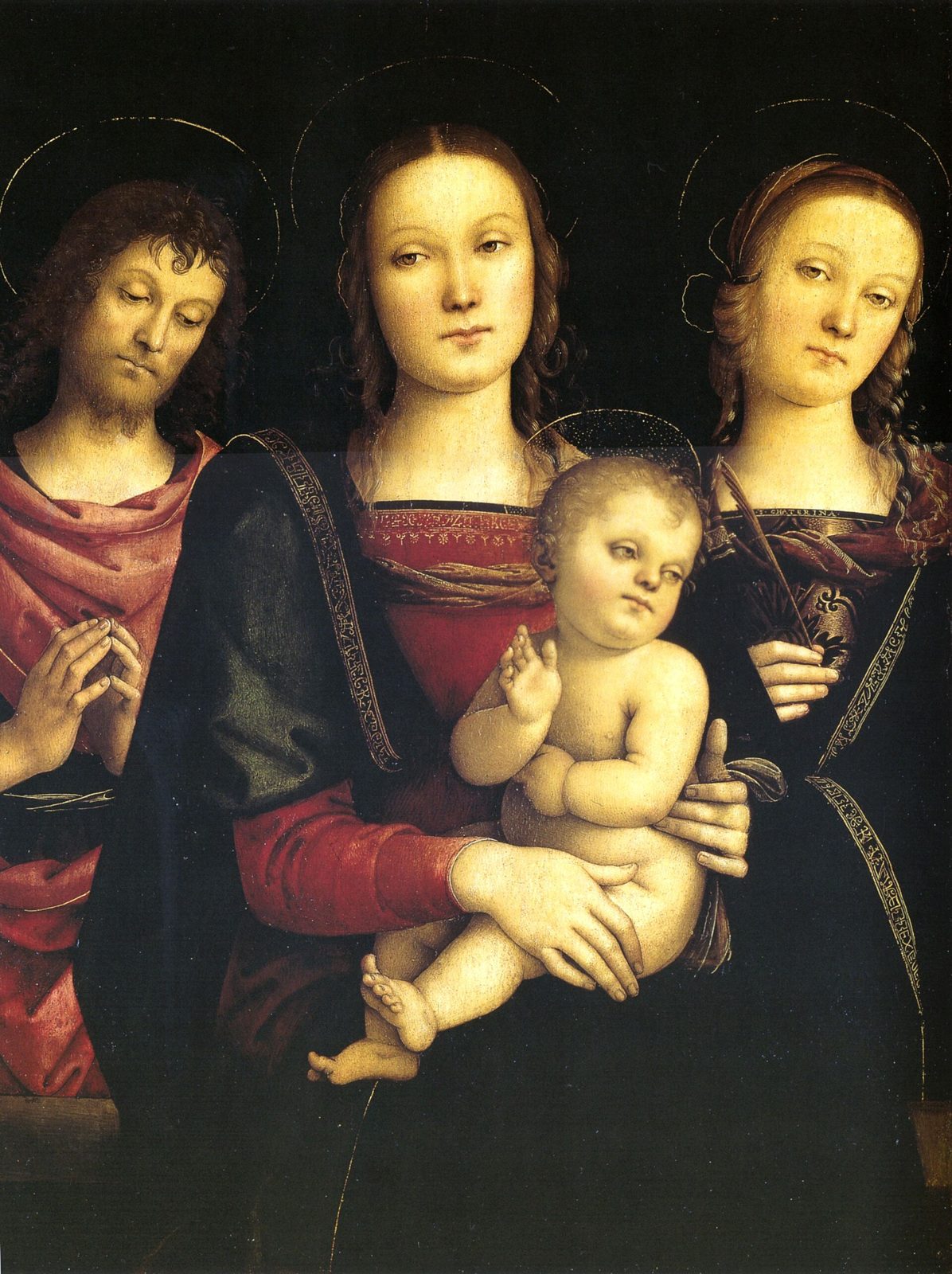
🎧 This work has audio narration — listen in the appTake a moment to really soak in the serene beauty of this painting, "Madonna and Child with Saints John the Baptist and Catherine of Alexandria" by Pietro Perugino. Notice how the Madonna, with her gentle expression, cradles the Christ Child in her arms, both seemingly lost in their own thoughts. Look closely at the way her head tilts slightly to the left, while the Child gazes to the right, creating a subtle tension that draws your eye across the canvas.
Now, check out the details of Saint Catherine on the right. What’s fascinating is that her face mirrors the Madonna’s, a choice by Perugino that suggests a deeper connection between them, perhaps reflecting the idea of divine motherhood and sanctity.
This painting, created around 1495, is a prime example of Perugino’s mature style, where he blends harmony and symmetry with a spiritual depth. It’s said that the Madonna’s face is based on that of Perugino’s wife, Chiara Fancelli, adding a personal touch to this sacred scene.
As you stand here, think about the stories these figures tell and the emotions they evoke. What do you feel when you look at the serene expressions of the Madonna and Child? How does this moment in time resonate with your own experiences of love and protection?
Pietro Perugino, born Pietro Vannucci around 1446-1452 in Città della Pieve, was a pivotal figure in the Italian Renaissance, particularly within the Umbrian school. His early training in Perugia and Florence, where he likely apprenticed under Verrocchio alongside Leonardo da Vinci, laid the foundation for his mastery in fresco and oil painting. Perugino's style is characterized by serene compositions, elegant figures, and harmonious landscapes, reflecting a balance between realism and idealism.
His career flourished after he was commissioned to create frescoes for the Sistine Chapel, including the Baptism of Christ and Delivery of the Keys, showcasing his significant role in the High Renaissance. Notably, he became Raphael's mentor, influencing the next generation of artists. Despite facing criticism later in life, including a public rebuke from Michelangelo, Perugino continued to produce notable works, such as the extensive decoration of the Sala delle Udienze del Collegio del Cambio in Perugia.
Perugino's legacy endures through his innovative techniques and the serene beauty of his religious subjects, marking him as one of the foremost painters of his time. His contributions helped shape the trajectory of Renaissance art, bridging the gap between earlier and later masters. He passed away in 1523, leaving behind a rich body of work that continues to inspire.
This captivating piece, titled 'Madonna and Child with Saints John the Baptist and Catherine of Alexandria,' was created by the renowned Italian artist Pietro Perugino around 1495. Commissioned during a vibrant period of the Italian Renaissance, this painting showcases Perugino's mastery of oil on panel technique. It now resides in the illustrious Louvre in Paris, where it has drawn the admiration of countless visitors. Interestingly, this work was produced using the same cartoon as two other notable pieces by Perugino, demonstrating his consistent artistic vision. The Madonna's face is said to be inspired by Perugino's own wife, Chiara Fancelli, adding a personal touch to this divine representation. As you stand before this artwork, consider how it reflects not just the spiritual themes of its time, but also the intimate connections in the artist's life.
As you gaze upon this painting, take note of the serene symmetry that Perugino expertly crafts. The composition is meticulously structured, with the figures arranged in a harmonious triangle that draws your eye naturally across the canvas. The brushwork is delicate yet confident, creating a sense of calm that permeates the scene. The subtle variations in light and color enhance the emotional depth; the soft, warm tones of the Madonna’s garments contrast beautifully with the cooler hues of the saints’ attire. Perugino's choice to depict the Madonna with a more mature visage, reflecting a deeper spiritual authority, marks a shift from the youthful representations of earlier works.
This painting, completed around 1495, showcases Perugino's mastery in creating serene, symmetrical compositions that invite contemplation. His influence on Raphael, who was one of his students, is particularly noteworthy. Raphael absorbed Perugino's techniques and emotional depth, which helped shape the High Renaissance style. This work matters not just for its beauty, but for how it paved the way for future artists to explore the balance between divine and human qualities in their depictions of sacred subjects.
Interestingly, the painting's composition is not entirely unique; it shares a common cartoon with several other works by Perugino. This practice of reusing designs was not uncommon among Renaissance artists, allowing them to maintain a consistent style while also exploring variations in execution.
The face of the Madonna in this painting is modeled after Perugino's wife, Chiara Fancelli, which adds a deeply personal touch to the religious subject matter. This connection between his personal and artistic life reflects the intimacy he sought to convey in his depictions of sacred figures.
As Perugino's career progressed, some critics noted a decline in innovation, leading to a loss of students and commissions. This shift in public perception marked a challenging period for him, as he struggled to adapt to the evolving artistic landscape of the High Renaissance.