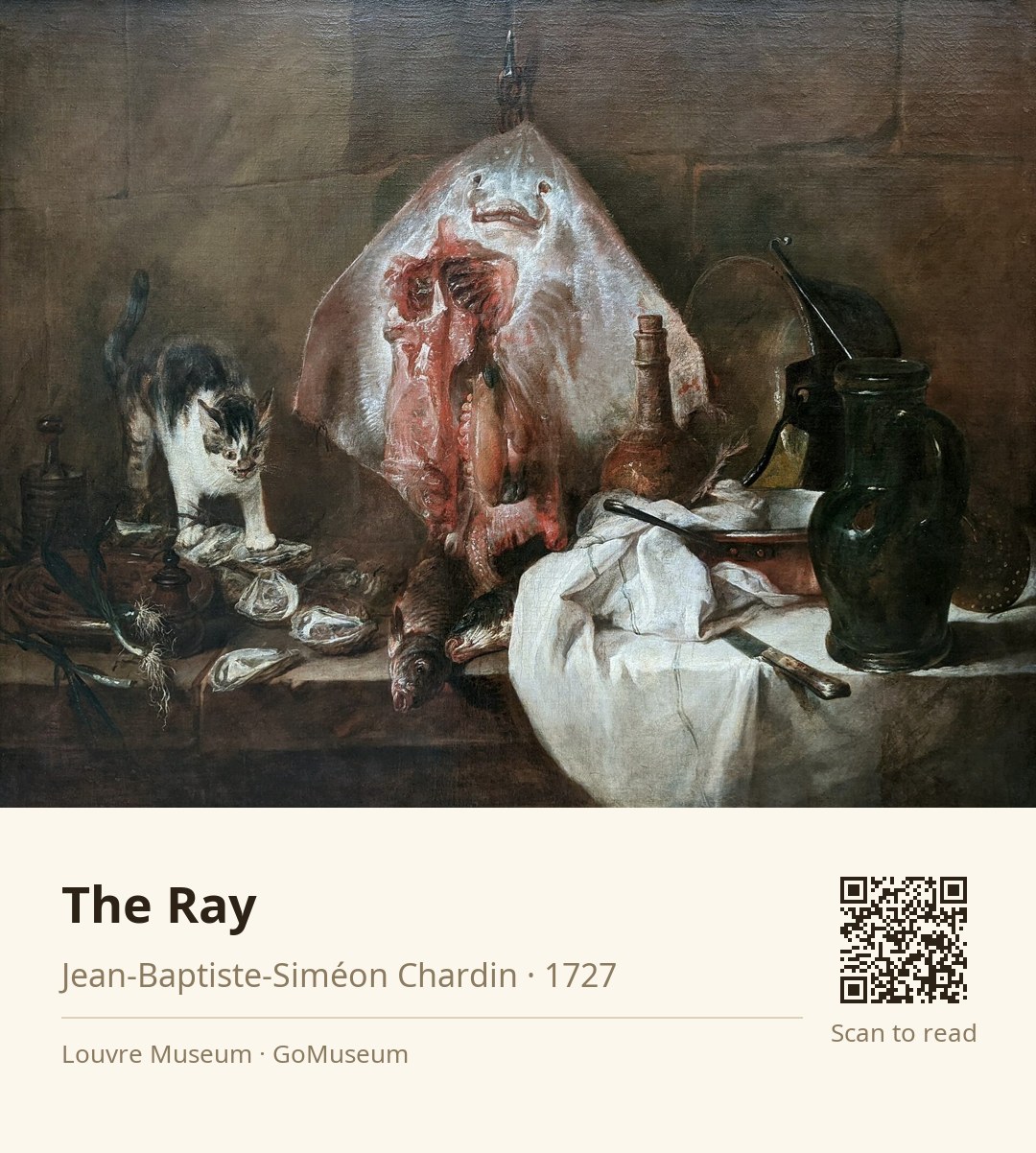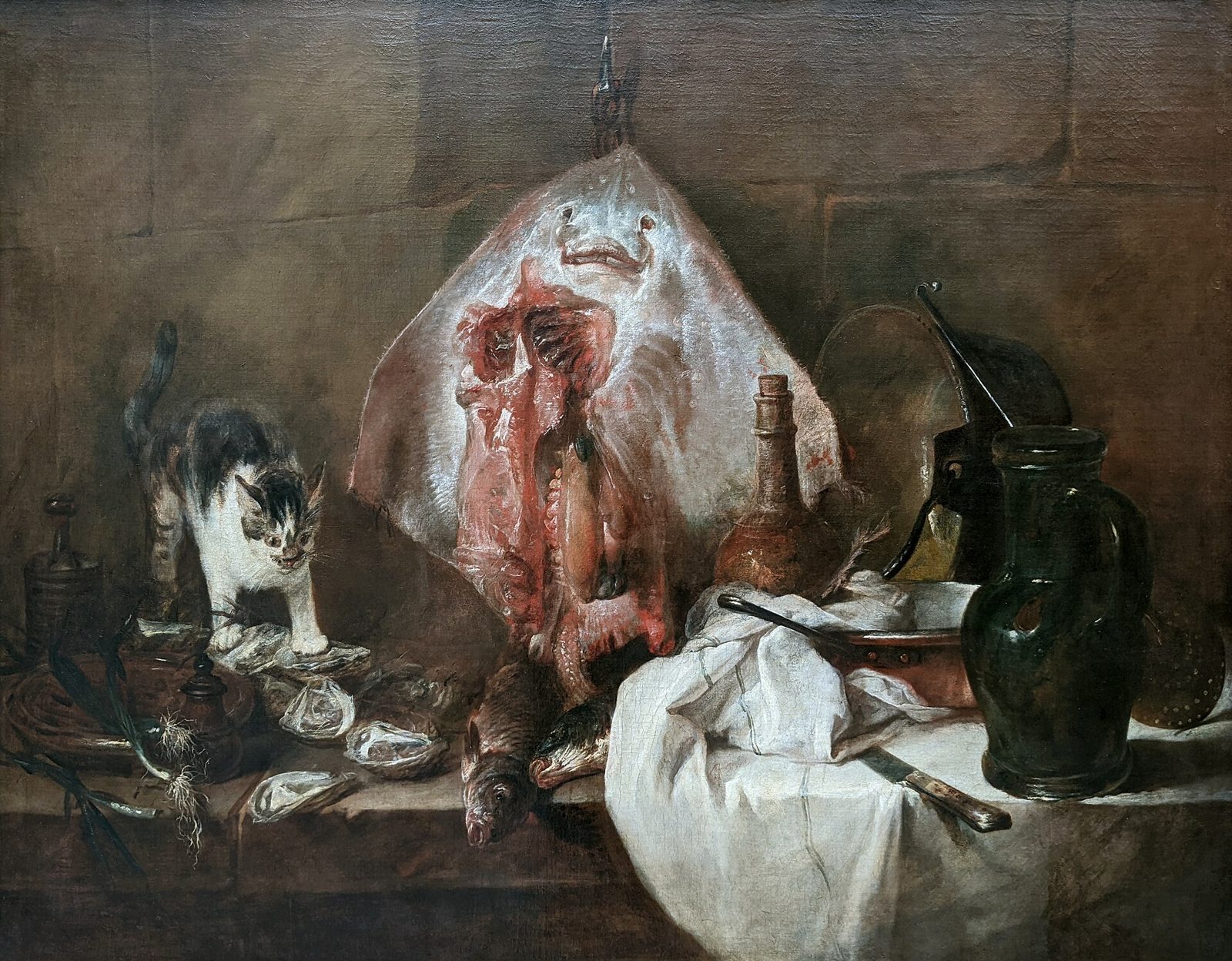
Take a moment to really look at "The Ray." Notice how the gutted skate hangs there, its bloody underside stark against the stone wall. It’s not just a fish; it’s a visceral encounter with life and death, suspended in time. The way Chardin captures the texture of the skate’s flesh, the sheen of the metal pans, and the delicate curve of the oysters invites you to feel the weight of the scene.
These details matter because they challenge the norms of still life painting in the 18th century. While many artists focused on beauty and idealized forms, Chardin dives deep into the raw, unfiltered reality of the kitchen. The skate, with its unsettling resemblance to a human face, evokes a complex emotional response, blurring the lines between the familiar and the grotesque. This was revolutionary for its time, pushing viewers to confront their own perceptions of beauty and decay.
It’s fascinating to think how this painting, initially met with mixed reactions, has since become a cornerstone of still life art.
As you stand here, consider: what does this painting say about our relationship with food, life, and the domestic space? How does it make you feel about the everyday objects that surround you?
Jean Siméon Chardin, born in Paris on November 2, 1699, and passing away on December 6, 1779, is celebrated as a master of still life and genre painting in the 18th century. The son of a cabinetmaker, Chardin's artistic journey began with apprenticeships under prominent history painters, leading to his recognition at the Académie Royale de Peinture et de Sculpture in 1728. His work, characterized by balanced compositions, soft light, and textured surfaces, diverged from the Rococo style prevalent in his time, focusing instead on the beauty of everyday objects and domestic scenes.
Chardin's life was marked by personal tragedies, including the deaths of his first wife and daughter, which deeply affected him. Despite these hardships, he found success and stability through his second marriage and the support of influential patrons. His paintings gained popularity through engravings, providing him with a steady income. Chardin's meticulous approach resulted in a modest oeuvre of around 200 works, reflecting his dedication to quality over quantity.
His legacy endures as he is recognized for elevating still life and genre subjects to a respected status in art history, influencing future generations of artists. Chardin's ability to capture the essence of human experience and the beauty of the mundane continues to resonate, securing his place as a pivotal figure in the evolution of European art.
Chardin's 'The Ray' was first unveiled at the Exposition de la Jeunesse on June 3, 1728, a lively open-air exhibition held on the day of Corpus Christi. This event marked a significant moment in Chardin's career, as it led to his acceptance into the prestigious Académie royale de peinture et de sculpture later that year. Initially, the painting received mixed reviews; while some critics found its raw depiction of a gutted skate 'disgusting,' others, including notable figures like Diderot, recognized its artistic merit. The work remained with the Academy until the French Revolution, after which it was transferred to the Louvre, where it continues to be celebrated as a cornerstone of still life art.
In 'The Ray,' Chardin employs a striking composition that balances the visceral with the geometric. The skate, hanging from a hook, serves as the focal point, its bloody underside drawing the viewer's eye. Notice how the arrangement of objects creates an ambitious pyramidal structure, with the skate at the apex, leading your gaze down to the surrounding utensils and oysters. Chardin's technique is particularly noteworthy; he used a tactile application method, often employing his hands to create the 'sticky chewiness' of the skate's flesh. This choice enhances the painting's realism, making the viewer almost feel the texture. The depth is achieved through a clever interplay of light and shadow, with the stone wall establishing a grid that contrasts with the organic forms of the fish and kitchenware. This meticulous attention to detail and innovative technique invites you to engage with the painting on a sensory level.
This visceral portrayal of a gutted skate, with its raw, almost confrontational realism, challenged the norms of beauty and taste in art. It influenced a generation of artists, including Henri Matisse, who admired Chardin's technique and emotional depth. The painting's focus on materiality and the human-like qualities of the skate pushed boundaries, prompting viewers to reconsider the relationship between art and the everyday world.
An intriguing anecdote about 'The Ray' involves the famous writer Marcel Proust, who described the painting as evoking the 'nave of a polychromatic cathedral.' This vivid imagery highlights how deeply the work resonated with viewers, transcending mere representation to evoke a sense of wonder and contemplation about life, death, and the beauty found in the everyday.
Chardin employed a tactile application method, using his hands and fingertips instead of traditional brushes, which allowed him to achieve a realistic 'sticky chewiness' in the depiction of the skate's flesh.
Proust likened the painting to the 'nave of a polychromatic cathedral,' suggesting that it evokes a sense of wonder and contemplation, merging the beauty of the everyday with deeper themes of life and death.
The Exposition de la Jeunesse in 1728 was crucial for Chardin as it marked the debut of 'The Ray,' which led to his rapid acceptance into the prestigious Académie royale de peinture et de sculpture, significantly advancing his career.