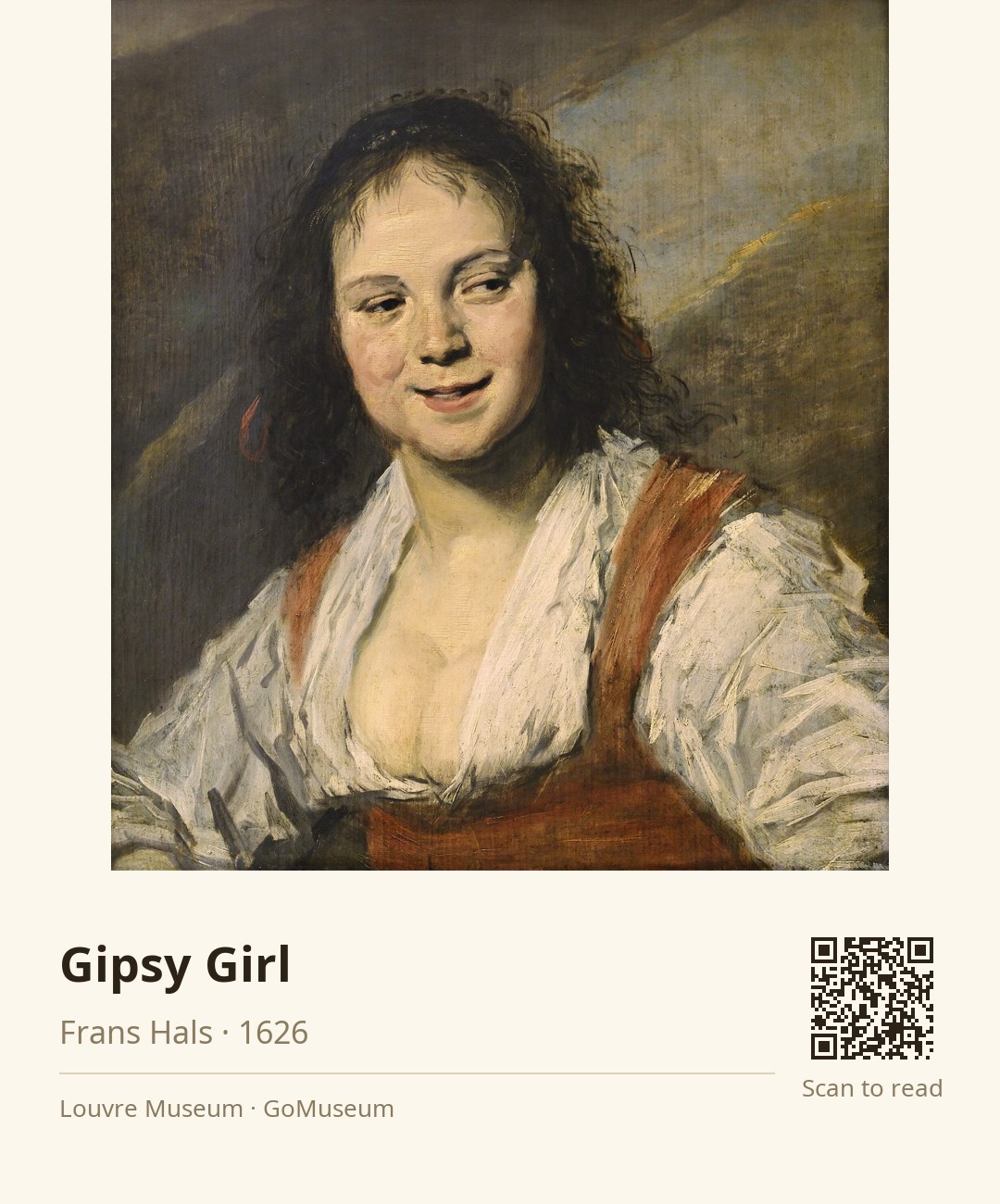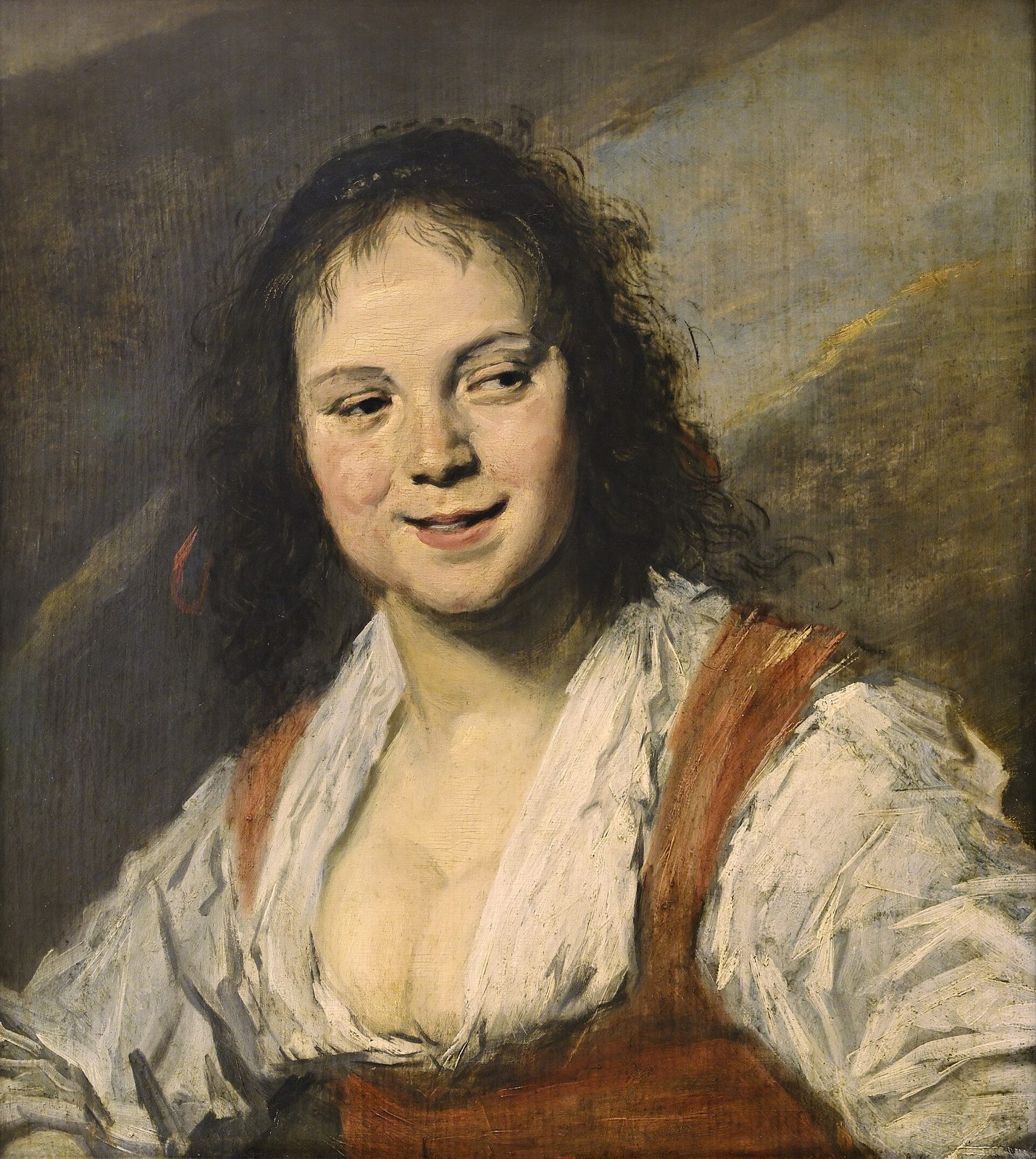
Take a moment to really look at the "Gipsy Girl" by Frans Hals. Notice how her bright smile and lively eyes seem to pull you in, almost as if she’s sharing a secret with you. Check out the way her red bodice contrasts with the soft white of her chemise, revealing just a hint of skin—something quite daring for the 17th century.
These details matter because they challenge the norms of Hals's time, hinting at a more liberated spirit. This painting isn’t just a portrait; it’s a tronie, a study of expression and character, capturing a moment of joy and perhaps a touch of mischief. Hals was known for his ability to breathe life into his subjects, and here, he invites us to engage with a woman who defies societal expectations.
Created around 1626, this piece reflects the Dutch Golden Age, a time when artists like Hals were exploring new themes beyond traditional portraiture. What do you imagine her life was like?
Frans Hals the Elder was a prominent Dutch Golden Age painter, born around 1582 in Antwerp. His family fled to Haarlem during the tumultuous period of the Spanish rule, where he would spend the rest of his life. Hals became renowned for his lively and expressive portraits, capturing the essence of his subjects with a unique painterly style that contrasted with the more formal approaches of his contemporaries. His work often featured a subdued palette, reflecting the fashions of his wealthy clients, yet the personalities he portrayed radiated warmth and vitality.
Joining the Haarlem Guild of Saint Luke in 1610, Hals initially worked as an art restorer before achieving fame with his group portrait "The Banquet of the Officers of the St George Militia Company" in 1616. His influence extended beyond his lifetime, impacting later movements such as realism and impressionism. Despite personal challenges, including the loss of his first wife and struggles with financial stability, Hals remained a dedicated father and a steadfast figure in Haarlem's art scene, insisting that patrons come to him rather than seeking opportunities elsewhere. His legacy endures as one of the great masters of portraiture, alongside figures like Rembrandt and Vermeer.
This painting is a tronie, a genre that focuses on character and expression rather than traditional portraiture. It was first documented in a Paris sale in 1782 and has since become a staple in art discussions. The painting was cataloged by Hofstede de Groot in 1910, who described the girl as a laughing figure with a captivating gaze. Interestingly, the painting's daring depiction of cleavage was quite bold for its time, leading some art historians to speculate about the model's background. The work was later exhibited in the 1962 Frans Hals exhibition at the Frans Hals Museum, where it inspired a song called 'Malle Babbe,' further embedding it in popular culture. Today, it resides in the Louvre, continuing to draw viewers into its lively narrative.
Notice how the vibrant red of her bodice contrasts strikingly with the soft white of her chemise, creating a visual tension that draws your eye. The loose, expressive brushstrokes give the painting a sense of immediacy, almost as if the girl could step out of the frame. The light falls delicately on her face, highlighting her joyful expression and the subtle play of shadows adds depth. Hals often painted wet-on-wet, allowing him to blend colors seamlessly, which is evident in the way the skin tones transition smoothly. This technique not only captures the liveliness of the subject but also reflects Hals's innovative approach to composition, where spontaneity meets careful observation.
Hals's loose brushwork and focus on character paved the way for a more expressive style in portraiture, impacting movements like Realism and Impressionism. Artists such as Gustave Courbet and Vincent van Gogh drew inspiration from Hals's ability to infuse life into his subjects, marking a shift towards capturing human emotion and spontaneity in art. This painting exemplifies the evolution of genre painting, moving beyond mere representation to explore deeper narratives and expressions.
One curious tidbit about the 'Gipsy Girl' is that during its exhibition in 1962, it was mistakenly associated with another painting, leading to the creation of the song 'Malle Babbe.' This mix-up not only highlights the painting's allure but also shows how art can transcend its original context, becoming part of a broader cultural conversation.
The painting inspired the song 'Malle Babbe' during its 1962 exhibition, which became a Dutch hit in 1975. This song, celebrating the girl's vibrant sexuality, further embedded the painting in popular culture, leading to it being mistakenly referred to by the same name.
Hals often employed a wet-on-wet technique, allowing him to blend colors seamlessly while painting. This method is particularly visible in the 'Gipsy Girl,' where the transitions in skin tones and the lively brushwork create a sense of immediacy and spontaneity.