L'Indifférent
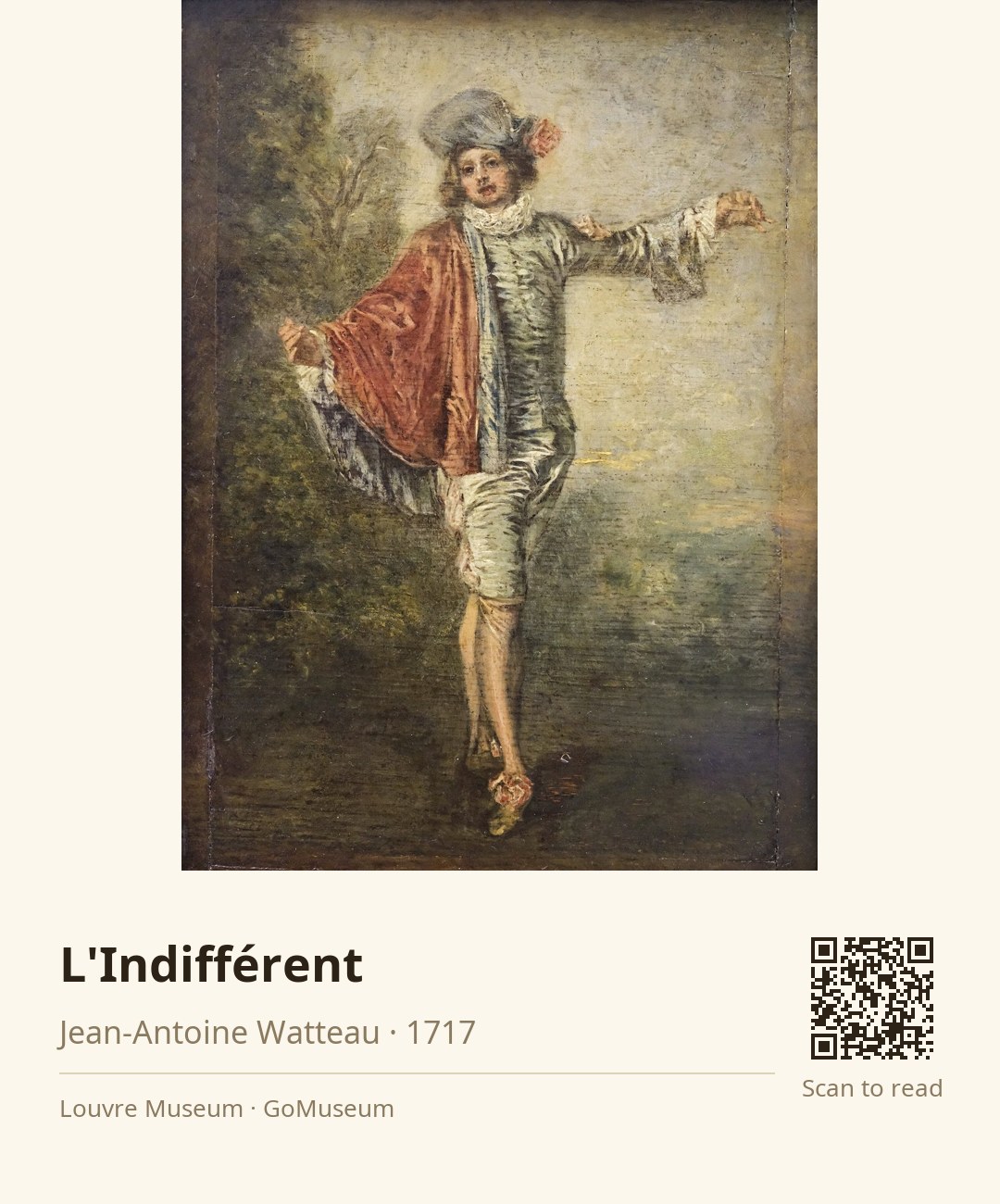
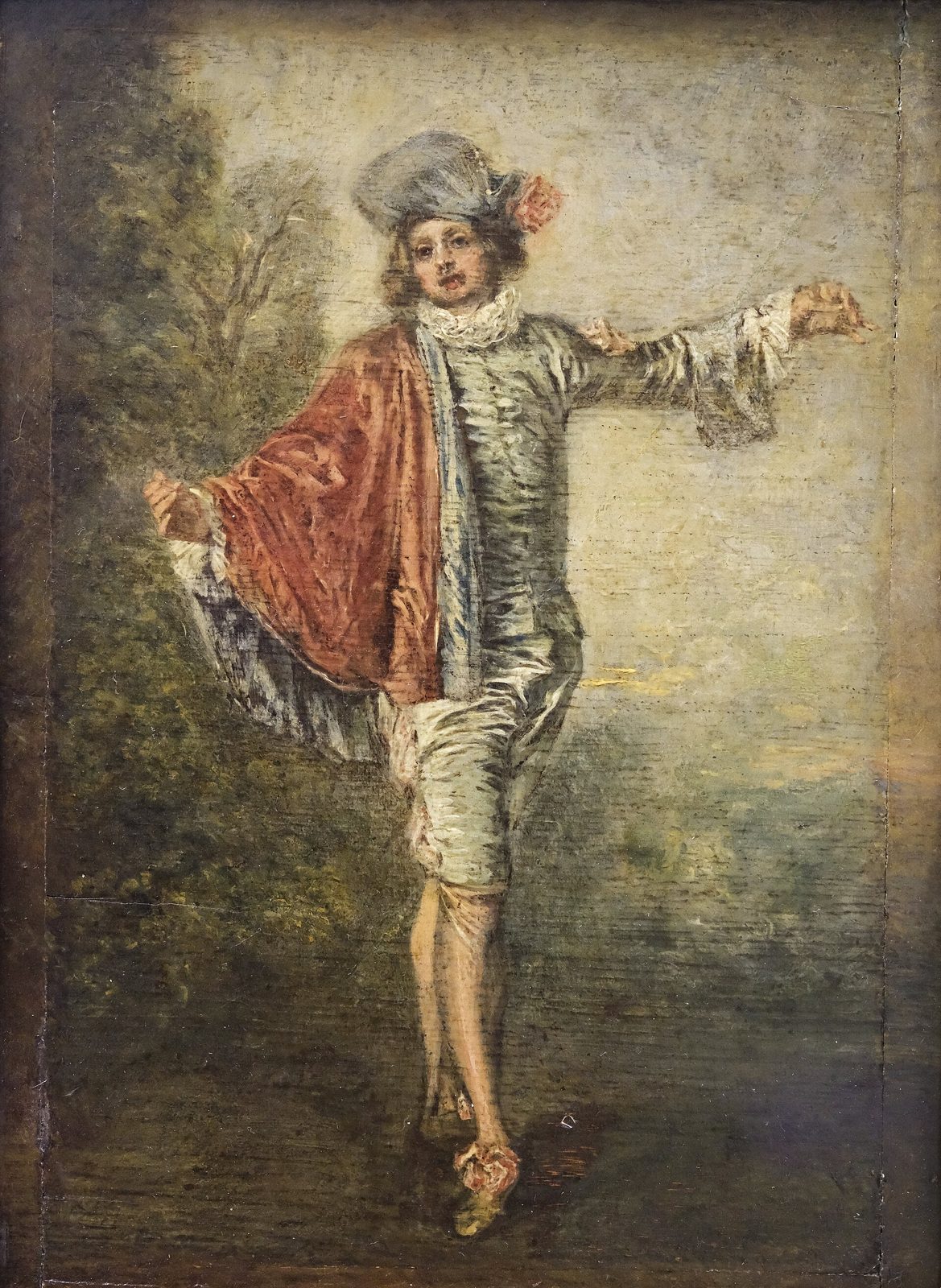
🎧 This work has audio narration — listen in the appAs you stand before "L'Indifférent" by Jean-Antoine Watteau, take a moment to really absorb the figure at the center. Notice how the young man’s satin blue outfit shimmers against the backdrop of trees and a sunset sky. His pose is almost theatrical, one arm outstretched as if he’s about to step into a dance, while the other holds a flowing cape that adds a sense of movement.
These details matter because they encapsulate the essence of the Rococo style, which Watteau helped to define. The vibrant colors and playful elegance invite you into a world of charm and flirtation, reflecting the cultural atmosphere of early 18th-century France, where indifference in love was both a social commentary and a fashionable stance. This painting isn’t just about a charming figure; it’s a glimpse into the complex emotions of the time, where the art of seduction was as much about appearance as it was about feeling.
Watteau, who created this piece in 1717, was a pioneer in the genre of fêtes galantes, capturing scenes of idyllic beauty and romantic escapades. His work often blurs the lines between reality and performance, much like the life of the aristocracy he depicted.
So, as you take in "L'Indifférent," consider: what does this figure’s poised indifference say about the nature of love and attraction? How does it resonate with your own experiences of romance and allure?
Jean-Antoine Watteau, born in Valenciennes in 1684, was a pivotal French painter whose brief but impactful career transformed the Baroque style into the more playful Rococo. He is renowned for pioneering the genre of fêtes galantes, which depicted charming, idyllic scenes infused with theatricality, often inspired by the commedia dell'arte. Watteau's early life was marked by a tumultuous family environment, which likely influenced his introspective nature and artistic sensibilities.
After moving to Paris in 1702, he honed his skills under various influences, notably Claude Gillot and Claude Audran III, before establishing his unique style characterized by vibrant colors and fluid movement. His masterpieces, including "Pilgrimage to Cythera" and "Pierrot," reflect his fascination with love and leisure, capturing the essence of 18th-century French society.
Despite his struggles for recognition, Watteau achieved success during his lifetime, becoming a full member of the Académie Royale in 1717. His legacy endures through his extensive body of work, which continues to inspire artists and collectors alike, solidifying his place in art history as a master of color and emotion. Watteau passed away in 1721, leaving behind a rich artistic heritage that would influence generations to come.
L'Indifférent was created in 1717 and is now part of the Louvre's collection, thanks to Louis La Caze, who bequeathed it in 1869. This painting emerged during a vibrant period in France, where the Rococo style was gaining momentum, reflecting the playful and flirtatious spirit of the time. Watteau, known for his fêtes galantes, captured the essence of social interactions among the aristocracy. The painting's title, 'L'Indifférent', hints at a theme of emotional detachment, a commentary on the era's complex relationship with love. Interestingly, about fifteen years after its creation, the concept of indifference in romance inspired a group of artists and performers to form the 'Order of the Indifferent', celebrating a lifestyle free from passionate entanglements. This painting not only represents Watteau's artistic genius but also serves as a cultural artifact of early 18th-century French society.
As you gaze at L'Indifférent, pay attention to the delicate brushwork that Watteau employs. The soft, almost feathery strokes create a shimmering effect on the young man's satin blue outfit, making it appear to glow against the more muted background of trees and a sunset sky. Notice how the composition draws your eye to the figure's outstretched arm, suggesting movement and a dance-like quality. The use of light is masterful; it highlights the contours of the figure while casting gentle shadows that add depth. Watteau's choice to paint on a wooden panel, rather than canvas, gives the work a unique texture and richness. The small scale of the painting (just 26 cm high) invites intimacy, as if you are privy to a private moment of charm and allure. This combination of techniques not only showcases Watteau's skill but also immerses you in the playful, theatrical world he so loved to depict.
In a twist of fate, L'Indifférent was stolen from the Louvre in 1939, making headlines as the first major theft since the Mona Lisa was taken nearly three decades earlier. The thief, Serge Bogousslavsky, claimed he intended to restore the painting.
About fifteen years after 'L'Indifférent' was painted, a group of artists and performers founded the 'Order of the Indifferent', celebrating a lifestyle free from passionate entanglements, inspired by the painting's theme of emotional detachment.
The theft of 'L'Indifférent' was significant as it marked the first major theft from the Louvre since the Mona Lisa, drawing considerable media attention and highlighting the painting's value and cultural importance.