 Image: Jörg Bittner Unna · Jörg Bittner Unna · Jörg Bittner Unna · Jörg Bittner Unna · Jörg Bittner Unna
Rebellious Slave
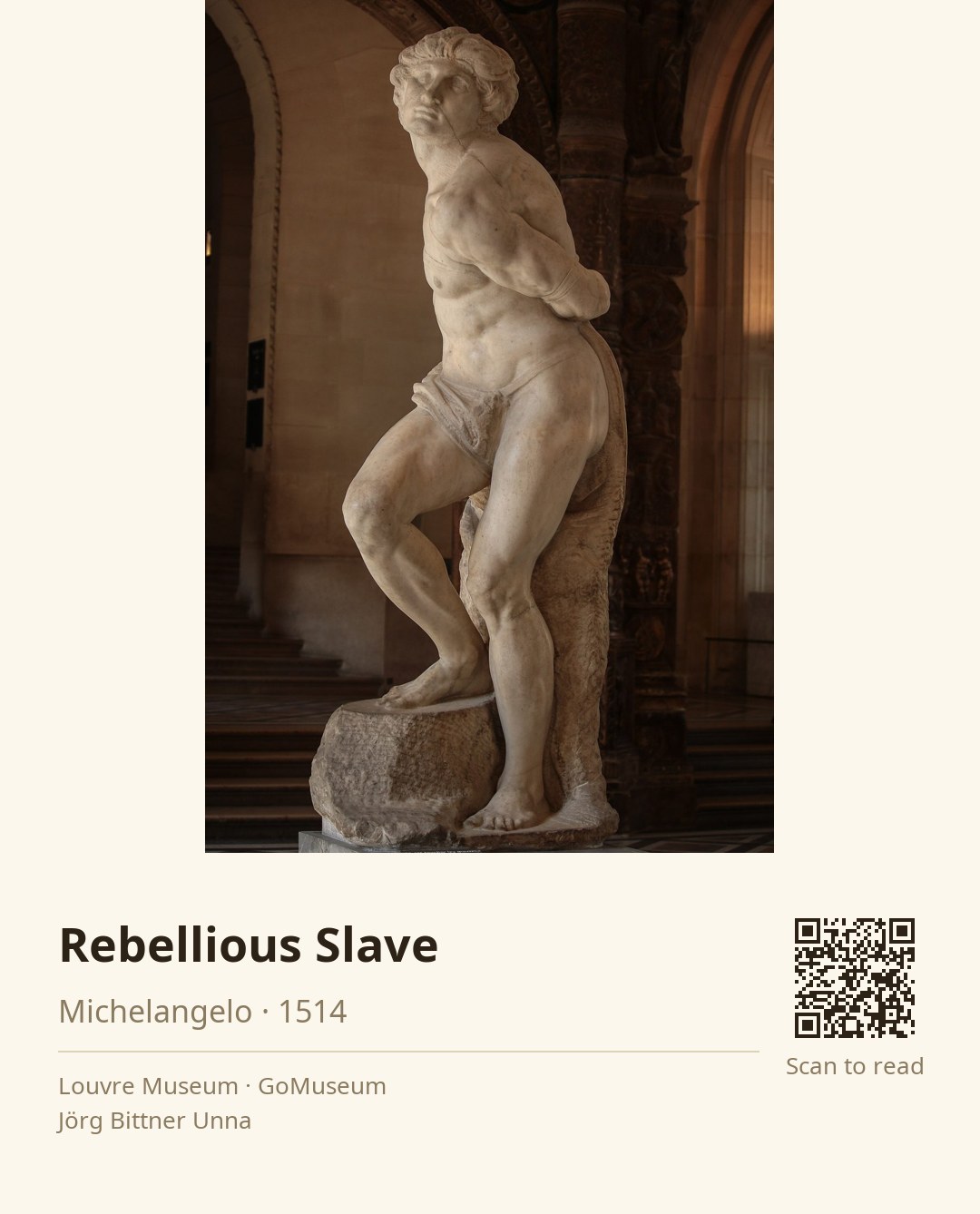
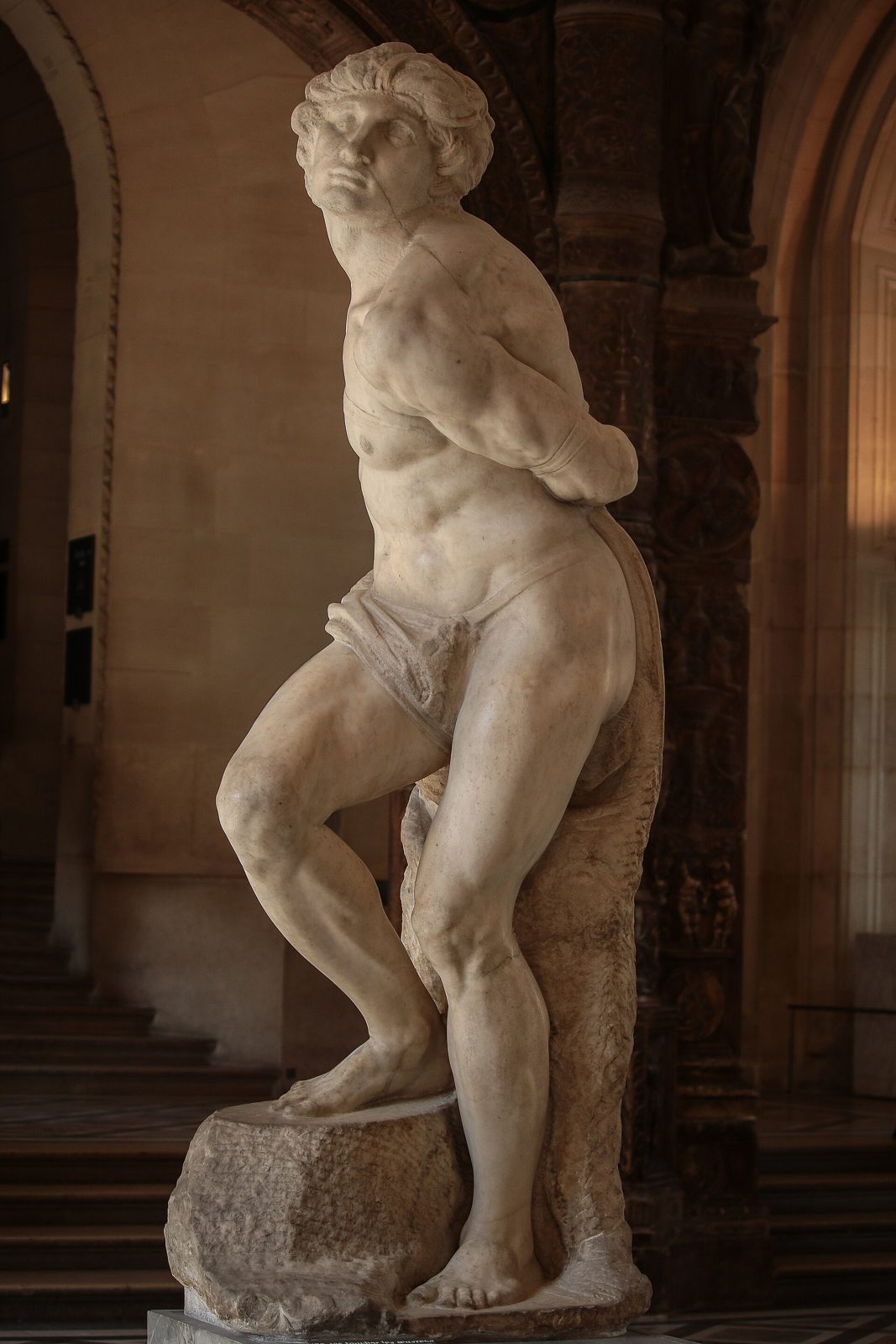
🎧 This work has audio narration — listen in the appTake a moment to really look at the "Rebellious Slave." Notice how his body twists and contorts, as if he's straining against invisible chains. Look closely at his raised shoulder and knee—these details create an impression of movement, as if he's desperately trying to break free.
This tension is key. Michelangelo captures not just a figure, but the very essence of struggle and resistance.
While this piece was originally part of a grander tomb design, it was ultimately left unfinished, adding to its raw emotional impact. The unfinished quality invites you to ponder what lies beneath the surface, both in the sculpture and in the artist’s own life.
As you stand here, think about the weight of those chains. What does it mean to be rebellious? What chains do we carry in our own lives?
Michelangelo di Lodovico Buonarroti Simoni, known simply as Michelangelo, was a towering figure of the High Renaissance, born on March 6, 1475, in Caprese, Italy. He grew up in Florence, where his early exposure to marble and art ignited a lifelong passion for sculpting. His formative years were marked by a profound influence from classical antiquity, shaping his artistic vision and driving his relentless pursuit of perfection across various mediums, including sculpture, painting, architecture, and poetry.
Michelangelo achieved remarkable fame early in his career, creating masterpieces such as the Pietà and David before turning 30. Though he considered himself primarily a sculptor, his frescoes on the Sistine Chapel ceiling and The Last Judgment are among the most significant works in Western art history. His architectural contributions, notably the design of St. Peter's Basilica, further solidified his legacy.
Regarded as "Il Divino" by his contemporaries, Michelangelo's ability to evoke awe through his art was unparalleled. He was one of the first artists to have his biography published during his lifetime, with Giorgio Vasari proclaiming him the greatest artist of all time. His impact on art is profound, influencing the Mannerist movement and leaving a lasting legacy that continues to inspire artists today. Michelangelo passed away on February 18, 1564, in Rome, but his work endures as a testament to the genius of the Renaissance.
Notice the way he skillfully carved the figure, leaving some areas rough and unfinished, which adds a raw, emotional quality to the sculpture. The tension in the muscles and the intricate details of the figure's contorted form showcase Michelangelo's mastery of anatomy. You can almost feel the struggle as he captures the essence of a body in motion, yearning for freedom, yet bound by invisible chains.
Originally, the tomb was to be a monumental structure filled with sculptures, but due to political and financial issues, it was scaled down. The two 'slaves' were intended for the lower part of the tomb, but they were ultimately left out of the final design completed in 1542. After Michelangelo's death, the statues changed hands several times, eventually finding a home in the Louvre, where they were displayed for the first time in 1794 after being hidden during the Revolution. The journey of these sculptures reflects the tumultuous history of art and patronage in the Renaissance.
This work, alongside its counterparts, was originally intended for the grand tomb of Pope Julius II, yet it was never completed for that purpose. Instead, it has influenced countless artists who came after Michelangelo, embodying the struggle for freedom and the tension between the human form and its constraints. The way the figure twists and contorts speaks to a deeper philosophical exploration of captivity, both physical and artistic. This piece has inspired generations, encouraging artists to delve into the emotional and symbolic potential of the human body, making it a cornerstone in the narrative of Western art history.
Did you know that Michelangelo's 'Rebellious Slave' was originally intended for a grand tomb? Commissioned by Pope Julius II, the statue was part of a much larger project that ultimately got scaled back. The irony? Imagine the artist, pouring his soul into this marble, only to have it sidelined in history!
The Rebellious Slave was intended to be part of a grand tomb for Pope Julius II, which was originally envisioned as a monumental structure filled with numerous sculptures. However, due to political and financial issues, the project was significantly scaled down, leading to the exclusion of these figures from the final design.