The Apotheosis of Homer
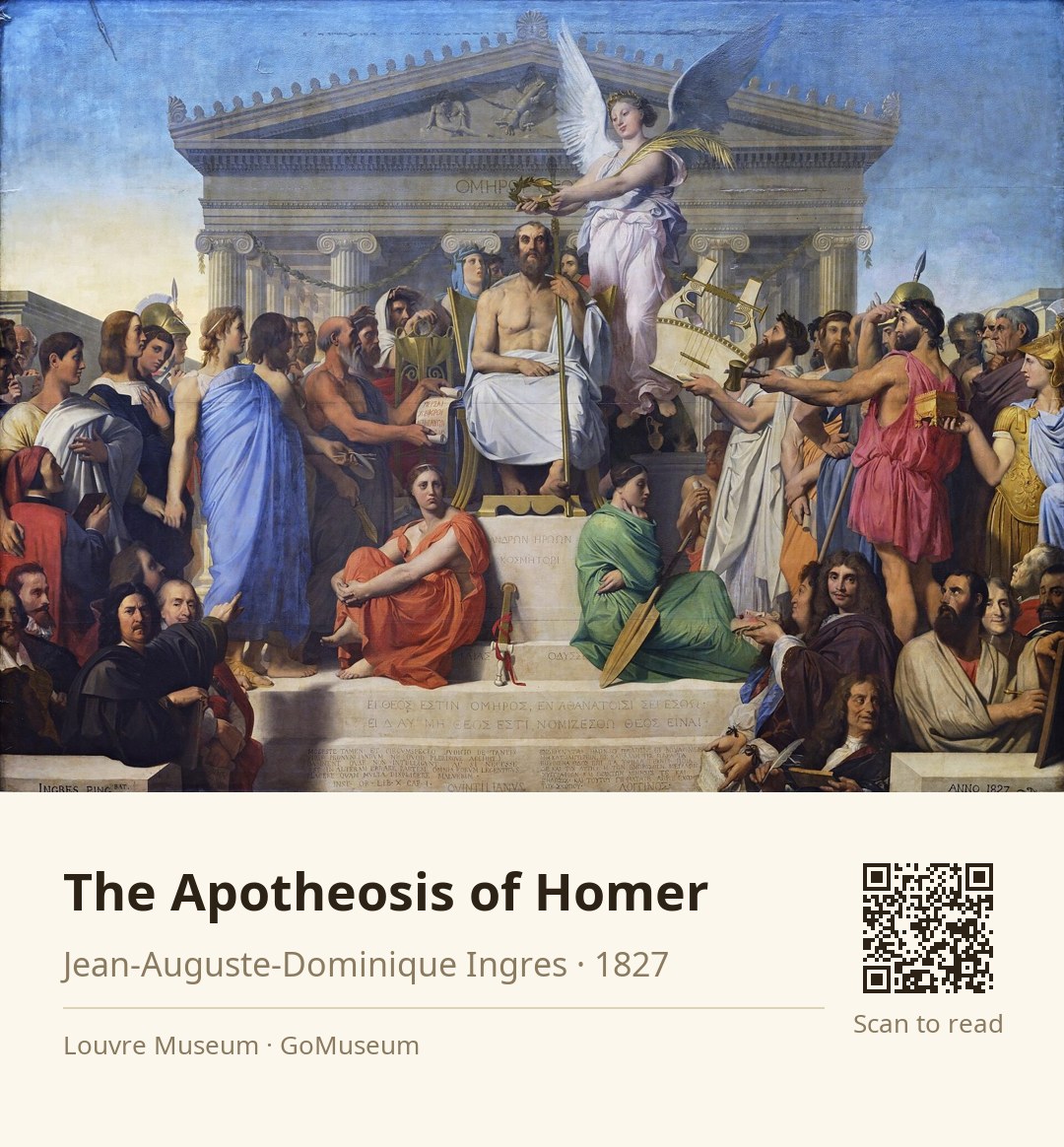
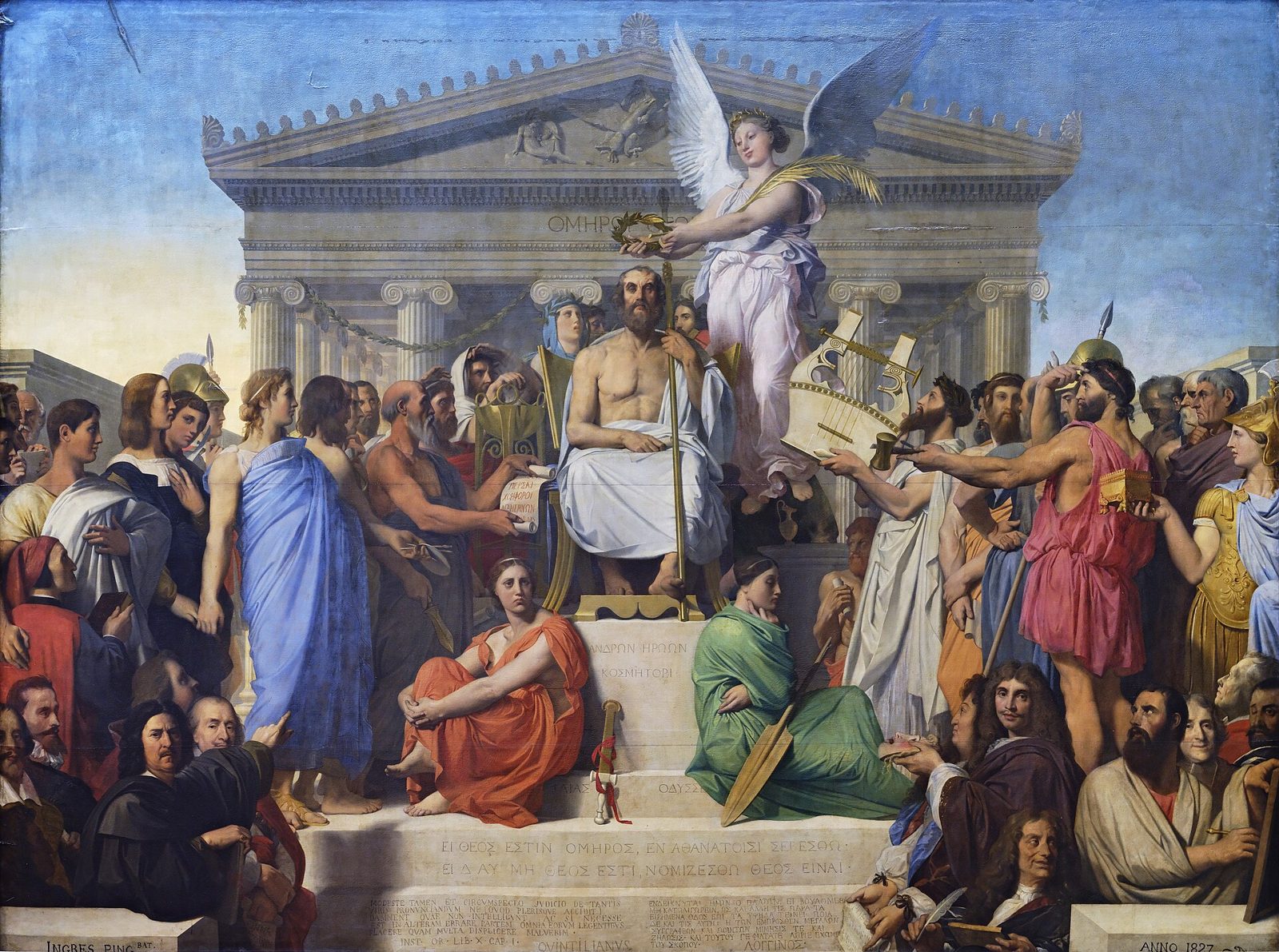
🎧 This work has audio narration — listen in the appTake a moment to really soak in the grandeur of "The Apotheosis of Homer" by Ingres. Look closely at the figure of Homer, seated at the center, crowned by a winged personification of Victory. Notice how his expression exudes both wisdom and serenity, as if he’s aware of the monumental legacy he’s left behind.
Now, shift your gaze to the figures surrounding him. You’ll see a remarkable array of poets, philosophers, and artists from both ancient and modern times, all paying homage to this legendary figure. This isn’t just a gathering; it’s a celebration of the influence of literature and art throughout history. Each character is meticulously placed, creating a sense of harmony and reverence that echoes the classical ideals Ingres admired.
Ingres crafted this work not only to honor Homer but also to assert the timeless value of classical art in the face of a rising Romantic movement. By depicting such a diverse assembly of intellectual giants, he’s making a bold statement about the interconnectedness of cultural heritage. It’s a visual manifesto of his belief in the supremacy of classical tradition.
Commissioned in 1827 for the Louvre, this painting was part of a larger renovation project aimed at celebrating the Bourbon legacy. Ingres poured his heart into this work, producing over a hundred sketches to perfect his vision.
As you stand here, consider this: What does it mean to you to witness such a powerful tribute to creativity and intellect? How does it inspire your own understanding of art and its place in our lives?
Jean-Auguste-Dominique Ingres was a pivotal figure in French Neoclassicism, born on August 29, 1780, in Montauban. He was the son of a versatile artist, which nurtured his early artistic inclinations. Ingres studied under Jacques-Louis David in Paris, where he developed a commitment to academic traditions, aspiring to elevate history painting above all genres. His early career was marked by struggles, as critics dismissed his style as archaic, yet he persevered, achieving recognition with works like "The Vow of Louis XIII" in 1824.
His portraits, characterized by expressive distortions, became his most celebrated contributions, influencing modern artists such as Matisse and Picasso. Ingres's time in Italy, from 1806 to 1824, was crucial; he immersed himself in the study of Renaissance masters, which shaped his distinctive style. Despite facing criticism for his meticulous approach, he remained steadfast in his vision of beauty, emphasizing drawing over color.
Later in life, he returned to Paris, where he continued to create significant works, including "The Turkish Bath." Ingres's legacy endures as a bridge between classical traditions and modern art, embodying the tension between adherence to established norms and the evolving landscape of artistic expression. He passed away on January 14, 1867, leaving behind a profound impact on the art world.
In 1827, Jean-Auguste-Dominique Ingres received a state commission to create 'The Apotheosis of Homer' for the ceiling of the musée Charles X, now known as the Egyptian galleries at the Louvre. This ambitious project was part of a larger renovation effort aimed at celebrating the Bourbon legacy. Ingres was given a tight deadline of one year to complete the work, and he quickly sketched the broad outlines of his composition in just an hour. His dedication is evident in the over 100 sketches he produced, meticulously refining every detail. The painting debuted to mixed reviews at the Paris Salon, where it was described as a grand tribute to Homer, receiving homage from the great minds of Greece, Rome, and modernity. However, it faced criticism for its perceived coldness, especially when juxtaposed with the emotive works of Romantic artists like Delacroix. Ingres's painting was later removed from its original site in 1855, replaced by a copy, but its legacy continued to resonate in his later works, as he revisited the theme multiple times throughout his career.
As you gaze at 'The Apotheosis of Homer,' notice the symmetry that Ingres employs to create a sense of order and harmony. The central figure of Homer is not just a focal point; he is elevated, both literally and figuratively, crowned by a winged personification of Victory. Ingres's brushwork is precise, with a clarity that gives the colors a fresh, almost luminous quality, reminiscent of frescoes. The careful arrangement of figures around Homer creates a layered composition, inviting your eye to travel from the ancient philosophers to the modern poets. Each character is rendered with meticulous detail, showcasing Ingres's mastery of the human form and his deep respect for classical ideals. The use of light enhances the three-dimensionality of the figures, while the vibrant palette contrasts with the somber themes of mortality and legacy, reinforcing the painting's celebratory tone. This careful balance of elements makes the work not only a tribute to Homer but also a testament to Ingres's belief in the enduring power of classical art.
One fascinating tidbit about 'The Apotheosis of Homer' is that Ingres was so dedicated to perfecting his vision that he even copied the portrait of Nicolas Poussin directly from the artist's own self-portrait, which is housed in the Louvre. This level of research and attention to detail highlights Ingres's commitment to authenticity and reverence for his artistic predecessors.
Ingres meticulously researched the figures he included, even copying the portrait of Nicolas Poussin directly from Poussin's own self-portrait in the Louvre, demonstrating his commitment to authenticity and reverence for his artistic predecessors.
He produced over a hundred sketches to refine his vision for 'The Apotheosis of Homer,' showcasing his intense dedication to detail and composition, which he believed were essential for a successful history painting.
Upon its debut at the Paris Salon, the painting received mixed reviews; while it was praised as a grand tribute to Homer, it was also criticized for its perceived coldness, especially in contrast to the emotive works of Romantic artists like Delacroix.