Annunciation
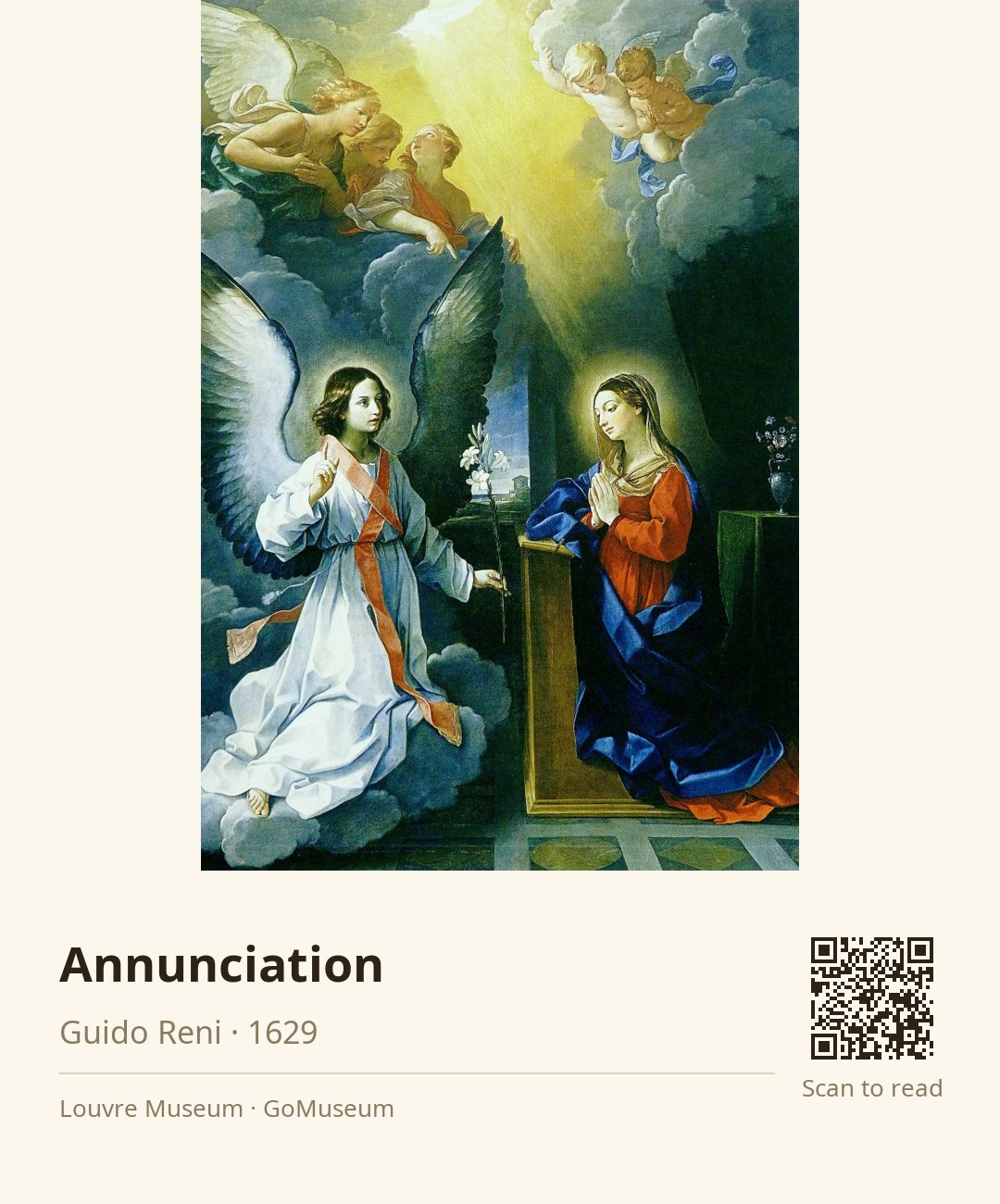
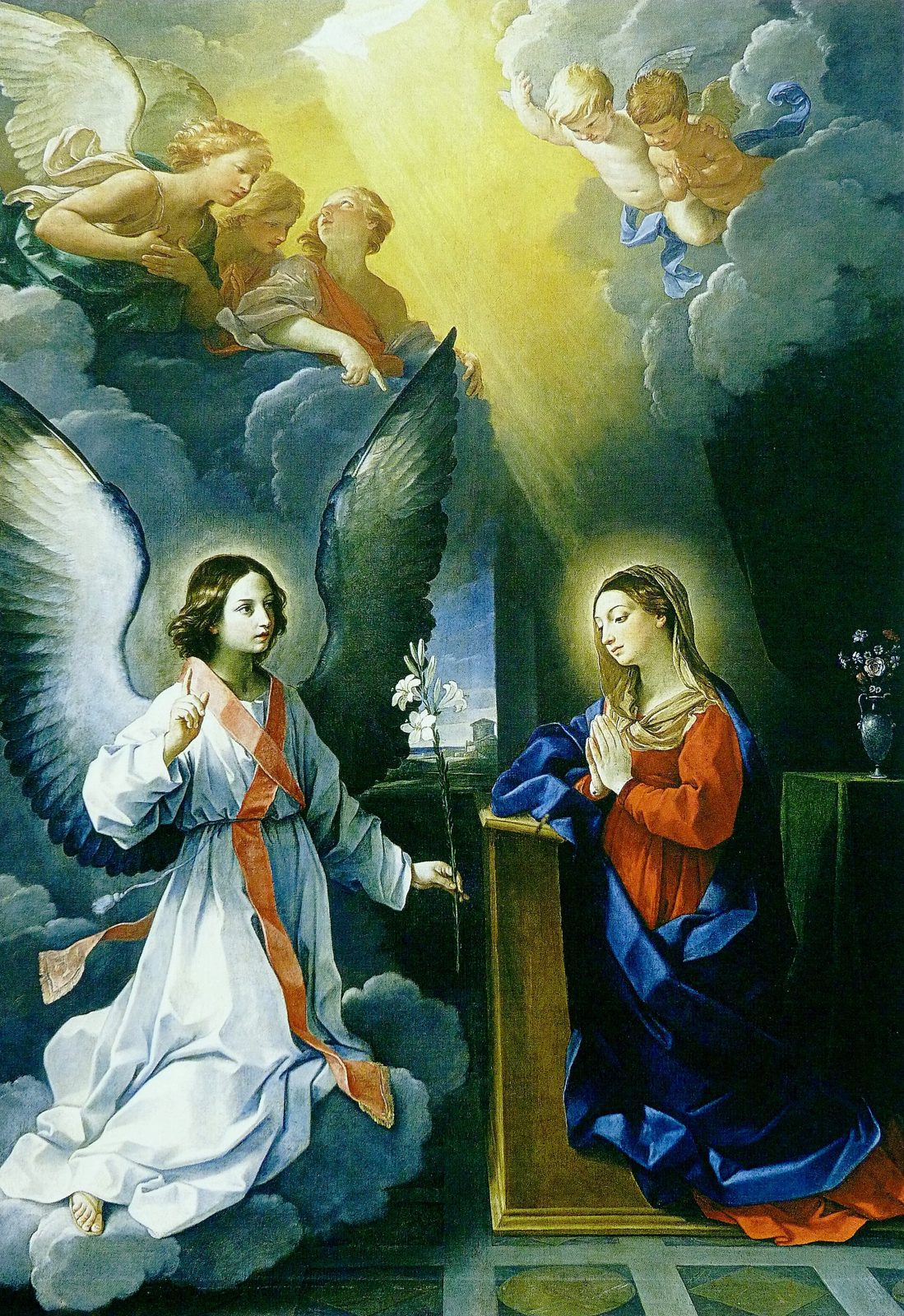
🎧 This work has audio narration — listen in the appTake a moment to really absorb the ethereal beauty of Guido Reni's "Annunciation." Notice how the angel, with his grand, sweeping wings, seems to float effortlessly, almost as if he’s caught in a moment of divine grace. Look closely at the soft, cool light that bathes the figures, creating an atmosphere that feels both intimate and otherworldly.
These details matter because they reflect Reni's mastery of light and composition, elevating a biblical moment into something transcendent. The angel's majestic presence and the serene expression on Mary’s face invite you into a sacred narrative, one that speaks to the heart of faith and revelation. This painting was commissioned by Marie de' Medici, a powerful patron of the arts, who sought to bring the divine into the everyday lives of the people of France.
Created in 1629, this work marks a pivotal moment in Reni's career, as it was his first major piece to reach France, influencing countless artists and becoming a cornerstone of French Baroque painting. As you stand here, think about the impact this painting has had over the centuries. What feelings does it evoke in you? How does it connect to your own understanding of the divine?
Guido Reni, born on November 4, 1575, in Bologna, was a prominent Italian Baroque painter known for his classical style that echoed the works of contemporaries like Simon Vouet and Nicolas Poussin. The only child of musicians, Reni began his artistic journey at the tender age of nine, apprenticing under Denis Calvaert. He later joined the Accademia degli Incamminati, where he flourished alongside fellow artists, forming the core of the Bolognese School.
Reni's career blossomed in Rome, where he became a favored artist of the Borghese family, creating masterpieces such as the fresco "L'Aurora" in the Casino dell'Aurora. His work often reflected a restrained classicism, contrasting with the more vibrant styles of his peers. Reni's notable commissions included the "Archangel Michael" for the Cappuccini church, which sparked legends about his artistic choices.
After returning to Bologna around 1614, he established a successful studio, producing significant works like "Saint Dominic in Glory." Reni's influence extended beyond his lifetime, impacting the Neoclassical style and inspiring future generations, including artists like Picasso. He passed away on August 18, 1642, leaving behind a legacy as a master of Baroque painting, celebrated for his grace and technical skill.
The 'Annunciation' was commissioned by Marie de' Medici, a formidable patron of the arts, who sought to enhance the spiritual life of France through art. This monumental work was painted in early 1629, marking a significant moment as it was Reni's first major piece to reach France. Initially, Marie attempted to lure Reni to Paris to decorate the Palais du Luxembourg, a commission originally intended for Rubens. The painting was displayed prominently on the high altar of the Carmelite convent in Paris, framed in lavish marble and gilded wood, before being relocated to the church's choir by 1684. It garnered admiration from contemporaries, including Bernini, who famously remarked that it was worth half of Paris. Over time, it influenced notable artists of the era, such as Laurent de La Hyre and Philippe de Champaigne, and became a pivotal piece in the development of French Baroque painting. After the French Revolution, the painting was seized and eventually became part of the Louvre's collection, where it remains today.
The cool, soft light envelops the figures, enhancing the sense of intimacy and divine presence. Notice how the brushwork feels almost restless, with delicate strokes that give life to the angel's majestic wings and the serene expression on Mary's face. The composition is carefully structured, balancing the monumental figure of the angel with the humble posture of Mary, creating a dynamic tension that elevates the scene. Reni's choice of a cooler palette imbues the painting with a sense of tranquility, while the grand scale—over three meters tall—commands attention, making it a striking focal point in any space. This technique not only showcases Reni's skill but also invites viewers to contemplate the sacred moment being depicted.
Commissioned by Marie de' Medici, this piece influenced a generation of artists, including leaders of the Atticism movement, who sought to blend classical ideals with contemporary themes. Reni's mastery of light and form inspired painters like Philippe de Champaigne and Eustache Le Sueur, pushing them towards a more refined, classicizing style. The painting's impact was so profound that even Bernini, a titan of Baroque art, praised it as 'one of the most beautiful things to be seen.' Remember this: Reni's work didn't just decorate a church; it reshaped the artistic landscape of France, establishing a legacy that resonated through the centuries.
Interestingly, Reni created an earlier, less elaborate version of the 'Annunciation' in 1621 for the church of San Pietro in Valle in Fano, Italy. The existence of multiple copies of the 'Annunciation' also highlights its popularity and the desire of other artists to replicate Reni's success, further embedding this work into the fabric of art history.