 Image: Sailko
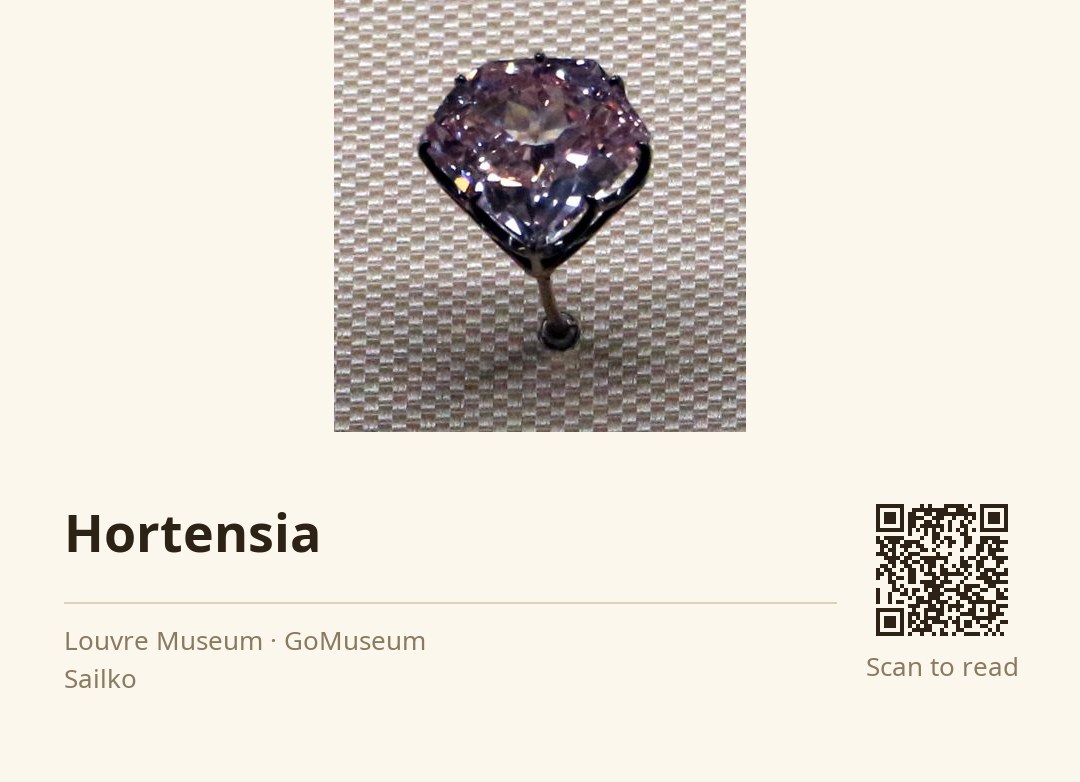
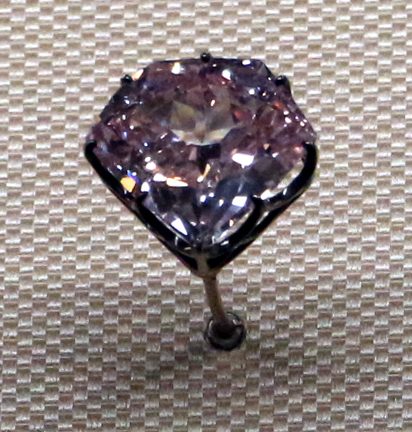
Take a moment to really look at the Hortensia diamond before you. Notice how its pale orange-pink hue catches the light, almost glowing from within. And if you look closely, you might spot that fine crack, or "feather," running from the tip to the girdle—it's a reminder that even the most precious things have their imperfections.
This diamond isn't just a pretty stone; it’s a piece of history. Mined in India and once part of the French Crown Jewels, the Hortensia has seen the rise and fall of empires. It was once worn by King Louis XIV, who had a flair for the extravagant, and later, it was linked to Napoleon, a man who loved to surround himself with symbols of power and prestige. The fact that it was stolen not once, but twice, speaks to its allure and the chaos of its times.
Interestingly, it’s named after Hortense de Beauharnais, a woman who never actually owned it. This curious twist adds a layer of intrigue—why her? Perhaps it’s a nod to the connections between power, beauty, and legacy.
As you stand here, think about the stories this diamond could tell if it could speak. What do you think it has witnessed throughout its journey?
The Hortensia diamond has a rich and tumultuous history that reflects the upheaval of its time. Purchased by King Louis XIV in 1643, it was a prized possession until his death in 1715. The diamond was stolen during the chaos of the French Revolution in 1792 from the Garde-Meuble de la Couronne, where royal treasures were kept. The diamond faced another theft in 1830 from the Ministry of the Navy but was swiftly recovered. Its name, given in the early 1800s, is linked to Hortense de Beauharnais, who never owned it, adding a layer of mystery. The diamond later adorned the epaulette of Napoleon and was set into a headband for Empress Eugénie in 1856. Today, it resides in the Louvre, a testament to its storied past.
Purchased by Louis XIV, it became a symbol of his reign, worn proudly on his epaulette. The diamond's tumultuous story—stolen during the French Revolution, recovered, and then again pilfered—mirrors the upheaval of its time. Its name, linked to Hortense de Beauharnais, though she never wore it, adds a layer of intrigue, hinting at the intertwining of personal and political legacies. Today, as part of the Louvre's collection, the Hortensia continues to captivate, influencing how we perceive royal artifacts and their stories in art history.
One intriguing fact about the Hortensia diamond is that a full-sized replica was created in 2026 by gem cutter Scott Sucher, using a lab-grown diamond. This modern interpretation allows us to appreciate the diamond's beauty in a new light, bridging the gap between historical significance and contemporary craftsmanship.