 Image: Shonagon · Gary Todd from Xinzheng, China · Vania Teofilo · Vania Teofilo · Chatsam
Dendera zodiac
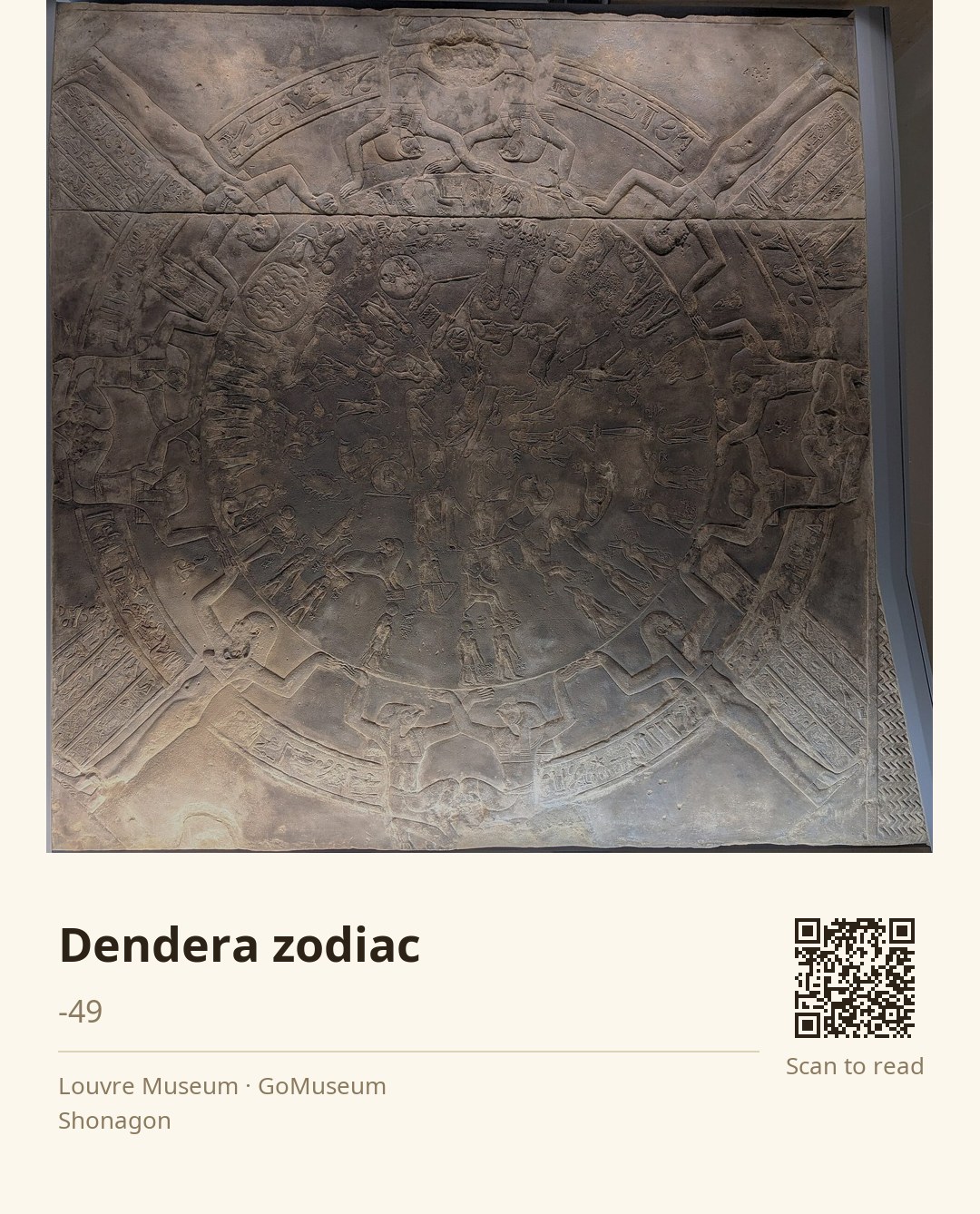
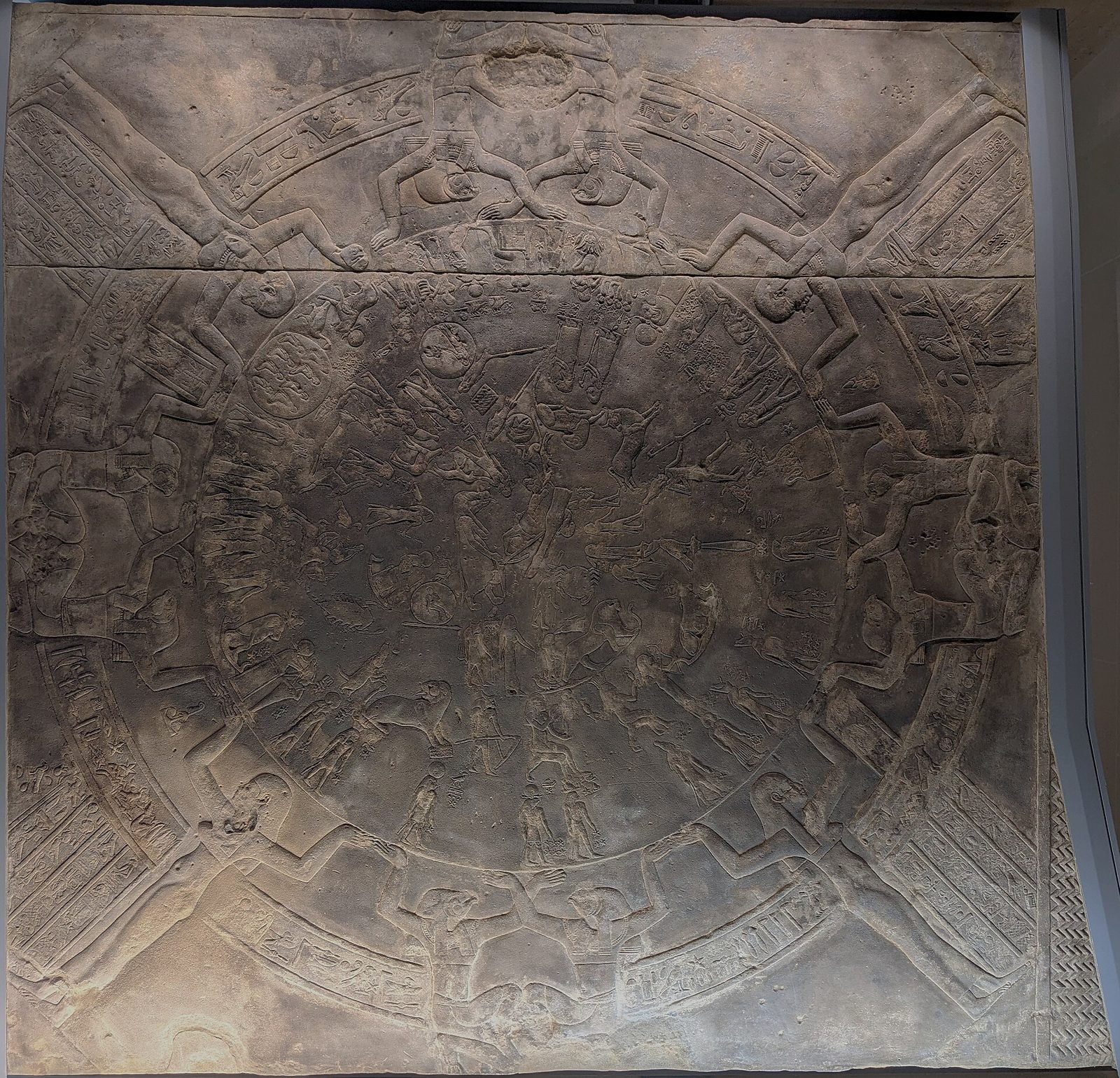
🎧 This work has audio narration — listen in the appLook closely at the Dendera zodiac, and let your eyes wander over the intricate details of this ancient masterpiece. Notice how the circular relief is not just a map of the stars, but a vibrant tapestry of Egyptian mythology and astronomy. The bull of Taurus and the scales of Libra leap out at you, but it’s the jackal representing Ursa Minor that truly captures the imagination, blending the familiar with the exotic.
Why does this matter? It reveals how ancient cultures intertwined their beliefs about the cosmos with their daily lives, tracking time and seasons through the stars. Each figure, from the flood god Hapi pouring water to the falcon-headed deities, serves a purpose in this celestial narrative.
Created around 49 BC, during the late Ptolemaic period, this sculpture reflects a time when Egypt was a melting pot of cultures, influenced by both Greek and Egyptian traditions. It was originally part of a chapel dedicated to Osiris, a testament to the deep spiritual connections the Egyptians had with the cosmos.
As you stand here, think about the night sky above you. What stories do you see written among the stars? How might the ancient Egyptians have looked up and found their own narratives woven into the constellations?
Take a moment to appreciate the craftsmanship of the Dendera zodiac. Carved from a solid block of sandstone, this bas-relief showcases the skill of ancient artisans. Notice the intricate details of the figures, each one meticulously chiseled to bring the celestial scene to life. The circular form is unique in Egyptian art, a departure from the more common rectangular zodiacs. The artists used a technique that allowed them to create depth and texture, making the constellations appear to float against the night sky. Can you feel the energy in the brushwork? It’s almost as if the stars are alive, whispering their secrets to those who dare to look closely.
The Dendera zodiac, a remarkable Egyptian bas-relief, was sculpted around 50 BC, during the late Ptolemaic period. It originally adorned the ceiling of a chapel dedicated to Osiris in the Hathor temple at Dendera. The zodiac's journey began during Napoleon's campaign in Egypt, when it was discovered by General Desaix in 1798. A year later, Dominique Vivant Denon sketched the zodiac, igniting a debate about its age and purpose. In 1821, the zodiac was cut from its original location by Claude Lelorrain, commissioned by antique dealer Sébastien Louis Saulnier, and transported to France. It was eventually purchased by King Louis XVIII and displayed in the Royal Library before finding its home in the Louvre in 1922. The Dendera zodiac has sparked significant scholarly discussion, particularly regarding its dating and cultural influences, with Egyptologist Zahi Hawass recently advocating for its return to Egypt.
Did you know that the Dendera zodiac sparked a heated debate known as the 'Dendera Affair'? When it was first brought to Europe, scholars were divided over its age and purpose. Some believed it dated back to the New Kingdom, while others argued it was a Greco-Roman creation. This controversy highlighted the challenges of interpreting ancient artifacts and the complexities of cultural exchange. The zodiac's journey from Egypt to France is a story of intrigue, with its removal involving dramatic measures like saws and even gunpowder!
Scholars have conjectured that the Dendera zodiac served as a foundational reference for later astronomical systems, as it is characterized as 'the only complete map that we have of an ancient sky.' Its unique circular form and detailed representations may have inspired subsequent interpretations of the cosmos.
The removal of the Dendera zodiac involved dramatic measures, including the use of saws, jacks, scissors, and even gunpowder to extract it from the temple ceiling. This brutal extraction led to significant damage to the surrounding artwork, highlighting the contentious nature of its acquisition.