 Image: Gary Todd from Xinzheng, China
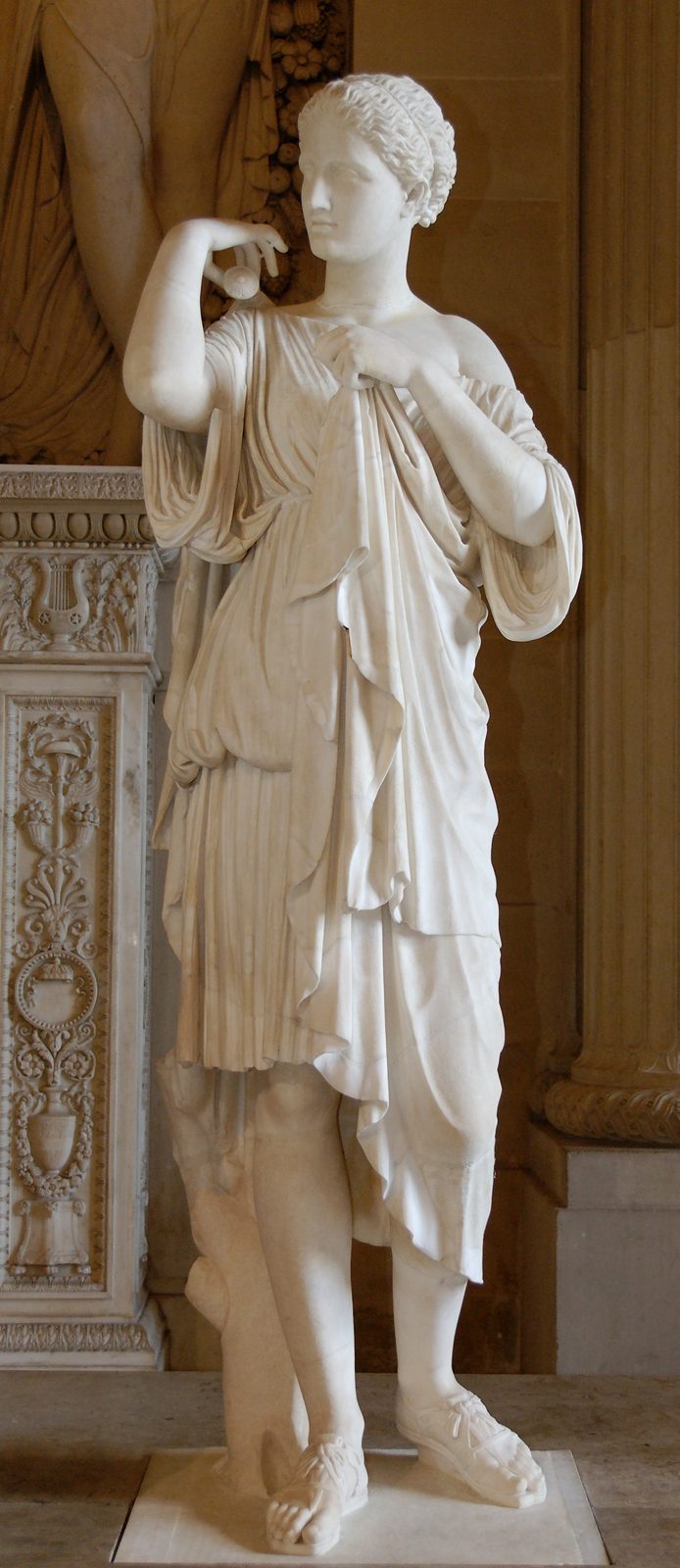
Diana of Gabii
🎧 This work has audio narration — listen in the appTake a moment to really look at the "Diana of Gabii." Notice how the fabric of her drapery seems to flow and cling to her form, almost as if it’s alive. The way her left foot is slightly raised, toes turned outward, gives her an air of grace and movement, as if she’s about to step forward or turn.
The exposed shoulder and the way she’s pinning her cloak suggest a moment of vulnerability and strength, embodying the goddess Artemis in a way that resonates with viewers even today.
Praxiteles, known for his lifelike sculptures, revolutionized how we perceive divine figures, making them relatable and human.
As you stand here, think about what this statue represents: a moment frozen in time. What do you think she’s thinking about as she gazes into the distance?
Praxiteles, an influential Athenian sculptor of the 4th century BC, is celebrated for his pioneering representation of the nude female form in life-sized sculptures. Born around 395 BC, he was the son of Cephisodotus the Elder and likely active until before Alexander the Great's reign. His works, although no originals survive, are known through numerous Roman copies and descriptions by ancient authors like Pliny the Elder. Praxiteles' style marked a shift towards a more graceful and naturalistic approach, exemplified in pieces such as "Hermes and the Infant Dionysus" and "Apollo Sauroktonos." His relationship with the courtesan Phryne, who inspired his famous "Aphrodite of Cnidus," has fueled artistic interpretations across centuries. Praxiteles' legacy lies in his ability to blend ideal beauty with human emotion, securing his place among the greats of classical sculpture and influencing generations of artists.
As you gaze at the 'Diana of Gabii,' let’s delve into the craftsmanship that makes this sculpture so captivating. Notice the way the fabric of her chiton hangs, expertly carved to mimic the delicate drapery of real cloth. The sculptor has skillfully created a sense of movement; the folds seem to cascade and cling to her form, almost as if they are alive. The intricate detailing around the fibula in her right hand showcases the artist's precision, allowing you to appreciate the texture and weight of the garment.
The 'Diana of Gabii' sculpture, attributed to the renowned artist Praxiteles, has a fascinating history that begins in 1792 when it was unearthed by Gavin Hamilton on the estate of Prince Borghese in Gabii, near Rome. Almost immediately, it became part of the prince's collection. However, in 1807, financial troubles forced the prince to sell this exquisite piece to none other than Napoleon. By 1820, it found its home in the Louvre, where it has captivated visitors ever since. The statue gained immense popularity in the 19th century, inspiring plaster casts displayed in places like the Athenaeum Club in London and even a cast iron replica adorning a fountain in Grancey-le-Château-Neuvelle. Its allure extended beyond the elite, as smaller terracotta and porcelain replicas were produced for art enthusiasts, making this masterpiece a beloved icon of classical sculpture.
Did you know that the 'Diana of Gabii' was so popular that it inspired a variety of replicas? One of the most interesting is a cast iron replica that adorned a fountain in the village of Grancey-le-Château-Neuvelle in Côte-d'Or, France. This speaks to the statue's widespread appeal and the lengths to which admirers would go to celebrate its beauty, turning a singular masterpiece into a shared cultural icon.
The 'Diana of Gabii' was discovered in 1792 on the property of the Prince Borghese at Gabii, near Rome, which highlights its connection to the aristocratic collection practices of the time, as it was quickly integrated into the prince's collection before being sold to Napoleon.
While the flowing drapery is often highlighted, the intricate detailing around the fibula in her right hand is a testament to the artist's precision, demonstrating a level of craftsmanship that allows viewers to appreciate the texture and weight of the garment.