The Sleep of the Child Jesus
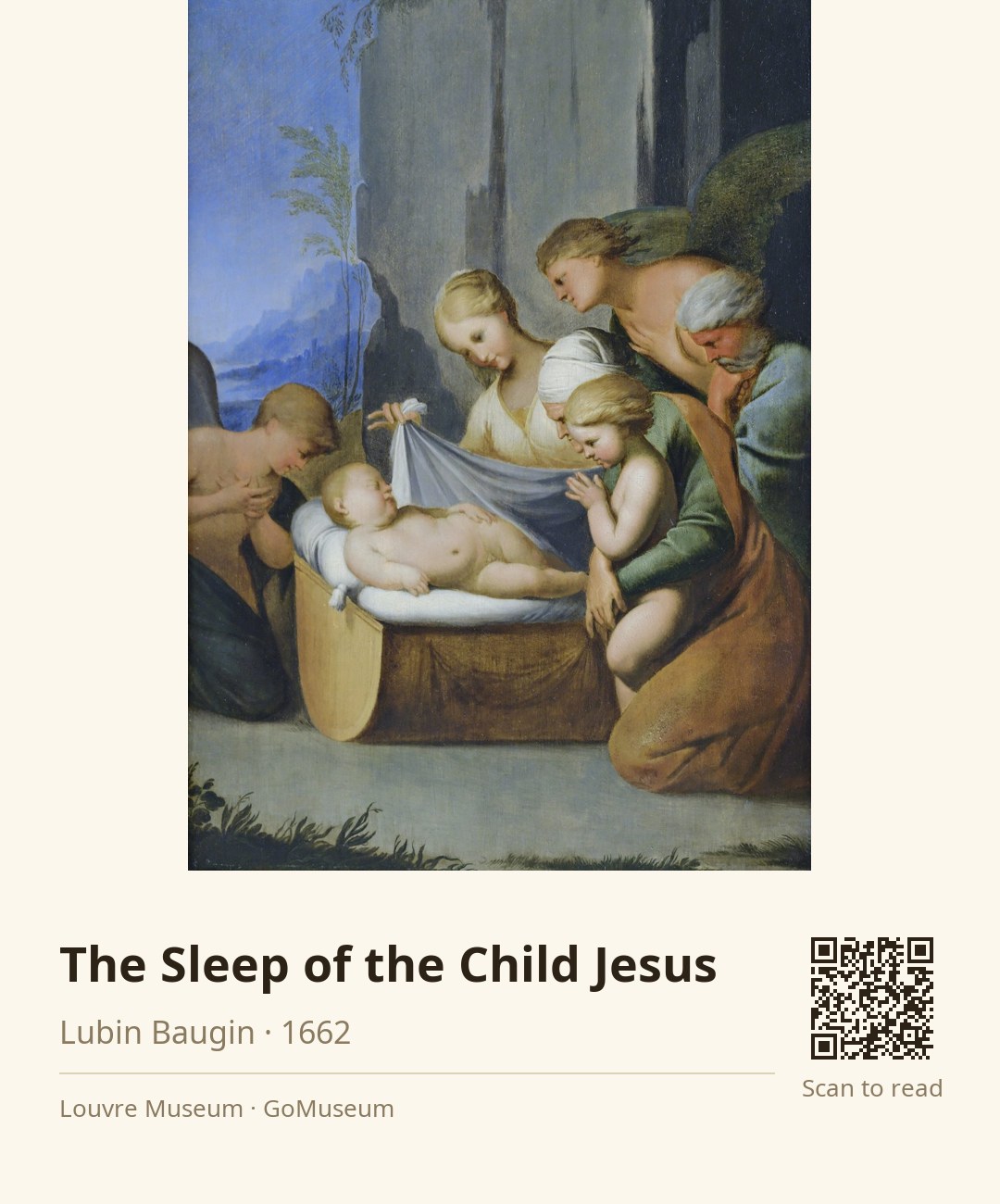
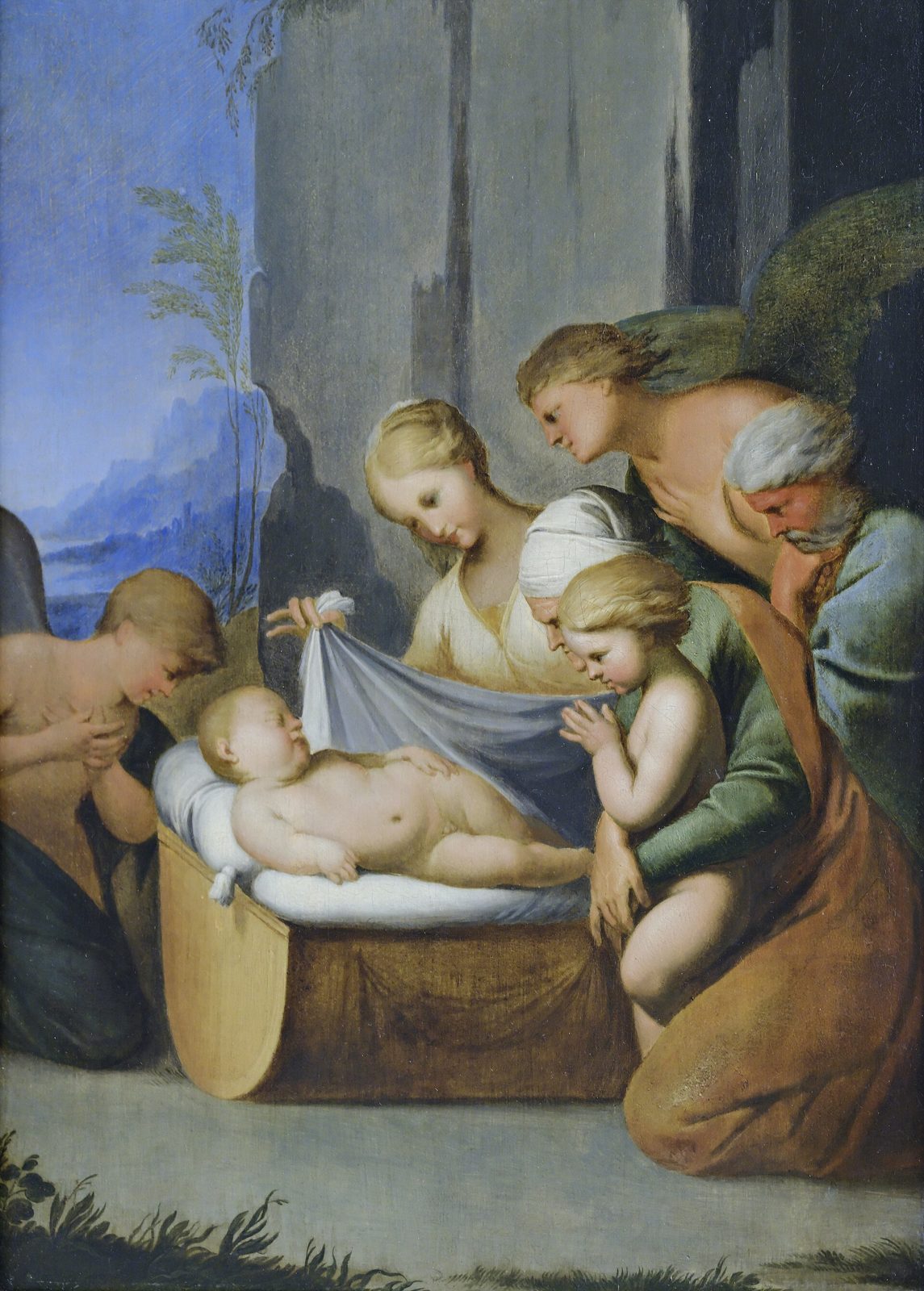
🎧 This work has audio narration — listen in the appThe baby Jesus, nestled in a wooden cradle, captures the heart of this serene scene painted by Lubin Baugin in 1662. Draped in a soft blue cloth, the infant rests on a white pillow, while a woman with flowing blonde hair gently holds the fabric, creating a tender moment of intimacy. Surrounding the cradle, a kneeling child with clasped hands and an elderly woman gaze lovingly at the baby, while a bearded man stands nearby, embodying the reverence of the moment. An angelic figure leans over, wings outstretched, adding a celestial presence to this intimate gathering.
Baugin's choice of soft blues and earthy tones enhances the gentle expressions of the figures, inviting viewers into a world of quiet devotion. The rocky landscape in the background, with hints of blue sky and distant hills, suggests a natural setting that complements the sacredness of the scene. This painting exemplifies Baugin's ability to blend stylized grace with emotional depth, influenced by the works of Raphael and Parmigianino, which he encountered during his time in Italy.
Known primarily for his religious works, Baugin's paintings often depict the Virgin and Child or the Holy Family, showcasing a unique divergence from his still lifes. His artistic journey took him from a provincial upbringing to the heights of Parisian acclaim, where he became a master painter and a member of the Royal Academy of Painting and Sculpture. Lubin Baugin passed away in 1663, leaving behind a legacy that reflects both his technical skill and his deep engagement with spiritual themes.
Lubin Baugin was a French painter born around 1612 in a prosperous family in Pithiviers. He trained as an artist from 1622 to 1628 and became a master painter in 1629. His early works, particularly still lifes, showcase a meticulous approach and innovative perspectives, earning him recognition as one of the most innovative still life painters of his time. Baugin traveled to Italy in the early 1630s, where he was influenced by the works of Raphael and Parmigianino, which later shaped his religious and mythological paintings upon returning to Paris around 1641.
Despite his success, including membership in the Royal Academy of Painting and Sculpture, Baugin's style diverged significantly between his still lifes and his religious works, leading to confusion about his authorship. His still lifes are characterized by a rigorous construction, while his religious paintings exhibit a more decorative style. After his death in 1663, Baugin fell into obscurity, criticized for not adhering to the prevailing classical standards. However, his unique contributions to still life and the complexities of his artistic identity have since garnered renewed interest, positioning him as a notable figure in 17th-century French art.
In 'Le sommeil de l'enfant Jésus,' Baugin employs oil on wood to create a vivid tableau that captures a moment of serene intimacy. The delicate brushwork is particularly striking, with soft strokes that lend a gentle quality to the figures' expressions. The palette, dominated by soft blues and earthy tones, enhances the emotional depth of the scene, inviting viewers into a world of quiet devotion. Baugin’s technique showcases a mastery of layering; he often used glazes to achieve a luminous effect, allowing light to play across the surfaces of the figures and the cradle. The composition is thoughtfully arranged, with the figures surrounding the baby Jesus, creating a sense of unity and reverence. This careful orchestration of elements not only draws the eye but also evokes a feeling of warmth and tenderness, making the viewer feel as if they are part of this sacred moment.
One intriguing aspect of Lubin Baugin's career is the paradox of his artistic output: while he is celebrated today for his religious works, he initially gained recognition for his still lifes. In fact, the four still lifes attributed to him were completed before he turned twenty, showcasing a remarkable talent at such a young age. This early success in a different genre adds a layer of complexity to his artistic identity, as he navigated the transition from the decorative precision of still lifes to the emotive depth of religious scenes.
Baugin initially gained fame for his still lifes before he became known for his religious paintings, showcasing a remarkable talent in a different genre at a young age.