 Image: Marie-Lan Nguyen
The fall of Icarus
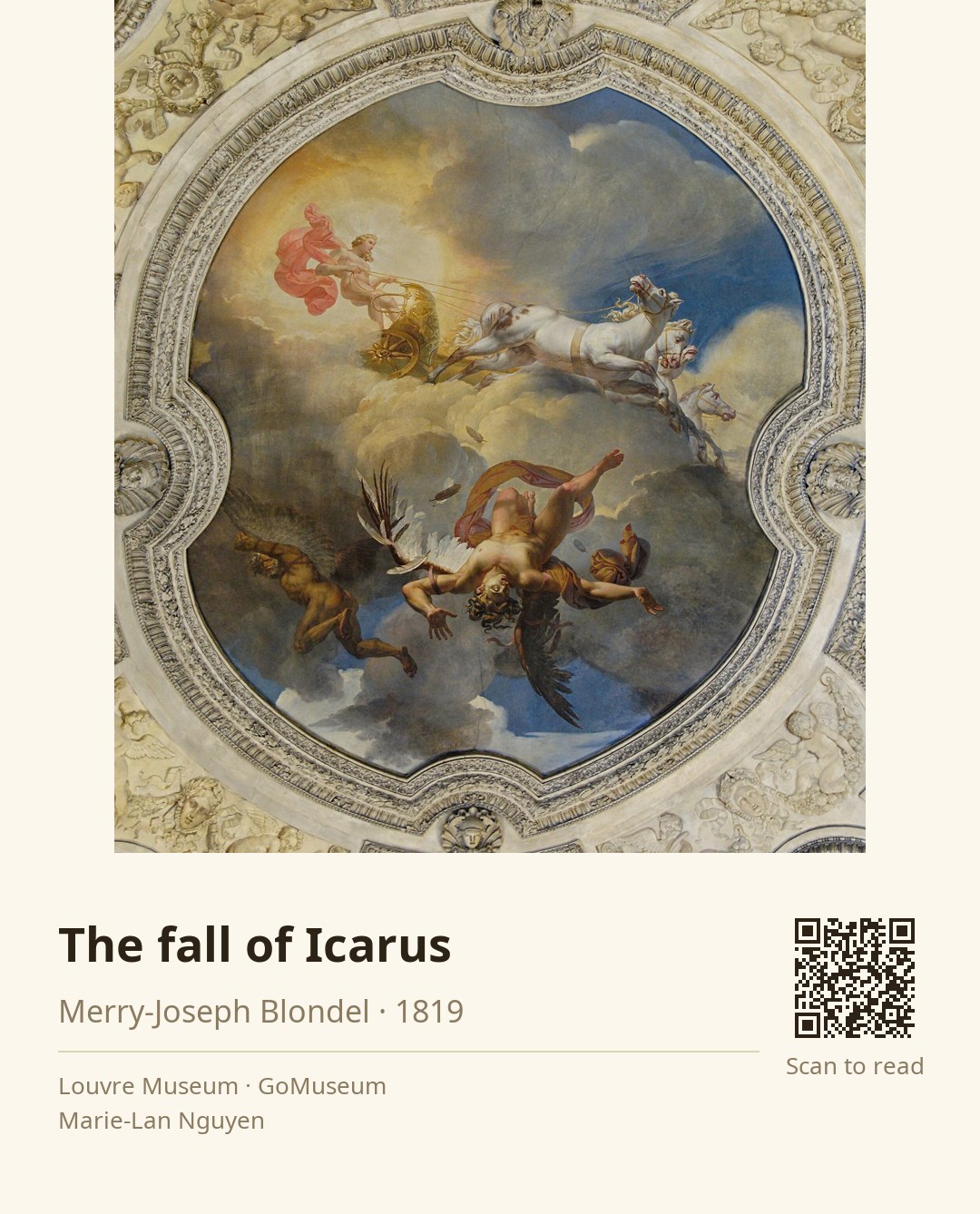
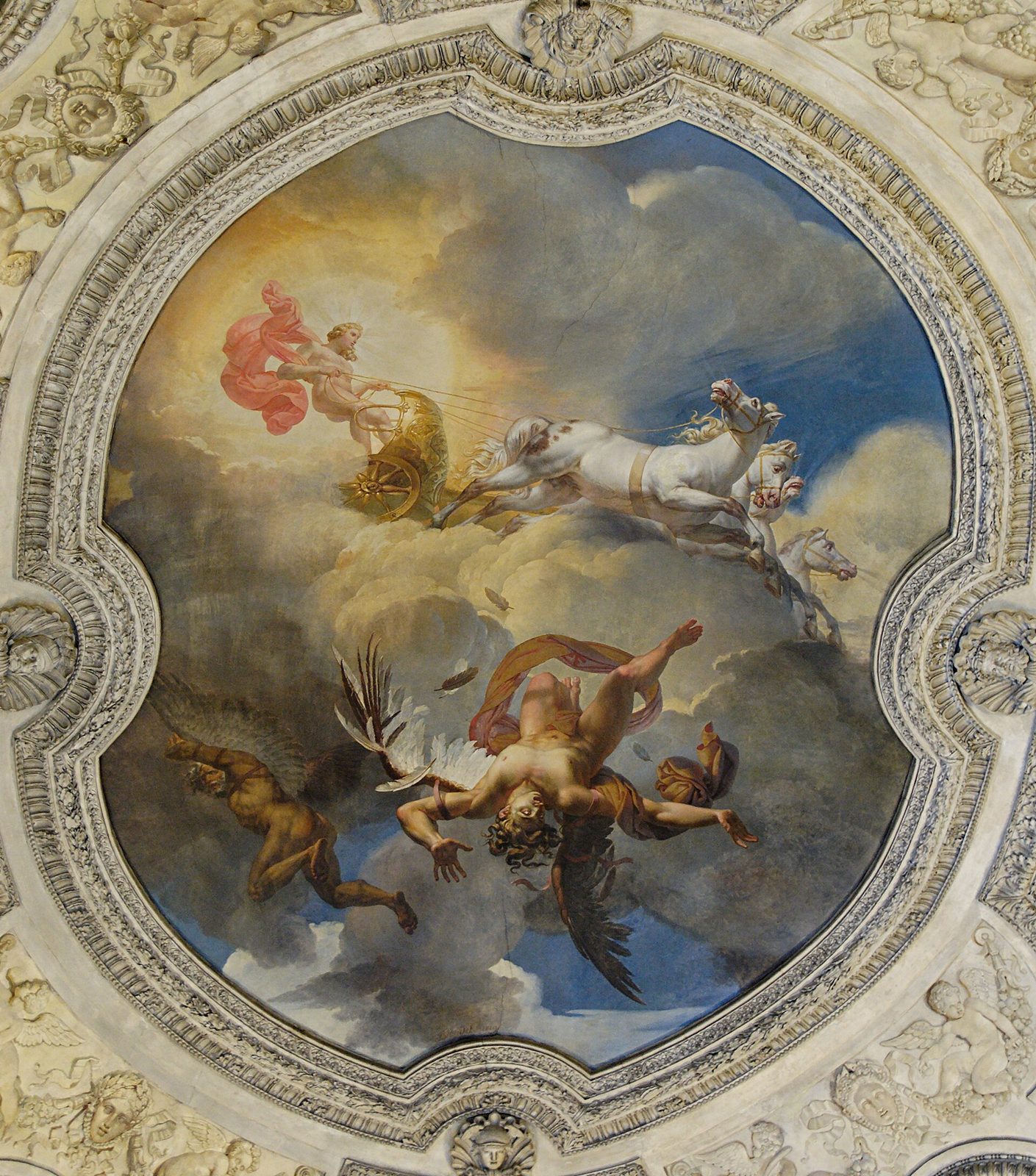
🎧 This work has audio narration — listen in the appThe figure of Icarus plummets through the swirling clouds, arms outstretched, with feathers cascading around him. Below, a darker winged figure mirrors his descent, while above, a radiant chariot, pulled by four white horses, emerges from a bright expanse, driven by a figure in vibrant red drapery. This striking contrast between the luminous upper section and the shadowy lower area heightens the drama of Icarus's fall, emphasizing the tragic consequences of hubris.
Blondel's choice to depict this mythological scene captures not just the moment of Icarus's demise but also the broader themes of ambition and the limits of human endeavor. The ornate frame surrounding the painting, adorned with intricate carvings, further enhances the sense of grandeur, inviting viewers to reflect on the weight of the narrative within a richly detailed context. The dynamic composition draws the eye, creating an almost theatrical atmosphere that underscores the emotional intensity of the moment.
Created in 1819, "The Fall of Icarus" was first exhibited at the Salon des artistes français in Paris, where it contributed to Blondel's reputation as a prominent Neoclassical painter.
Merry-Joseph Blondel was a prominent French Neoclassical painter, born on July 25, 1781, in Paris. He was the son of a painter and grew up in an artistic environment. His early career began with an apprenticeship in a porcelain factory, but he soon transitioned to studying under the esteemed Jean-Baptiste Regnault. His talent quickly earned him the nickname "Monsieur Cinq-Prix" for his numerous awards, culminating in the prestigious Prix de Rome in 1803.
Blondel spent three formative years at the Villa Medici in Rome, where he developed a lifelong friendship with Jean-Auguste Ingres. Upon returning to Paris, he became a celebrated history painter, completing significant public commissions for notable buildings, including the Louvre and Versailles. His works often depicted historical themes, showcasing his mastery of the Neoclassical style.
In 1824, he was appointed a professor at the École nationale supérieure des Beaux-Arts and later became a member of the Académie des Beaux-Arts. Despite his accolades, including the Legion of Honor, Blondel's work remained closely tied to the conventions of his time. He passed away on June 12, 1853, leaving behind a legacy as a skilled artist who contributed to the Neoclassical movement, yet never fully transcended its boundaries.
Merry-Joseph Blondel's 'The Fall of Icarus' was created in 1819 and first exhibited at the Salon des artistes français in Paris, a significant event for the artist that helped cement his reputation in the Neoclassical movement. The painting was well-received, showcasing Blondel's mastery of mythological themes and dramatic storytelling. It was later shown again at the same salon in 1833, further establishing its place in the public eye. Blondel, who had a rich background in public commissions, painted this piece during a period when he was gaining recognition for his work in prestigious venues like the Louvre and the Palace of Versailles. The painting remains in the inventory of the Louvre, where it continues to be appreciated for its narrative depth and technical skill.
The brushwork is fluid, particularly in the depiction of the clouds, which seem to pulse with energy, enhancing the sense of movement. The contrast between the bright, almost ethereal upper section, where the chariot of Apollo glows, and the darker, more tumultuous lower area, where Icarus falls, is striking. This choice not only heightens the drama but also emphasizes the tragic consequences of ambition. The scale of the figures is carefully considered; Icarus appears larger than the surrounding elements, drawing the viewer's eye to his desperate plight. Blondel's composition, with its diagonal lines and layered elements, creates a theatrical atmosphere that immerses the viewer in the narrative.
One surprising anecdote about Merry-Joseph Blondel is that his painting 'La Circassienne au Bain' became infamous in the early 20th century due to a bizarre incident involving the RMS Titanic. The painting was the subject of the largest claim for financial compensation made against the White Star Line for a single item of luggage lost by a passenger during the disaster.
Blondel studied under the Neoclassical master Baron Jean-Baptiste Regnault and developed a lifelong friendship with the painter Ingres.