Portrait of an Unknown Man
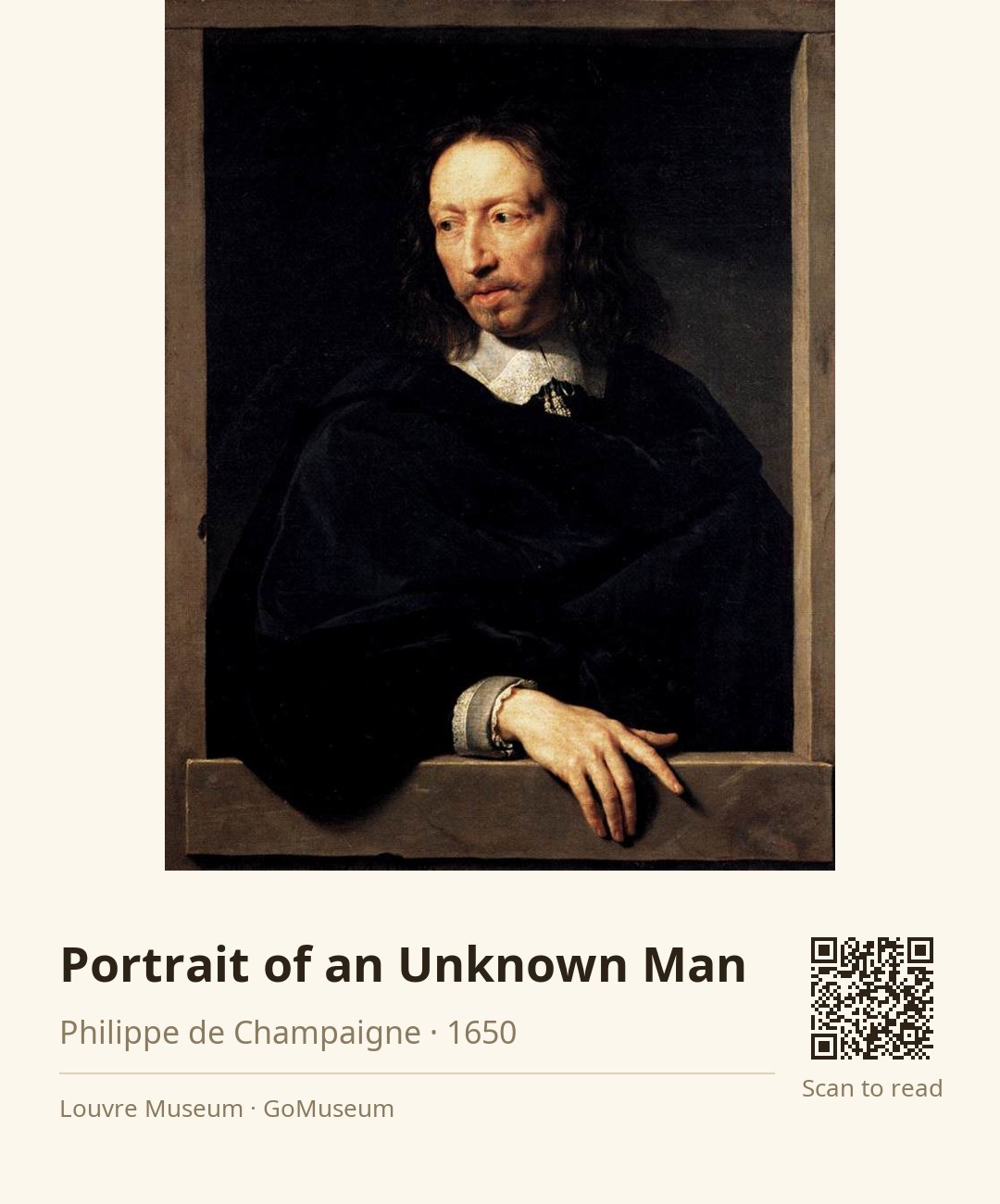
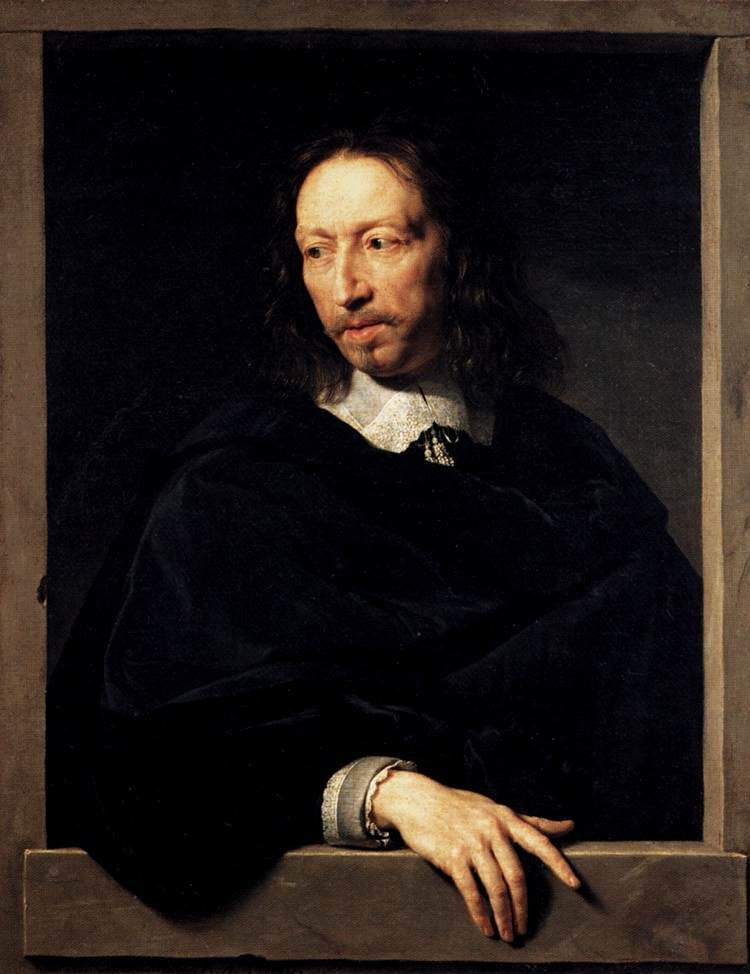
🎧 This work has audio narration — listen in the appThe man in this painting, with his long, dark hair and contemplative gaze, invites you into a moment of introspection. Clad in a dark cloak adorned with a white collar and a decorative brooch, he rests his right hand on a ledge, fingers slightly curled, while his left hand remains hidden. The stark contrast between his illuminated face and the dark background enhances the depth of his expression, creating an intimate connection with the viewer.
Champaigne’s meticulous brushwork captures not just the physical likeness but also the psychological essence of this unknown figure, suggesting a narrative that transcends the canvas. The trompe-l'œil stone window framing the portrait adds a three-dimensional quality, drawing you further into this enigmatic scene. The palette, dominated by deep blacks and browns, highlights the artist's skill in creating a sense of depth and realism, making the viewer feel as if they are peering into a private moment.
Philippe de Champaigne, a prominent figure in French Baroque painting, created this work in 1650, a time when he was establishing himself as a leading portraitist at the French court. His ability to convey the inner life of his subjects through their expressions set him apart, making his portraits not merely likenesses but profound explorations of identity.
Philippe de Champaigne was a prominent French Baroque painter born on May 26, 1602, in Brussels. Coming from a humble background, he trained under notable artists before moving to Paris in 1621, where he became an independent master. Champaigne gained recognition as the Queen's Painter, creating significant works for the royal family and religious institutions. His style evolved from the vibrant influences of Rubens to a more austere approach, characterized by the psychological depth of his subjects.
A founding member of the Académie royale de peinture et de sculpture, he played a crucial role in shaping French art during the Ancien Régime. His notable works include portraits of the French court and religious scenes, such as "Ex-Voto," which reflects his personal life and Jansenist beliefs. Champaigne's legacy endures through his masterful compositions and the emotional resonance of his paintings, securing his place in art history as a key figure of the Baroque era. He passed away on August 12, 1674, leaving behind a rich artistic heritage.
The dark palette, dominated by blacks and browns, serves to highlight the illuminated face and hands, creating a striking contrast that draws the viewer's eye. The trompe-l'œil stone window framing the portrait adds a three-dimensional quality, making it feel as though the figure is stepping out of the canvas. The composition is carefully balanced; the subject's pose is relaxed yet dignified, with his right hand resting on a ledge, suggesting both contemplation and confidence. This thoughtful arrangement, combined with the subtle highlights on the face, enhances the emotional depth of the portrait, inviting viewers to ponder the man's thoughts and feelings.
An intriguing anecdote about Champaigne is that he was the only artist permitted to paint Cardinal Richelieu in his cardinal's robes, a privilege he enjoyed eleven times. This exclusivity not only highlights his standing in the court but also reflects the close relationship he had with influential figures of his time.
Champaigne was the only artist allowed to paint Cardinal Richelieu in his cardinal's robes, and he did so eleven times.
Champaigne's only son died young, leading him to bring his nephew Jean Baptiste to Paris to be his main pupil.