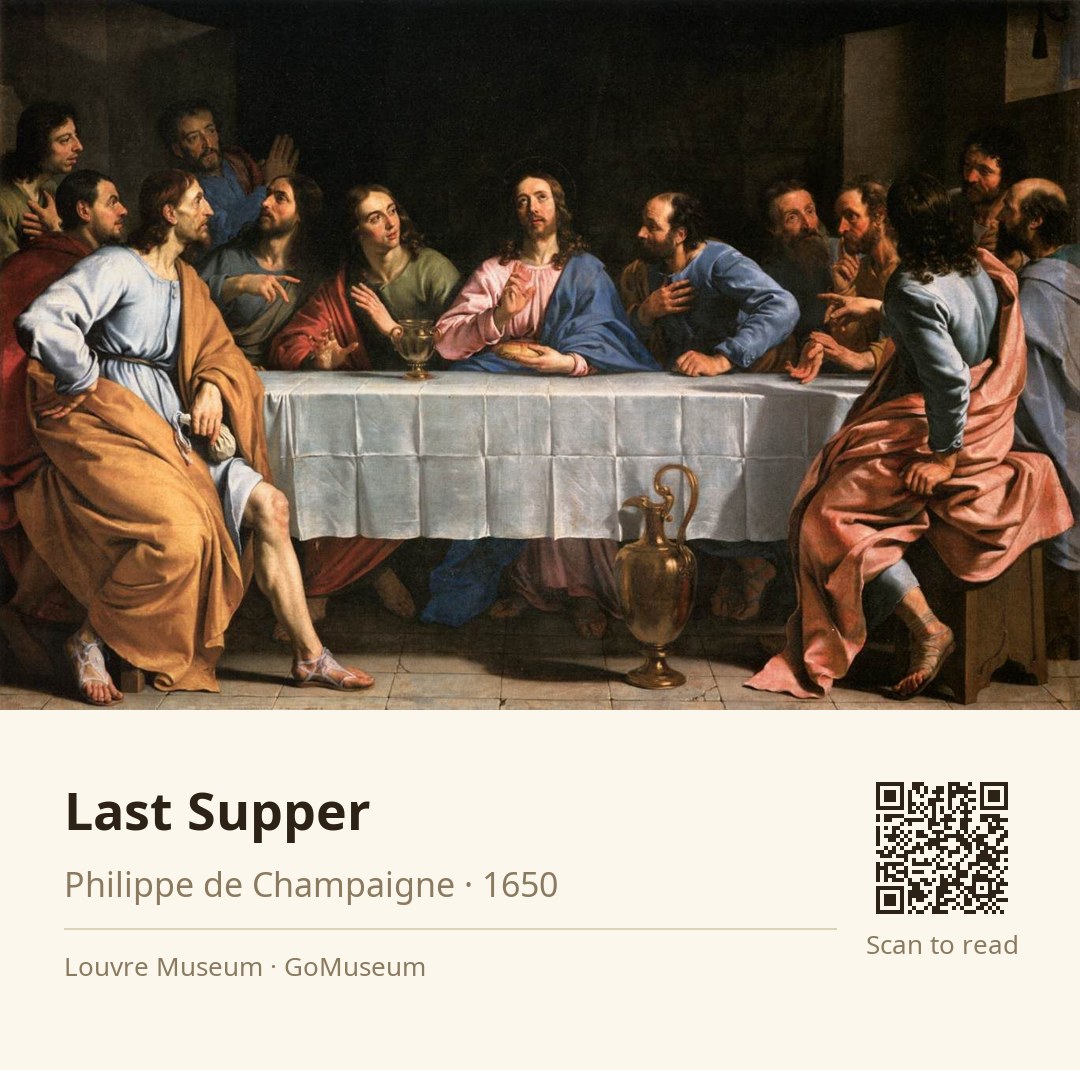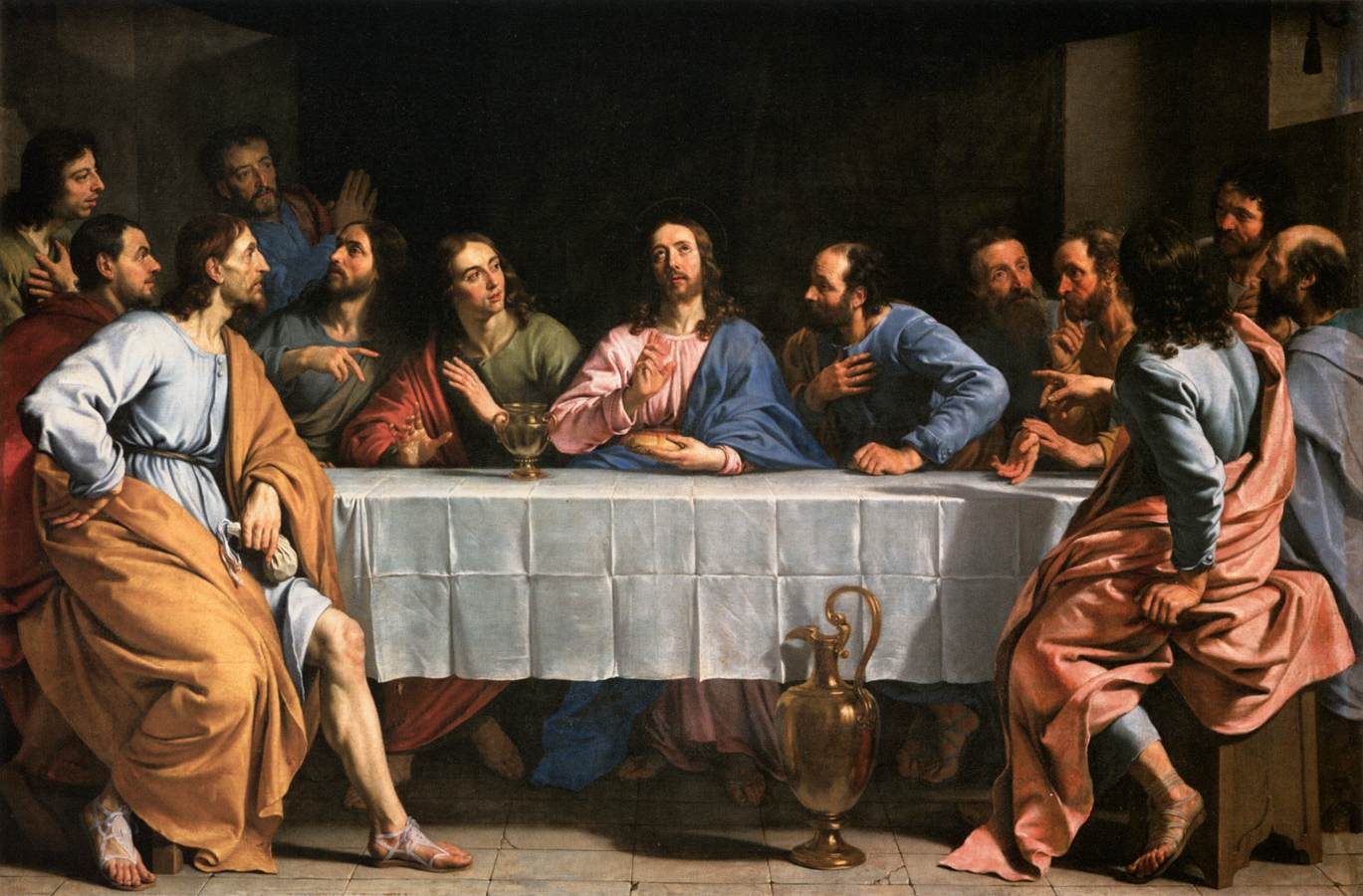
The central figure in Philippe de Champaigne's "Last Supper" holds a piece of bread in one hand and gestures with the other, drawing your attention to the moment of communion. Surrounding him, twelve men clad in richly colored robes engage in animated conversation, their expressions capturing a range of emotions from curiosity to solemnity. The ornate jug placed on the floor adds a touch of opulence, hinting at the significance of the meal being shared.
Champaigne's choice to depict this biblical scene with such vibrant colors and intricate details emphasizes the gravity of the moment. The dark background serves to isolate the figures, allowing their interactions to take center stage, while the white cloth on the table symbolizes purity and the sacredness of the event. This painting, created in 1650, reflects the artist's mastery of composition and his ability to convey psychological depth through facial expressions and gestures.
Born in Brussels in 1602, Champaigne became a prominent figure in the French Baroque movement, eventually serving as the Queen's Painter. His works often focused on religious themes, and he was known for his ability to capture the essence of his subjects. "Last Supper" stands as a testament to his skill and the influence of his early training, showcasing a pivotal moment in Christian narrative through a distinctly personal lens.
Philippe de Champaigne was a prominent French Baroque painter born on May 26, 1602, in Brussels. Coming from a humble background, he trained under notable artists before moving to Paris in 1621, where he became an independent master. Champaigne gained recognition as the Queen's Painter, creating significant works for the royal family and religious institutions. His style evolved from the vibrant influences of Rubens to a more austere approach, characterized by the psychological depth of his subjects.
A founding member of the Académie royale de peinture et de sculpture, he played a crucial role in shaping French art during the Ancien Régime. His notable works include portraits of the French court and religious scenes, such as "Ex-Voto," which reflects his personal life and Jansenist beliefs. Champaigne's legacy endures through his masterful compositions and the emotional resonance of his paintings, securing his place in art history as a key figure of the Baroque era. He passed away on August 12, 1674, leaving behind a rich artistic heritage.
Philippe de Champaigne's 'Last Supper' was completed in 1650, during a time when the artist was firmly established as a leading figure in the French Baroque movement. Commissioned by an unknown patron, this piece was likely intended for a religious setting, reflecting the era's deep devotion and the importance of biblical narratives in art. After its completion, the painting was displayed in various locations, contributing to Champaigne's growing reputation. The work was well-received, praised for its emotional depth and vibrant colors, which were hallmarks of Champaigne's style.
Champaigne's technique in 'Last Supper' showcases his mastery of oil painting, particularly in how he layers colors to achieve a rich, luminous effect. The brushwork is meticulous, with fine details that bring the figures to life, from the intricate folds of their robes to the subtle expressions on their faces. The dark background serves a dual purpose: it not only isolates the figures, enhancing their emotional interactions, but also creates a dramatic contrast that makes the vibrant colors of the robes pop. The composition is carefully balanced, with the central figure drawing the eye and the surrounding characters arranged to create a sense of depth and engagement. The scale of the painting, measuring 158 by 233 centimeters, allows for an immersive experience, inviting viewers to feel as if they are part of the scene. This thoughtful arrangement and use of color and light elevate the painting beyond mere representation, transforming it into a powerful narrative moment.
The Académie royale de peinture et de sculpture was the leading art institution in France, and as a founding member, Champaigne played a crucial role in shaping the standards and practices of French art during the Baroque period.