Susanna bathing.
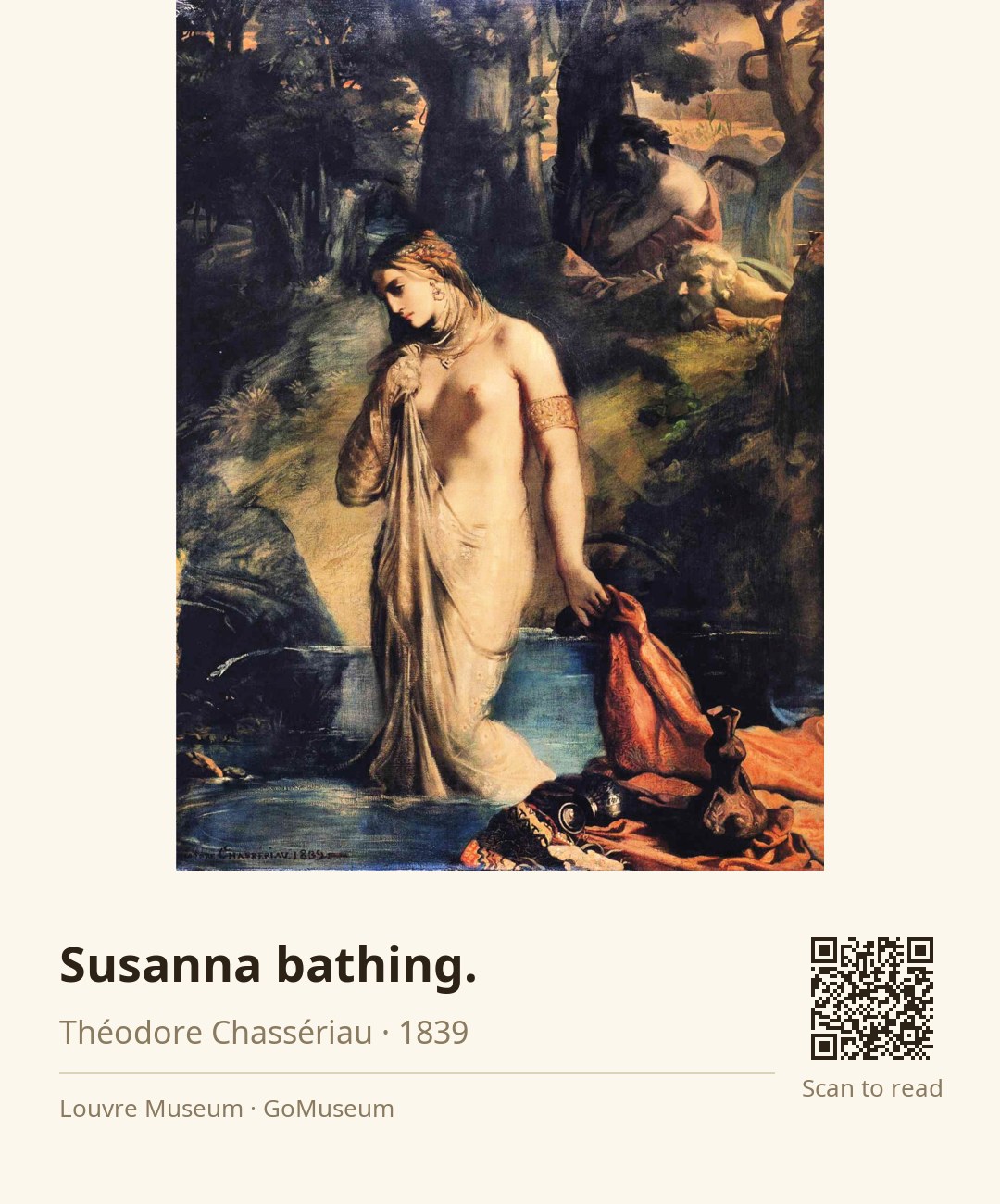
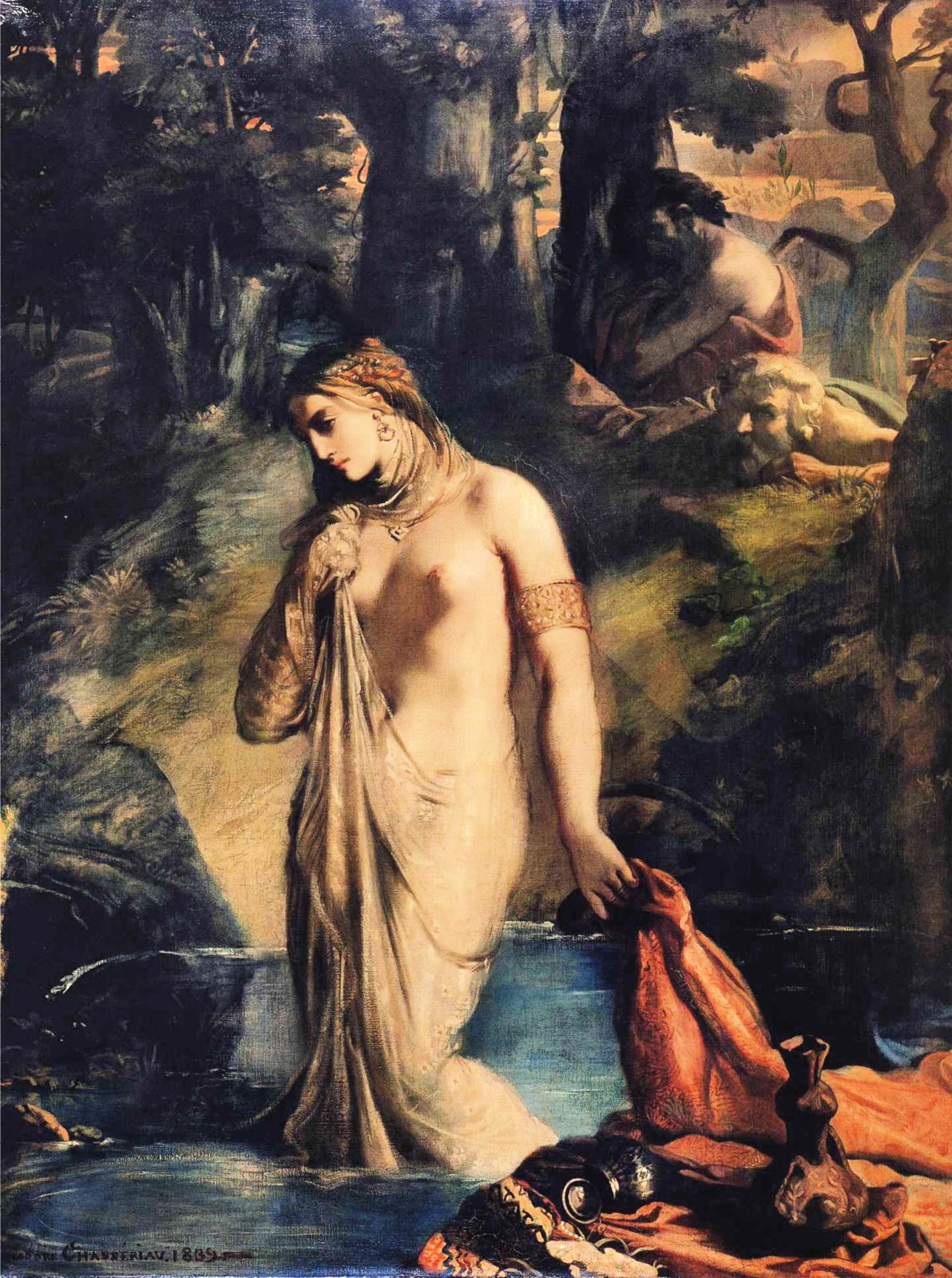
🎧 This work has audio narration — listen in the appThe woman in the painting stands gracefully in a shallow pool, her body partially veiled by a translucent fabric that hints at her form. A piece of vibrant red cloth is held delicately in her right hand, while her jewelry glimmers softly against her skin, drawing attention to her elegance. The lush greens and browns of the surrounding forest contrast beautifully with the warm hues of the textiles, creating a rich tapestry of color that envelops the scene.
Chassériau's choice to depict Susanna in this intimate moment not only highlights her vulnerability but also invites viewers to reflect on the themes of judgment and desire. The two figures observing her, one reclining and the other seated, add a layer of tension to the composition, embodying the biblical narrative of voyeurism and moral scrutiny. The meticulous brushwork captures the textures of her skin and the fabrics, showcasing Chassériau's skill in rendering the human form with both sensitivity and detail.
Created in 1839, this work was exhibited at the Salon des artistes français the same year, marking a significant moment in Chassériau's early career as he began to establish his unique voice within the Romantic movement. The painting remains a testament to his ability to blend classical influences with a burgeoning Romantic sensibility, setting the stage for his later explorations of the female nude.
Théodore Chassériau, born on September 20, 1819, in the Dominican Republic, was a prominent French Romantic painter known for his portraits, historical scenes, and Orientalist works. His early talent was nurtured under the guidance of Jean-Auguste-Dominique Ingres, who recognized his potential at a young age. Chassériau's style evolved from Neoclassicism to embrace the vibrant Romanticism of Eugène Delacroix, reflecting a unique blend of both influences.
Chassériau's artistic journey began in Paris, where he quickly gained recognition, exhibiting at the Salon and earning accolades for his innovative approach to the female form. His notable works include "Susanna and the Elders" and "The Toilette of Esther," showcasing his mastery of color and composition. He was also a skilled draftsman, producing a series of prints illustrating Shakespeare's "Othello."
His travels to Algeria inspired a series of dynamic works depicting Arab life, further establishing his reputation. Despite his success, Chassériau struggled with health issues and the pressures of his commissions, leading to his untimely death at 37 in 1856. He left behind a legacy that bridged classical and romantic styles, influencing future generations of artists. His contributions were celebrated by contemporaries like Théophile Gautier, who recognized him as a master in his own right, akin to Raphael.
Théodore Chassériau's 'Susanna bathing' was created in 1839 and marked a pivotal moment in his early career. Commissioned by the artist himself, it was first exhibited at the Salon des artistes français that same year, where it garnered attention for its blend of classical and Romantic styles. The painting's reception was mixed, as critics were still grappling with Chassériau's transition from the Neoclassical influences of his mentor, Ingres, to the more emotive and colorful approach of Delacroix. Over the years, the painting changed hands several times, with notable provenance including a sale in 1857 after Chassériau's death, and later anonymous collections in cities like New York and Saint Petersburg. It was also featured in the 1855 Exposition Universelle in Paris, further solidifying its place in the art world.
The artist employed meticulous brushwork to create a rich texture, particularly in the rendering of the woman's skin and the delicate fabrics that drape her form. The translucent quality of the fabric hints at her nudity while preserving an air of modesty, inviting viewers to engage with the tension of the scene. The color palette is striking, with warm hues in the textiles contrasting against the deep greens and browns of the forest backdrop. This choice not only enhances the vibrancy of the composition but also draws the eye to Susanna, making her the focal point amidst the lush surroundings. The arrangement of the two observing figures adds a layer of narrative complexity, as their placement creates a diagonal line that guides the viewer's gaze through the painting, emphasizing the themes of voyeurism and moral judgment.
Benoît Chassériau was a French adventurer and diplomat, which influenced Théodore's upbringing and exposure to diverse cultures.