Eliezer and Rebecca
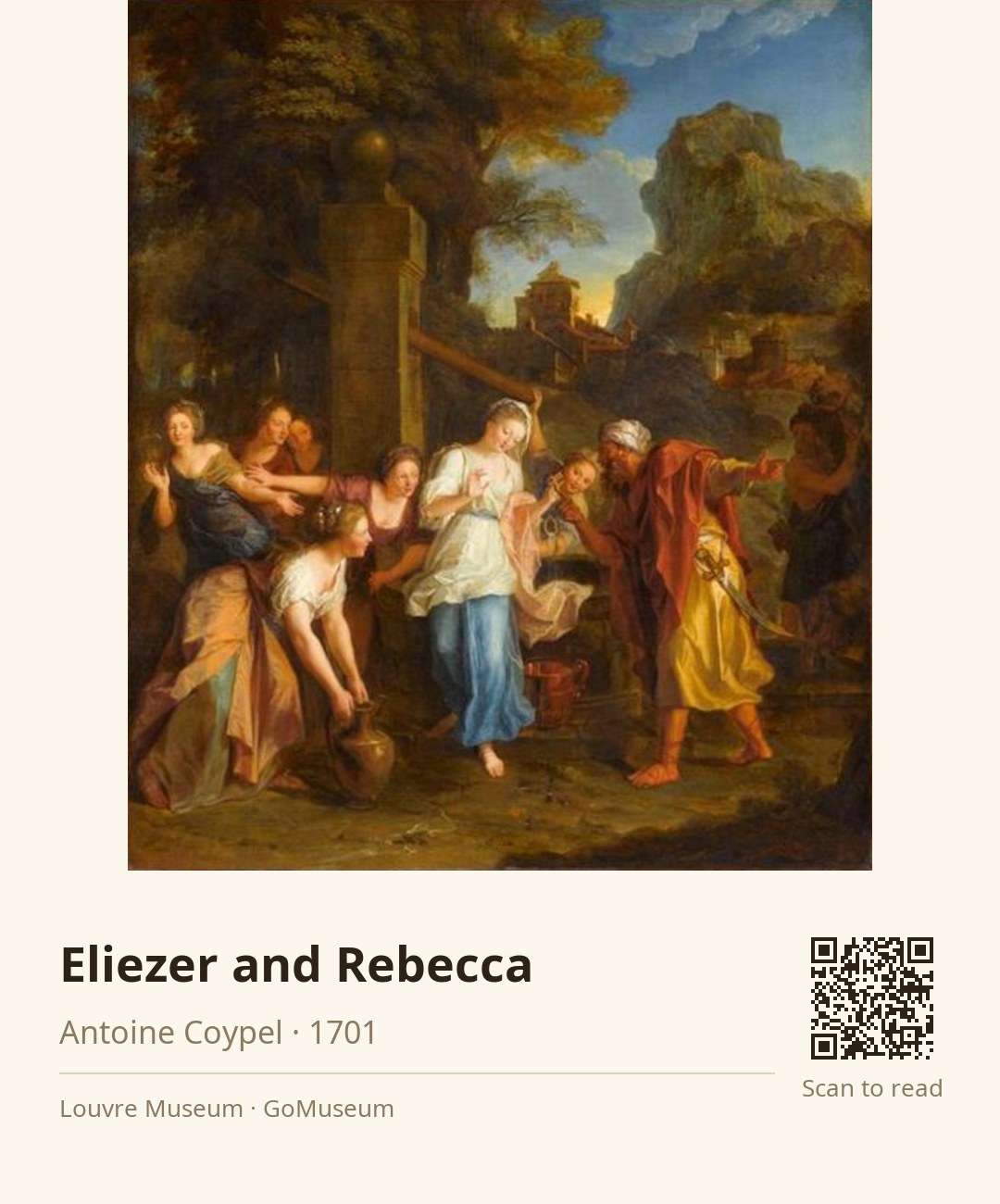
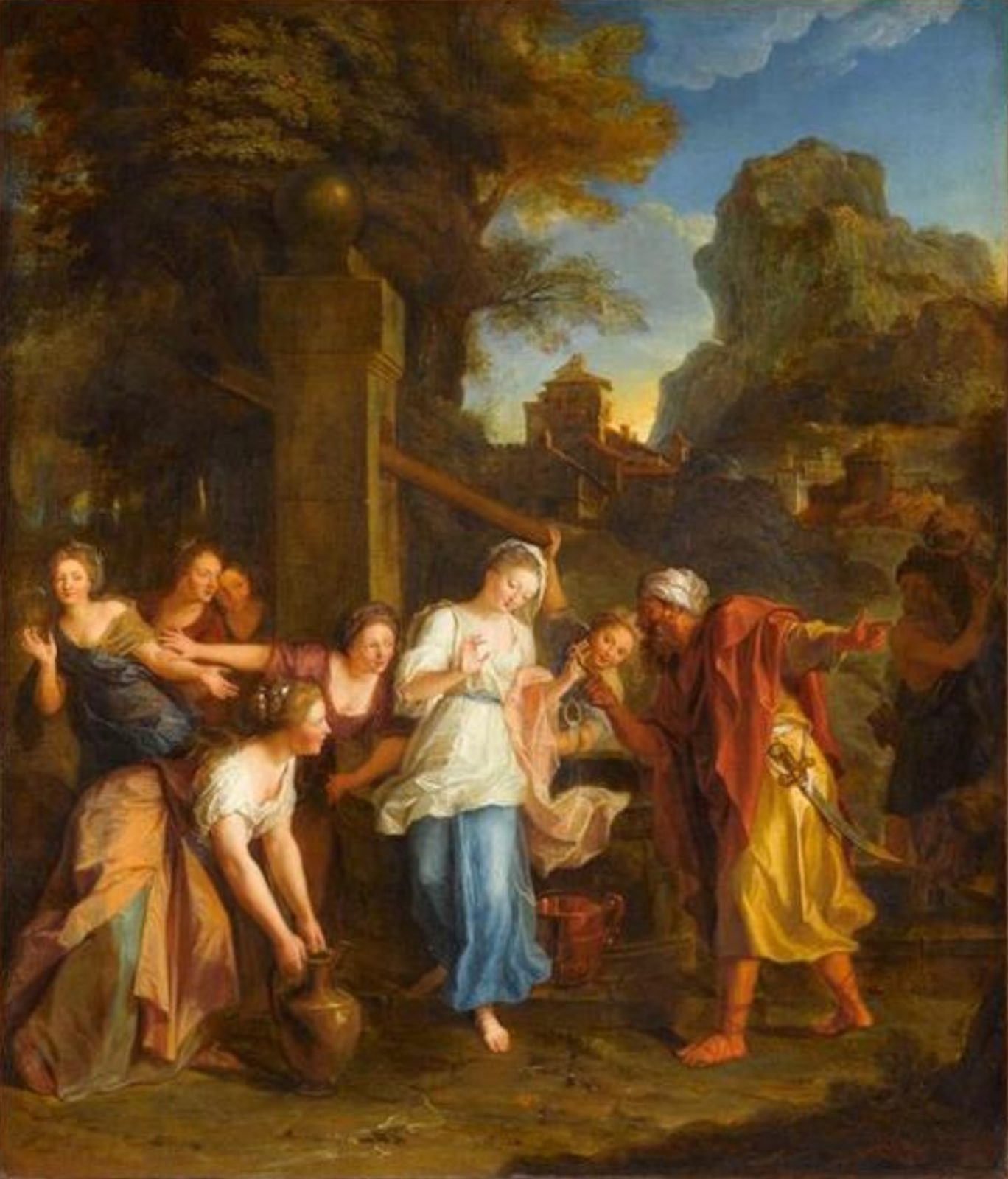
🎧 This work has audio narration — listen in the appIn the painting "Eliezer and Rebecca," a young woman stands gracefully at a well, her white blouse and blue skirt contrasting with the earthy tones of the rustic landscape. Beside her, another woman bends to fill a jug, while an older man in a vibrant red and yellow robe gestures animatedly, drawing attention to the gathering.
These figures are not just characters; they embody a moment of connection and hospitality from the biblical narrative, highlighting the significance of community and the act of drawing water, a vital resource in their lives. The warm palette and detailed brushwork bring the scene to life, inviting viewers to immerse themselves in this intimate encounter set against a backdrop of rocky hills and distant buildings under a serene sky.
Antoine Coypel, the artist, was a prominent figure in the early 18th century, known for his vibrant storytelling through art. He painted this work in 1701, during a time when he was establishing his reputation as a leading artist in France, having already gained recognition for his history and biblical scenes. His ability to blend narrative with rich color and texture is evident here, showcasing the influences he absorbed during his studies in Rome and his subsequent rise in the French art world.
Antoine Coypel was a prominent French artist born on April 11, 1661, in Paris, and he passed away on January 7, 1722. The son of painter Noël Coypel, he was immersed in art from a young age, studying under his father and later in Rome, where he was influenced by the great masters of the Renaissance and Baroque periods. His eclectic style evolved from classical roots to incorporate vibrant colors and dynamic compositions, reflecting the transition in French painting from the austere style of Louis XIV to a lighter 18th-century aesthetic.
Coypel became the court painter to Philippe I, Duke of Orléans, and later to King Louis XV, holding prestigious titles such as director of the Académie Royale and Keeper of the King’s paintings. His significant works include large-scale biblical and mythological paintings, such as "The Sacrifice of Jephta's Daughter" and "Democritus," showcasing his mastery of color and form. He also excelled in drawing, leaving behind around 500 sketches that highlight his skill in figure studies.
Coypel's legacy is marked by his contributions to the decoration of the Royal Chapel at Versailles and the Aeneas Gallery in the Palais-Royal. His influence extended through his family, with both his son and half-brother also becoming accomplished painters. As a key figure in the evolution of French art, Coypel's work bridged the gap between the grandeur of the past and the emerging styles of the 18th century.
The artist employs a rich, warm palette that draws the viewer into the scene, with earth tones harmonizing beautifully with the soft blues of the garments. His brushwork is both detailed and fluid, capturing the textures of the figures' clothing and the rugged landscape. The composition is dynamic, with the figures arranged in a way that creates a sense of movement and interaction. The older man’s animated gesture directs the viewer’s attention, while the young woman’s gentle posture evokes a sense of grace and tranquility. The scale of the painting, at 125 by 106 centimeters, allows for an immersive experience, inviting viewers to feel as though they are part of this intimate gathering.
Interestingly, Coypel was not just a painter; he was also a skilled draughtsman, with around 500 of his drawings surviving today. Many of these were preparatory sketches for his paintings, showcasing his meticulous planning and artistic process. This duality in his skill set highlights the depth of his artistic talent and the importance of drawing in the creation of his vibrant oil paintings.
In addition to being a painter, Coypel was a talented draughtsman, with approximately 500 surviving drawings that showcase his artistic process.
Coypel served as the court painter to Philippe I, Duke of Orléans, and later to King Louis XV, highlighting his prominence in the royal art scene.