La Marquise Visconti
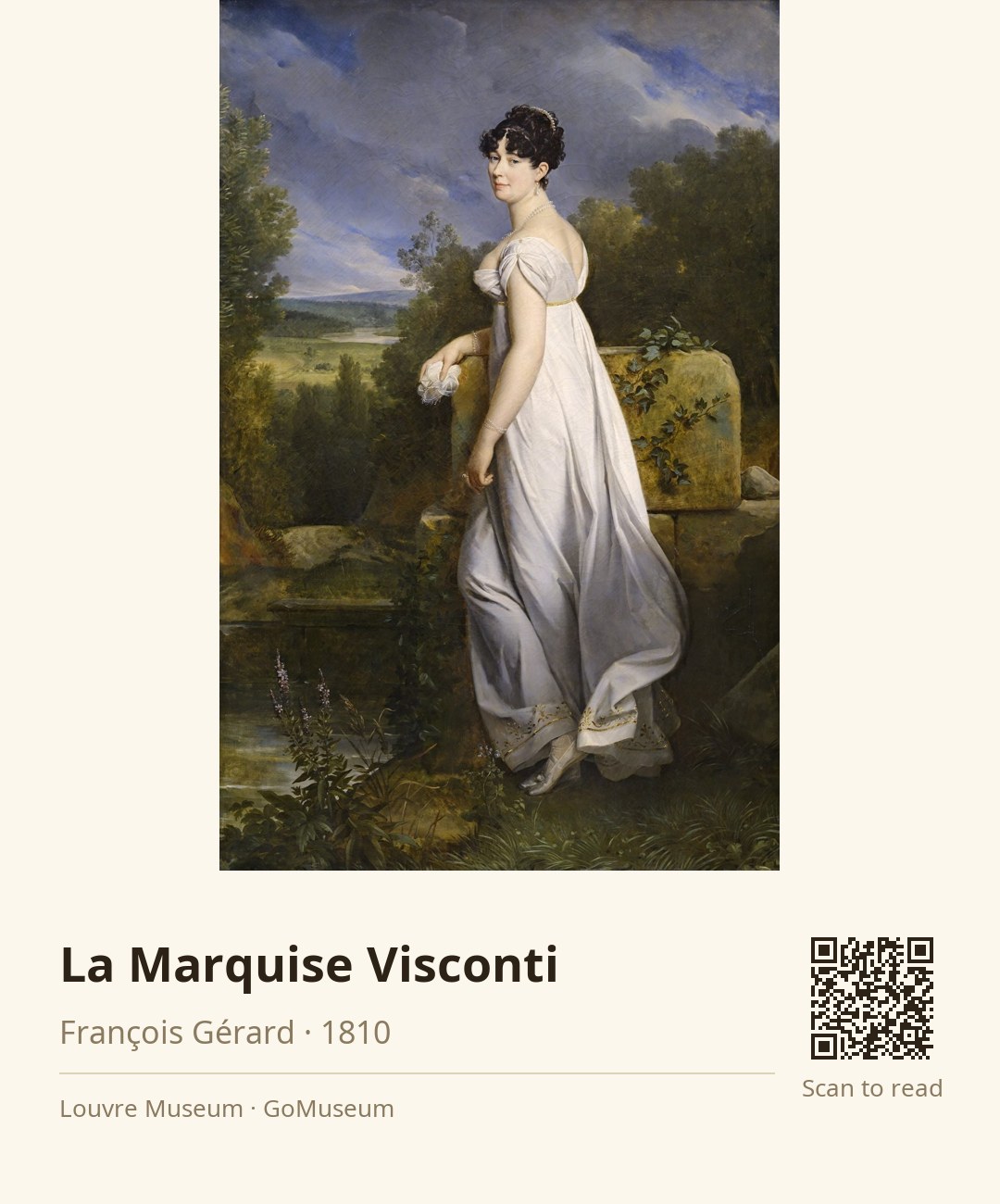
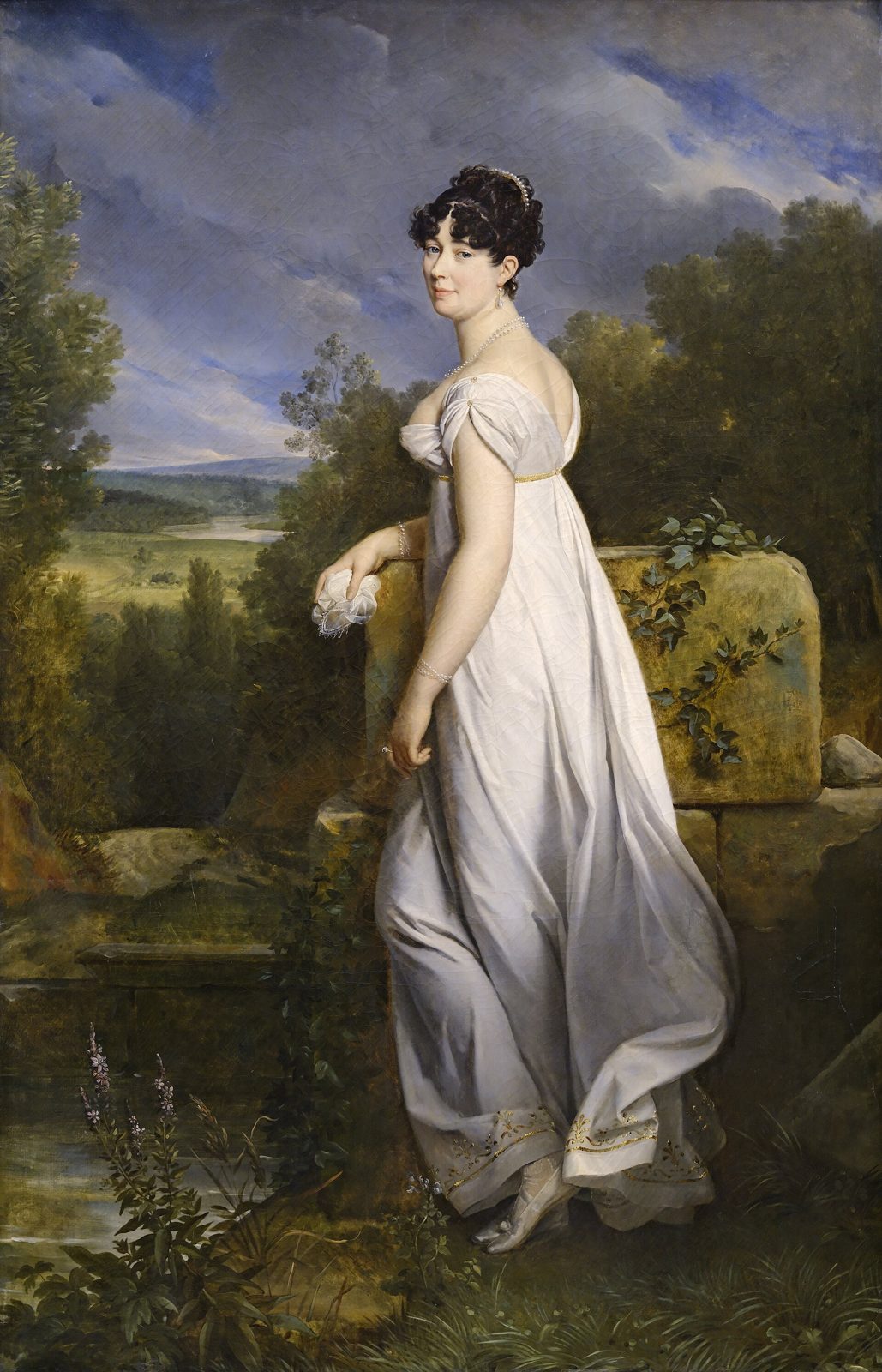
🎧 This work has audio narration — listen in the appGiuseppa Visconti stands elegantly in her flowing white gown, the delicate gold detailing at the hem catching the light. Her dark hair is styled with a small accessory, and she holds a white handkerchief, adding a touch of grace to her poised demeanor. Behind her, a lush landscape unfolds, with trees and fields stretching under a cloudy sky, creating a serene backdrop that enhances her presence.
This portrait, painted by François Gérard in 1810, captures not just the likeness of the Marquise but also the essence of her social standing and the refined taste of the early 19th century. The intricate brushwork reveals the textures of her gown and the surrounding foliage, showcasing Gérard's skill in portraying both fabric and nature with equal finesse. The choice of an outdoor setting suggests a connection to nature and perhaps a reflection of the marquise's own elegance and sophistication.
Gérard, a prominent figure in the art world of his time, was known for his portraits of European royalty and the elite. His work was celebrated at the Salon des artistes français in Paris, where this painting was first exhibited. By the time he created this portrait, Gérard had already established himself as a leading artist, having painted many notable figures of the era.
François Pascal Simon Gérard, born on May 4, 1770, in Rome, was a prominent French painter known for his exquisite portraits and historical works. As a student of Jacques-Louis David, he emerged as a leading artist during the First French Empire and the Bourbon Restoration. Gérard's talent earned him the title of court painter to Napoleon and later First Painter to Kings Louis XVIII and Charles X, solidifying his reputation across Europe.
His early life was marked by personal loss and financial struggles, which he overcame through determination and talent. Gérard's salon became a cultural hub, attracting influential figures and fostering artistic dialogue. His portraits captured the essence of European royalty, earning him the nickname "the painter of kings, the king of painters."
Despite his success, Gérard grappled with unfulfilled ambitions in history painting, a genre he aspired to master. His notable works, including the dramatic "Bataille d'Austerlitz," showcased his skill but ultimately, he felt overshadowed by the rise of Romanticism. Gérard's legacy endures through his delicate drawings and portraits, characterized by a purity of line and emotional depth. He passed away on January 11, 1837, leaving behind a significant mark on the art world.
François Gérard's portrait of Giuseppa Visconti, painted in 1810, was first showcased at the prestigious Salon des artistes français in Paris, a key event for artists of the time. Commissioned by the Visconti family, this work reflects the elite social circles of early 19th-century France. Gérard, already a celebrated portraitist, had garnered a reputation for capturing the essence of his subjects, making this painting a significant addition to his portfolio. The painting's provenance traces back to the Porto comtesse da, indicating its esteemed ownership. Over the years, it has been included in various catalogues, such as the Catalogue des peintures du Louvre, further solidifying its importance in art history.
Gérard's technique in 'La Marquise Visconti' showcases his mastery of oil paint on canvas, allowing for a rich depth of color and texture. The brushwork is meticulous, particularly in the way he captures the flowing fabric of Giuseppa's gown, where each fold seems to dance with light. The delicate gold detailing at the hem is rendered with such precision that it appears to shimmer. The composition is structured to draw the viewer's eye from the marquise's elegant figure to the serene landscape behind her. Gérard's choice of a soft palette—whites, greens, and blues—creates a harmonious atmosphere, enhancing the portrait's overall elegance. The slight turn of Giuseppa's body and her gaze back toward the viewer invites a sense of intimacy, as if she is inviting you into her world. This careful orchestration of elements not only highlights her status but also reflects the artistic ideals of the time, merging beauty with a sense of narrative.
Interestingly, Gérard was not just a painter of portraits; he also aspired to create historical paintings, a genre considered more prestigious at the time. Despite his success in portraiture, he often felt a sense of remorse for not fully realizing his ambitions in history painting. This internal conflict adds a layer of complexity to his legacy, as he navigated the expectations of his patrons while yearning to explore broader narratives through his art.
Gérard had aspirations to create historical paintings, which were viewed as a more prestigious genre compared to portraiture.
Gérard's salon attracted many prominent figures of his time, making it a celebrated gathering place for the elite.