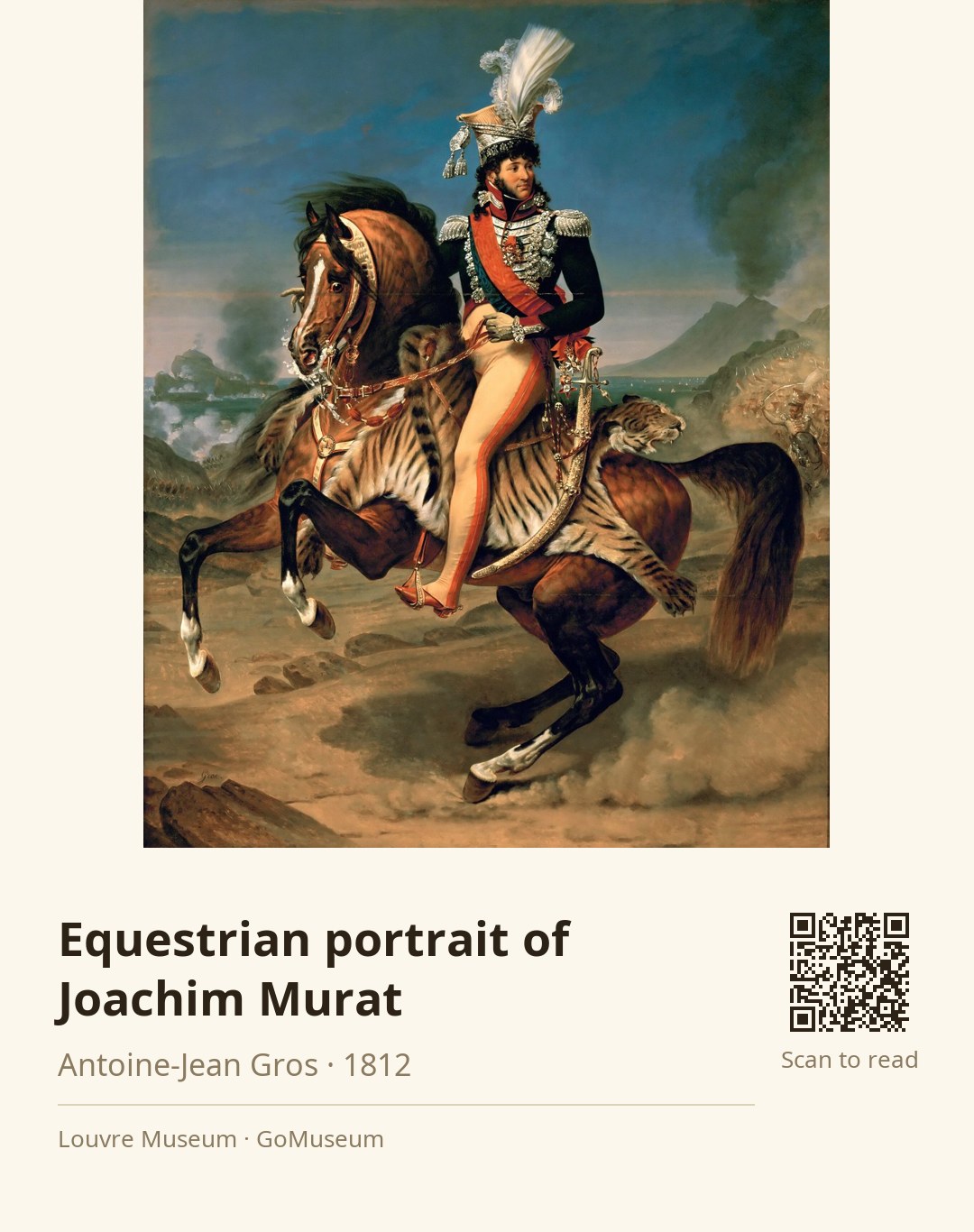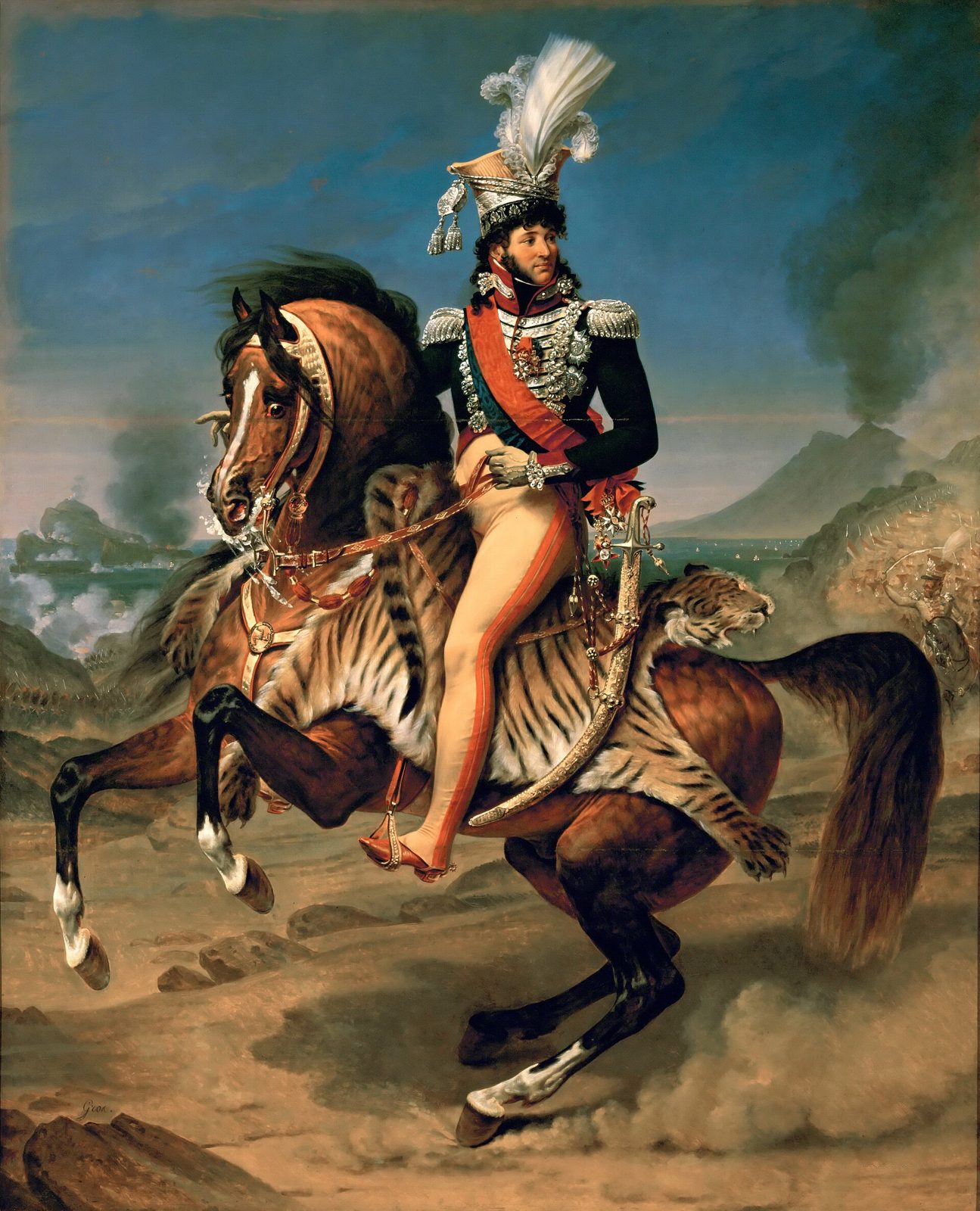
Equestrian portrait of Joachim Murat
🎧 This work has audio narration — listen in the appTake a moment to really soak in the commanding presence of Joachim Murat in this stunning equestrian portrait by Antoine-Jean Gros. Look closely at the vibrant colors of his uniform—the deep blue and striking red of the Legion of Honor. Notice how they contrast with the earthy tones of the tiger skin draped over his horse, a nod to his daring exploits during the Egyptian campaign.
These details matter because they encapsulate Murat’s dual identity: a fierce military leader and a king navigating the treacherous waters of political power. The tiger skin symbolizes bravery, while the regal colors assert his authority as the King of Naples, even as he was a mere puppet of the French Empire.
Painted in 1812, this piece was more than just a portrait; it was a calculated act of political propaganda, showcasing Murat as a conqueror of his own kingdom, despite the looming shadow of the Bourbons who still controlled Sicily.
As you stand here, consider the historical context: Murat's reign was fraught with challenges, and this portrait was meant to inspire loyalty and confidence in his rule.
What do you think this painting reveals about the complexities of leadership and identity during turbulent times?
Antoine-Jean Gros was a prominent French painter born on March 16, 1771, in Paris. He was a student of Jacques-Louis David, and his early life was marked by artistic promise, nurtured by a family of painters. Gros gained fame during the French Revolution, particularly for his portrait of Napoleon Bonaparte at the Battle of Arcole, which led to a close relationship with the emperor. His works often depicted historical events, blending neoclassicism with emerging romanticism, showcasing both grandeur and emotional depth.
After spending time in Genoa, where he painted portraits, Gros returned to Paris and became a celebrated artist. His notable works include "Bonaparte Visiting the Plague Victims of Jaffa," which served to counter negative propaganda against Napoleon. Despite his success, Gros struggled with the changing artistic landscape, feeling overshadowed by the rise of Romanticism. His later years were marked by personal turmoil, culminating in his tragic suicide in 1835. Gros's legacy lies in his ability to capture the complexities of his subjects, securing his place in art history as a bridge between neoclassicism and romanticism.
The Equestrian Portrait of Joachim Murat was painted between 1808 and 1812 by Antoine-Jean Gros, a prominent figure in the neoclassical movement. Murat, a key military leader and later King of Naples, commissioned this work to solidify his image during a tumultuous time. Gros had met Murat in Milan during the Italian campaigns, and their relationship blossomed into a series of commissions, including the grand Battle of Aboukir. This portrait was first exhibited at the Salon in Paris in 1812, where it garnered attention not just for its artistic merit but also for its political implications. The painting was intended to project Murat’s authority in Naples, a kingdom still under the shadow of the Bourbons and the French Empire. After Murat's execution in 1815, Gros was commissioned to paint the Surrender of Capri, but that project never materialized, leaving this portrait as a testament to Murat's complex legacy. The painting eventually found its home in the Louvre, acquired by donation in 1973, previously belonging to Prince Joachim Murat, a direct descendant of the king.
As you gaze at this portrait, take a moment to appreciate Gros's masterful technique. The brushwork is dynamic, capturing the energy of Murat and his horse in a three-quarters view that draws you into the scene. Notice how Gros uses vibrant colors—deep blues and striking reds—to convey both the military prowess and royal dignity of Murat. The tiger skin draped over the horse is not just a decorative element; it adds a layer of texture and symbolism, evoking Murat's bravery during the Egyptian campaign. The composition is carefully structured, with the distant silhouette of Vesuvius framing the scene, while the smoke from the volcano and the cannonade in the background hint at the ongoing conflicts of the time. This interplay of light and shadow enhances the drama, making the viewer feel the weight of Murat's dual identity as both a conqueror and a puppet king. The scale of the painting amplifies its impact, making it a commanding presence in the gallery.
Did you know that this painting was not just a simple portrait? It was a political statement! Gros painted Murat as a conqueror, showcasing his victory over Capri while hinting at his failed attempts to capture Sicily. It’s fascinating to think about how art was used as propaganda during this tumultuous time, isn’t it?
Viewers might miss the subtle interplay of light and shadow that Gros employs to enhance the drama of the scene, particularly how the smoke from the volcano and cannonade hints at the ongoing conflicts of Murat's reign. Additionally, the positioning of Vesuvius in the background serves as a reminder of the geographical and political landscape Murat navigated.