 Image: MOSSOT
The Genius of France animates the Arts, protects Humanity
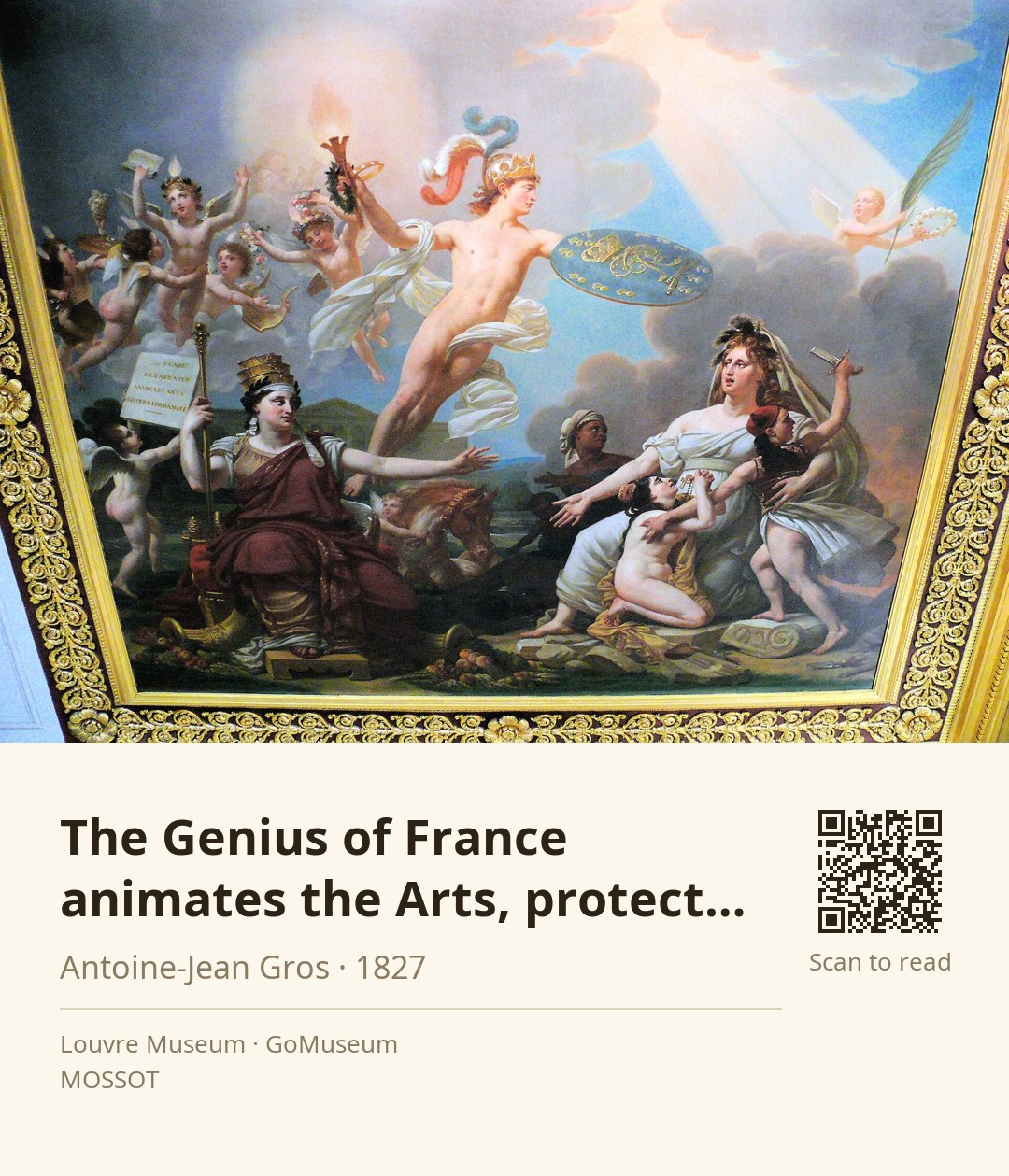
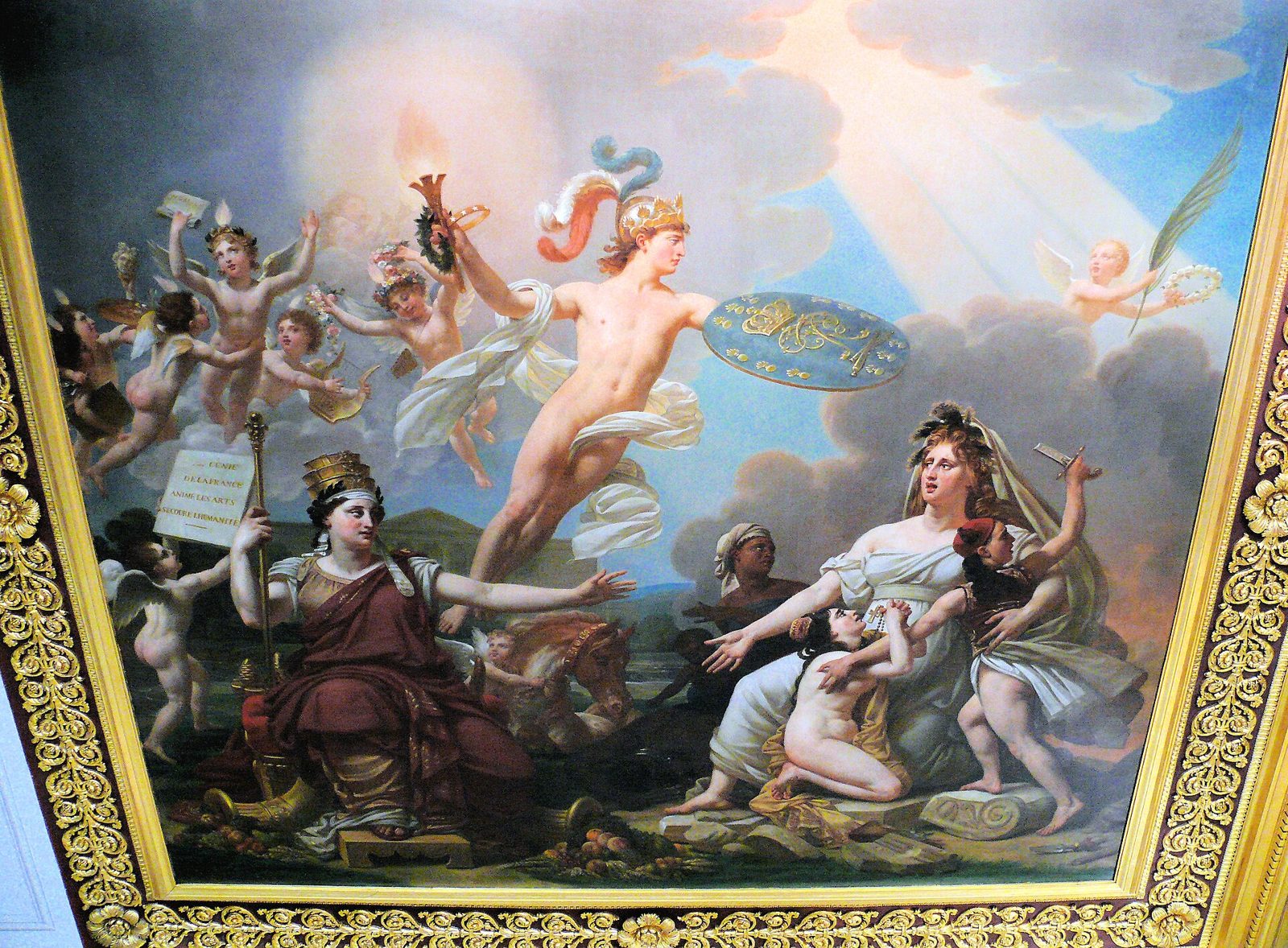
🎧 This work has audio narration — listen in the appThe central figure in this painting, a nude man crowned and draped in flowing fabric, embodies the spirit of France as he holds a shield and a torch, symbolizing enlightenment and protection. Surrounding him are cherubic figures, some with scrolls and wreaths, while a seated woman in a red robe clutches a scepter, her cornucopia spilling forth abundance at her feet. An inscription proclaims, "L'EMPIRE DE LA RAISON ANIME LES ARTS ET SOUTIENT L'HUMANITE," emphasizing the connection between reason, the arts, and humanity.
This dynamic composition, rich in blues, reds, and golds, reflects the optimism of the early 19th century, a time when France was emerging from the turmoil of revolution and seeking to redefine itself. The figures not only represent artistic ideals but also serve as allegories for France’s role in nurturing culture and civilization. The celestial atmosphere, with clouds and rays of light, further enhances the theme of divine inspiration guiding the nation’s artistic endeavors.
Antoine-Jean Gros, the artist behind this work, was a prominent figure in the neoclassical and pre-romantic movements, having studied under Jacques-Louis David. Gros gained fame for his historical paintings and portraits, particularly those depicting Napoleon Bonaparte. In 1827, he presented this piece at the Salon des artistes français in Paris, where it was well-received, showcasing his ability to merge national pride with artistic expression.
Antoine-Jean Gros was a prominent French painter born on March 16, 1771, in Paris. He was a student of Jacques-Louis David, and his early life was marked by artistic promise, nurtured by a family of painters. Gros gained fame during the French Revolution, particularly for his portrait of Napoleon Bonaparte at the Battle of Arcole, which led to a close relationship with the emperor. His works often depicted historical events, blending neoclassicism with emerging romanticism, showcasing both grandeur and emotional depth.
After spending time in Genoa, where he painted portraits, Gros returned to Paris and became a celebrated artist. His notable works include "Bonaparte Visiting the Plague Victims of Jaffa," which served to counter negative propaganda against Napoleon. Despite his success, Gros struggled with the changing artistic landscape, feeling overshadowed by the rise of Romanticism. His later years were marked by personal turmoil, culminating in his tragic suicide in 1835. Gros's legacy lies in his ability to capture the complexities of his subjects, securing his place in art history as a bridge between neoclassicism and romanticism.
Antoine-Jean Gros painted 'The Genius of France animates the Arts, protects Humanity' in 1827, a pivotal year for the artist as he showcased this work at the Salon des artistes français in Paris. This piece was also exhibited again in 1833 at the same Salon, further solidifying its place in the artistic landscape of the time. Over the years, the painting has been referenced in various bibliographies, including the 'Catalogue des peintures du Louvre' and the 'catalogue sommaire illustré du musée du Louvre et du musée d'Orsay,' highlighting its enduring significance and the artist's legacy.
The painting is a masterclass in oil technique, showcasing Gros's adept handling of color and form. The figures are rendered with a fluidity that brings them to life, each stroke of the brush contributing to the dynamic energy of the scene. The rich palette of blues, reds, and golds not only captivates the eye but also evokes a sense of optimism and grandeur, mirroring the aspirations of early 19th-century France. The central nude figure, embodying the spirit of France, is painted with a remarkable attention to detail, from the delicate folds of his drapery to the gleam of the shield and torch he holds. The composition is structured to draw the viewer's eye toward this figure, while the surrounding cherubic figures create a harmonious balance, enhancing the overall narrative of enlightenment and protection. The celestial atmosphere, with its clouds and rays of light, is achieved through soft blending techniques, creating a dreamlike quality that invites contemplation.
Interestingly, Gros had a close friendship with Élisabeth Vigée Le Brun, a prominent female artist of the time. She had known him since childhood and even painted his portrait when he was just seven years old. Their bond was unique in the male-dominated art world, and Vigée Le Brun once remarked on Gros's passionate nature, noting how deeply he felt about art and kindness alike.
Gros had a close friendship with Élisabeth Vigée Le Brun, who had known him since childhood and even painted his portrait when he was seven years old.
Gros was socially reclusive and often brusque, which made it challenging for him to connect with others, but he managed to form a strong bond with Vigée Le Brun.
In 1824, Gros was granted the title of Baron Gros, recognizing his contributions to art.