 Image: Sailko
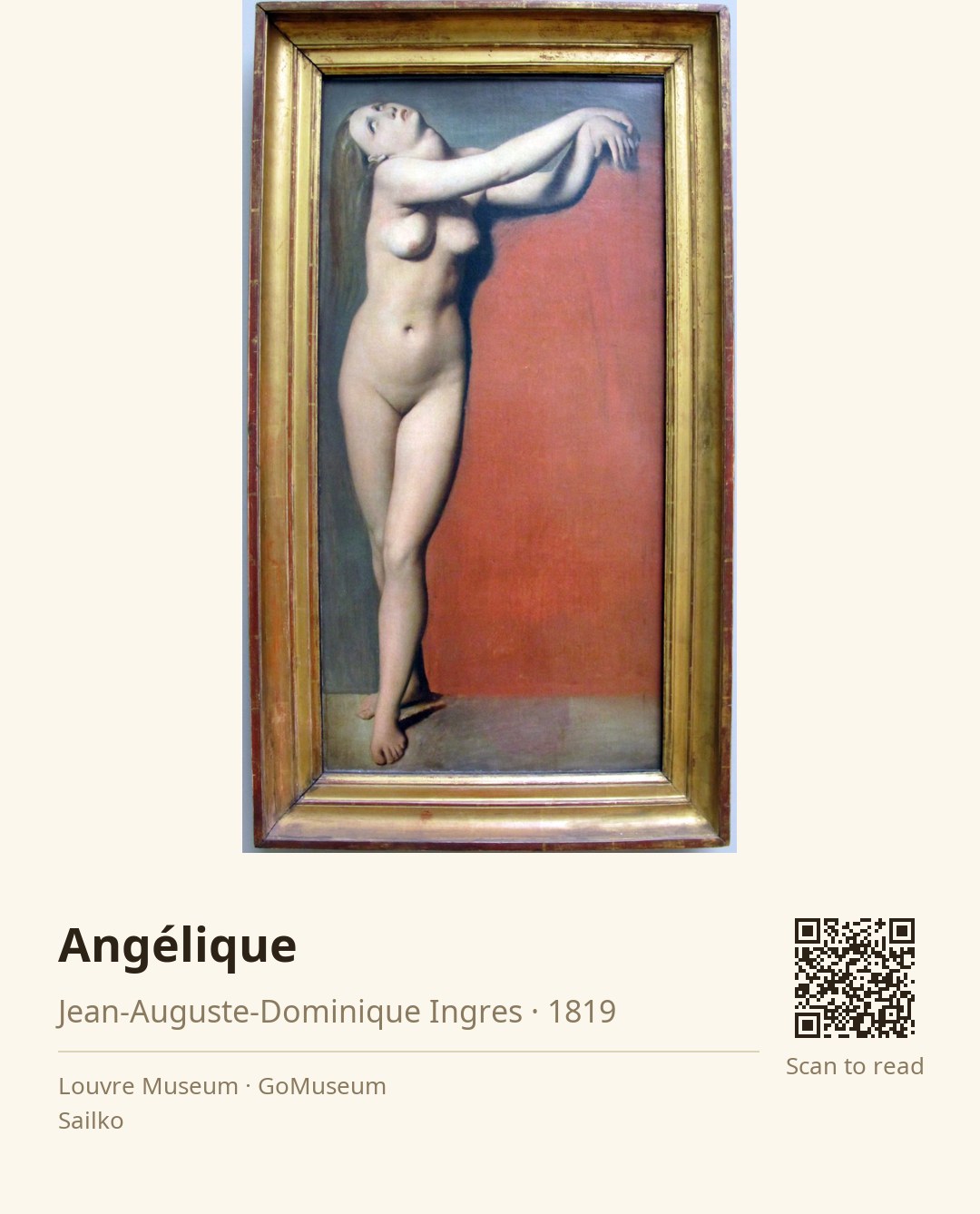
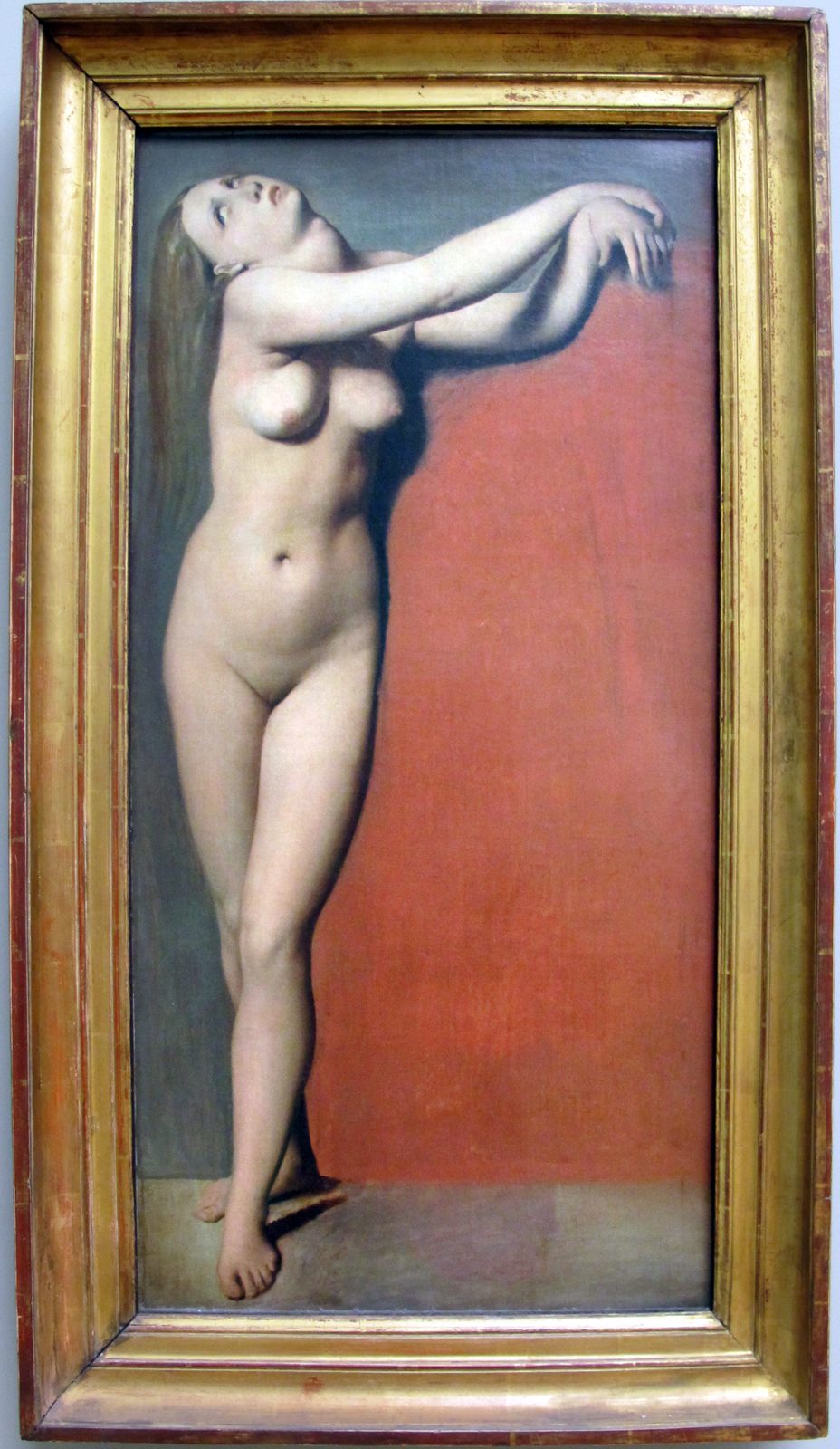
Angélique stands gracefully, her body slightly turned, arms raised and hands gently clasped, inviting you to appreciate the elegance of her form. The smooth, delicate brushwork captures the contours of her nude figure, while her head tilts back, directing her gaze upwards, as if lost in thought or reverie. The contrasting background—a muted gray on one side and a warm earthy red on the other—highlights her presence, enhancing the sense of intimacy and vulnerability.
This portrayal reflects Ingres' mastery in depicting the female form, emphasizing both beauty and grace. The choice of a nude figure, particularly in the early 19th century, speaks to the artist's commitment to Neoclassical ideals, where the human body was celebrated as a subject of art. Ingres, influenced by the Renaissance masters, aimed to elevate the nude beyond mere representation, infusing it with emotional depth and a sense of timelessness.
Created in 1819, this painting exemplifies Ingres' dedication to his craft during a period when he was still striving for recognition. It was exhibited at the Salon in Paris, marking a significant moment in his career, as he navigated the complexities of artistic expression amid the evolving tastes of his time.
Jean-Auguste-Dominique Ingres was a pivotal figure in French Neoclassicism, born on August 29, 1780, in Montauban. He was the son of a versatile artist, which nurtured his early artistic inclinations. Ingres studied under Jacques-Louis David in Paris, where he developed a commitment to academic traditions, aspiring to elevate history painting above all genres. His early career was marked by struggles, as critics dismissed his style as archaic, yet he persevered, achieving recognition with works like "The Vow of Louis XIII" in 1824.
His portraits, characterized by expressive distortions, became his most celebrated contributions, influencing modern artists such as Matisse and Picasso. Ingres's time in Italy, from 1806 to 1824, was crucial; he immersed himself in the study of Renaissance masters, which shaped his distinctive style. Despite facing criticism for his meticulous approach, he remained steadfast in his vision of beauty, emphasizing drawing over color.
Later in life, he returned to Paris, where he continued to create significant works, including "The Turkish Bath." Ingres's legacy endures as a bridge between classical traditions and modern art, embodying the tension between adherence to established norms and the evolving landscape of artistic expression. He passed away on January 14, 1867, leaving behind a profound impact on the art world.
In 1819, Jean-Auguste-Dominique Ingres painted 'Angélique', a work that marked a pivotal moment in his career. Commissioned during a time when he was still seeking recognition, it was first exhibited at the Salon in Paris, where it received a mixed reception. Critics were divided, some praising its elegance while others dismissed it as overly rigid. The painting's provenance traces back to its sale in 1867, where it was listed as the first item in the Sudre auction. It later changed hands through the Hulot sale in 1892 before becoming part of the Louvre's collection.
Ingres' technique in 'Angélique' showcases his meticulous brushwork and a refined handling of oil paint on canvas. The smooth transitions in the skin tones reveal his commitment to realism, while the vertical composition emphasizes the figure's grace and elegance. The contrasting backgrounds—muted gray and warm earthy red—serve to enhance the figure's presence, creating a dynamic tension that draws the viewer's eye. Ingres' choice to depict the nude form in such a poised manner reflects his Neoclassical ideals, where beauty is not just seen but felt.
Interestingly, Ingres was not just a painter; he was also a talented musician, having played second violin in the Orchestre du Capitole de Toulouse. This musical background influenced his artistic sensibilities, as he often sought harmony and rhythm in his compositions, much like a symphony in visual form.
Yes, Ingres was also a skilled musician and played second violin in the Orchestre du Capitole de Toulouse.
After its creation, 'Angélique' was first sold in the Sudre auction in 1867, where it was listed as the first item.
During his time in Italy, Ingres regularly sent his paintings to the Paris Salon, but critics often deemed his style bizarre and archaic.