Love Consoling Painting from the Critics of her Enemies
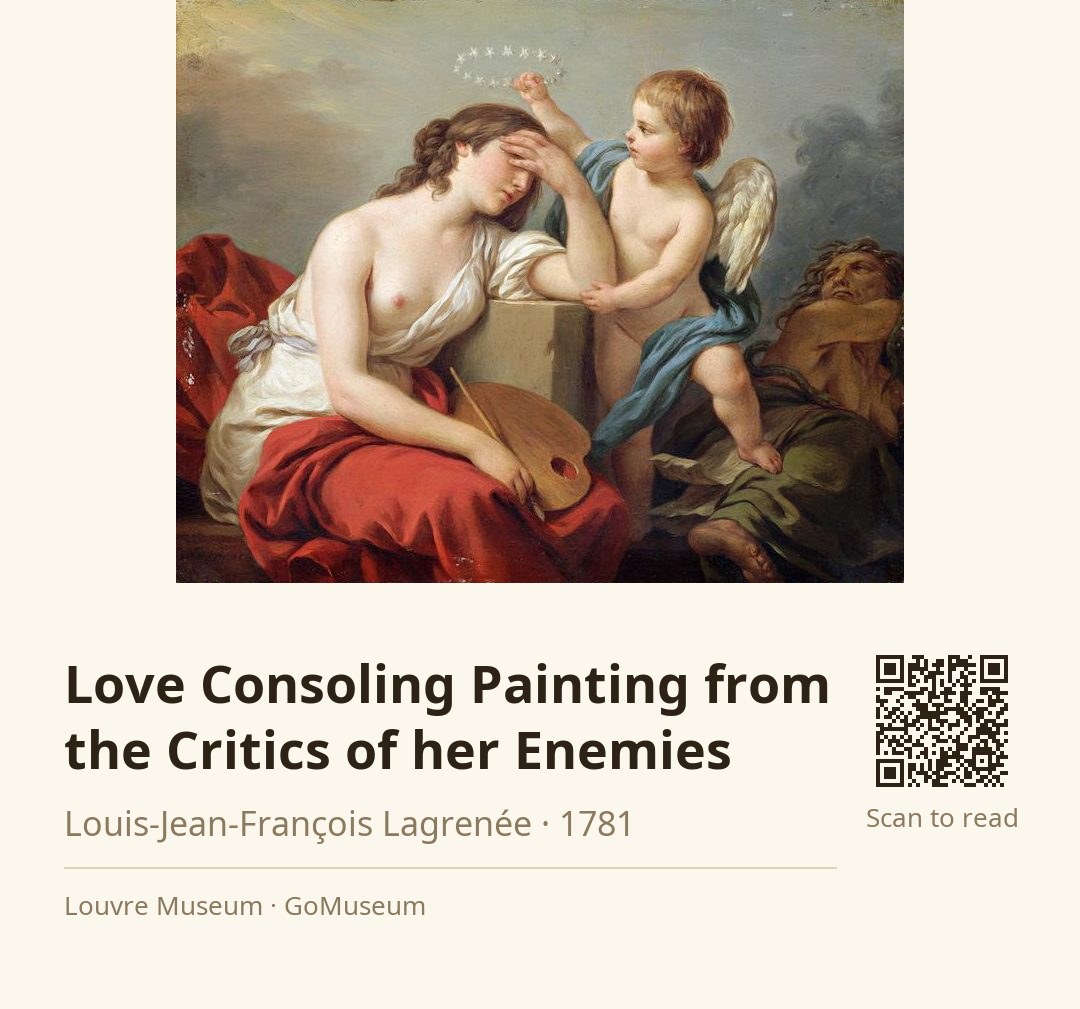
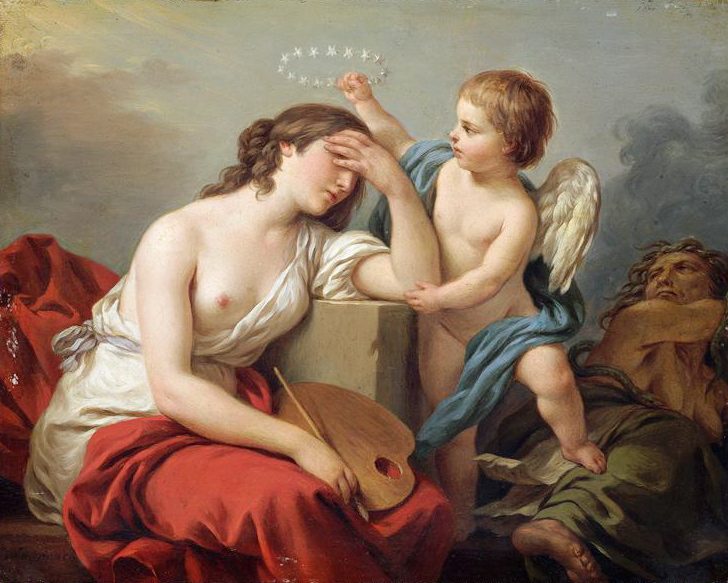
🎧 This work has audio narration — listen in the appA seated woman, her upper body partially exposed, leans against a stone block, cradling a painter's palette and brush in her lap. Her hand covers her eyes, hinting at contemplation or sorrow, while beside her, a cherubic figure reaches to place a crown of stars above her head, embodying a sense of protection and hope. The soft, muted earth tones of the palette enhance the serene atmosphere, inviting a deeper emotional connection to the scene.
This portrayal of "Love Consoling Painting from the Critics of her Enemies" reflects the struggles faced by artists in the 18th century, particularly in the context of criticism and public perception. The woman symbolizes the art of painting itself, vulnerable yet resilient, while the cherub represents the supportive forces of creativity and inspiration. Lagrenée’s choice to depict this allegory speaks to the tension between artistic aspiration and societal judgment, a theme that resonates through the ages.
Created in 1781, this work was exhibited at the Salon des artistes français in Paris, where it contributed to the ongoing dialogue about the role of art in society. Lagrenée, a prominent figure in the French rococo movement, was known for his delicate compositions and ability to evoke emotion through color and form. His career flourished as he navigated the complexities of artistic expression during a transformative period in art history.
Louis-Jean-François Lagrenée, known as Lagrenée the Elder, was a prominent French rococo painter born on December 30, 1724, in Paris. A student of Carle van Loo, he demonstrated exceptional talent early on, winning the Grand Prix de Rome in 1749 with a painting that is now lost. His time in Rome deepened his appreciation for Baroque art, particularly the works of Guido Reni and Francesco Albani, earning him the nickname "the French Albani."
Lagrenée's career flourished upon his return to Paris, where he became a celebrated artist, recognized for his mythological and religious works, often characterized by their graceful and delicate style. His reception piece, "The Abduction of Deianira by the Centaur Nessus," secured his membership in the Académie royale de peinture et de sculpture in 1755. He married Anne-Agathe Isnard in 1758, and their enduring union lasted until his death in 1805.
Throughout his life, Lagrenée held various prestigious positions, including director of the Imperial Academy of Arts in Russia and later, professor-rector at the Royal Academy in Paris. His contributions to art were significant during a transitional period leading to Neoclassicism, and he was honored with the Legion of Honour by Napoleon in 1804. Lagrenée's legacy endures through his numerous works in major collections, reflecting a blend of French elegance and Italian influence that marked his place in art history.
Lagrenée's technique in this painting is a masterclass in oil handling. The soft, muted earth tones create a warm atmosphere, inviting viewers into a moment of introspection. His brushwork is delicate yet confident, allowing for a smooth transition between light and shadow, which enhances the emotional depth of the scene. The composition is structured around the seated woman, whose partially exposed body symbolizes vulnerability. The cherub, with its rounded features and gentle expression, draws the eye upward, creating a visual dialogue between the figures. This upward movement is further emphasized by the crown of stars, suggesting hope and protection. The scale of the painting, relatively small at 21.5 by 27 inches, encourages a personal connection, making it feel intimate and inviting. Lagrenée's choices in color and form not only convey the allegorical message but also evoke a sense of empathy, resonating with the viewer's own experiences of struggle and aspiration.
After winning the Grand Prix de Rome, he spent time in Italy, where he developed a deep appreciation for Baroque painting. Interestingly, he was once criticized by the famous philosopher and art critic Denis Diderot, who initially found his work lacking in imagination. However, Diderot later praised Lagrenée's growth as an artist, noting the surprising progress he made in his craft.
Diderot initially criticized Lagrenée for his lack of imagination, but later praised his surprising progress and the beauty of his compositions.