Night or Diane
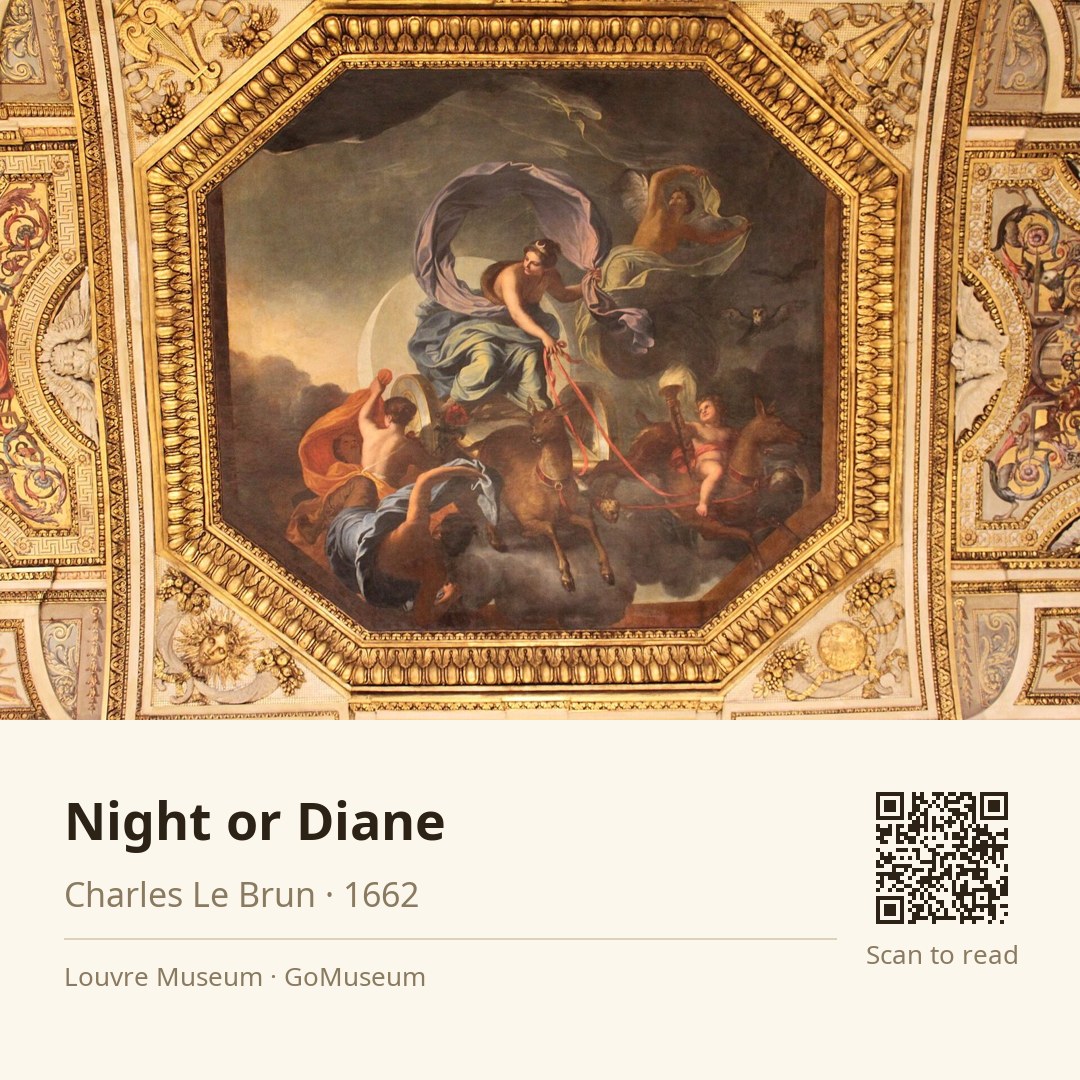
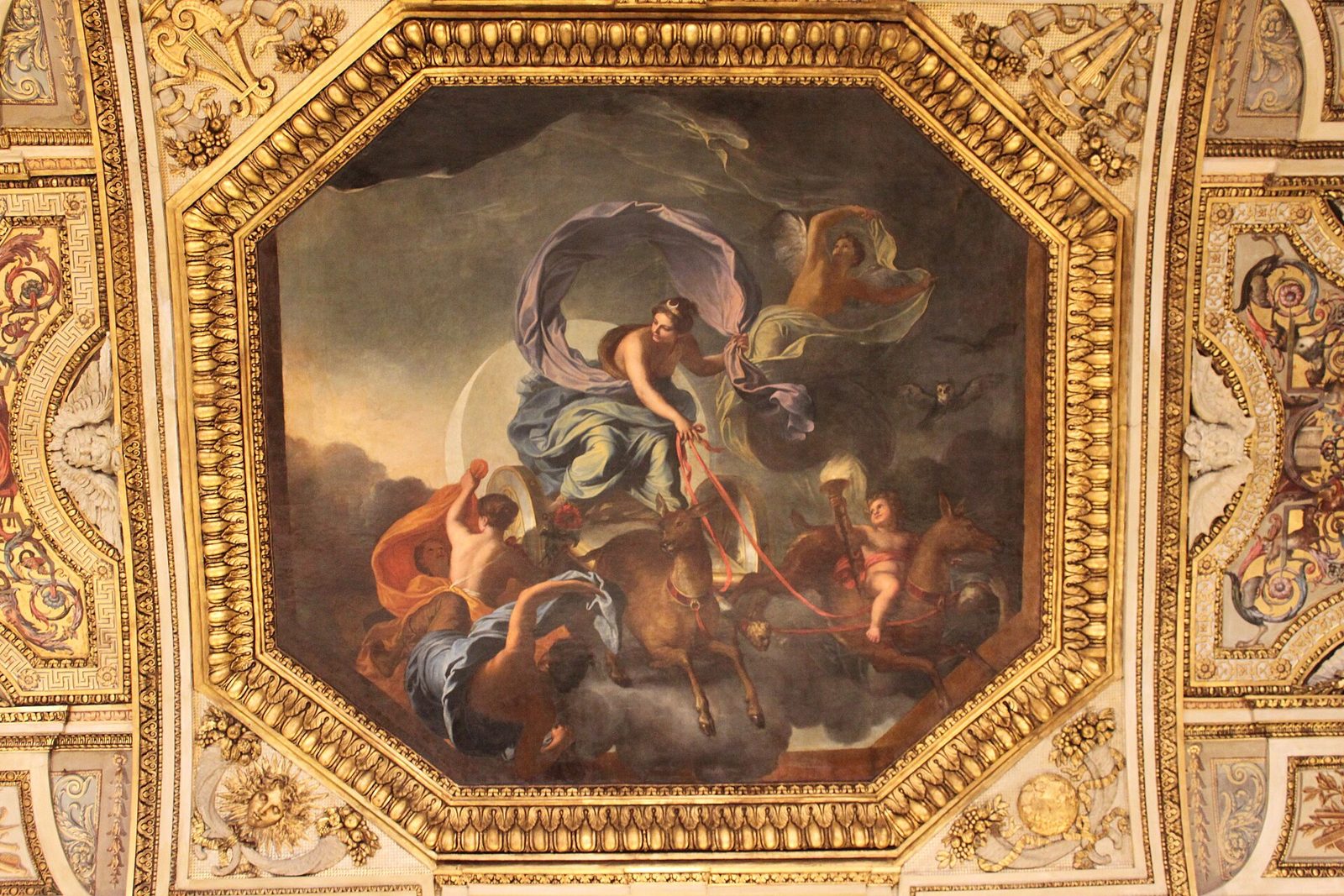
🎧 This work has audio narration — listen in the appThe chariot at the center of Charles Le Brun's "Night or Diane" draws your eye with its vibrant blue and purple drapery, where a figure confidently holds the reins, guiding the horses through swirling clouds. Flanking this central figure are mythological companions, one illuminating the scene with a torch, their partially clothed forms suggesting a dreamlike quality that enhances the allegorical theme of night.
This dynamic arrangement captures the essence of celestial movement, as the figures and horses swirl in a circular dance, creating a harmonious balance that reflects the grandeur of the night sky. The rich palette of earth tones, blues, and golds, combined with soft brushwork, evokes a sense of fluidity and life, inviting viewers to immerse themselves in this mythical realm. The painting serves as a testament to Le Brun's mastery of allegory, where each element contributes to a narrative that celebrates the beauty and mystery of the night.
Created in 1662, this work exemplifies Le Brun's role as a leading figure in 17th-century French art, where he not only painted but also shaped the artistic direction of his time through his involvement with the Royal Academy and various royal commissions.
Charles Le Brun was a prominent French painter and art theorist, born in Paris on February 24, 1619. He became a pivotal figure in 17th-century French art, serving as the court painter to Louis XIV, who hailed him as "the greatest French artist of all time." Le Brun's artistic journey began at a young age, receiving his early training under Simon Vouet and later studying in Rome, where he was influenced by the works of Nicolas Poussin and ancient Roman sculpture.
His return to Paris marked the beginning of a successful career, with significant commissions from influential patrons like Cardinal Richelieu and Nicholas Fouquet. As a founding member of the French Royal Academy of Painting and Sculpture, Le Brun played a crucial role in shaping the direction of French art, emphasizing a theoretical foundation that would influence generations. His work at the Gobelins manufactory further established his dominance in the artistic landscape, producing designs that would define the Louis XIV style.
Le Brun's grand projects, including the decoration of the Château de Versailles, showcased his ability to blend grandeur with narrative, particularly in his series depicting the history of Alexander the Great. His emphatic style resonated with the tastes of the king, leading to his ennoblement and appointment as Premier Peintre du Roi. Le Brun's legacy endures, as he not only shaped the aesthetics of his time but also laid the groundwork for future artistic endeavors in France and beyond, influencing the trajectory of European art for centuries. He passed away on February 12, 1690, leaving behind a rich artistic heritage.
The painting is a ceiling artwork, framed in an ornate, gilded border that adds to its grandeur. At the heart of the piece, a figure in flowing blue and purple garments confidently holds red reins, guiding a chariot drawn by powerful horses. This central figure is flanked by other mythological characters, some of whom are partially clothed, contributing to the dreamlike atmosphere. One of these figures holds a torch, casting a warm glow that enhances the celestial theme. The background is alive with swirling clouds and a crescent shape, evoking the night sky. The color palette is rich and varied, featuring deep earth tones, vibrant blues, and shimmering golds, all rendered with soft, fluid brushwork that suggests movement and life. The entire composition is arranged in a circular motion, creating a harmonious balance that draws the viewer into this mythical scene.
Interestingly, the painting is titled "Night or Diane" in English, while its French title is "LA NUIT OU DIANE."
Le Brun was instrumental in founding the French Royal Academy of Painting and Sculpture, where he held significant positions and influenced the direction of French art.
The ornate, gilded border framing the ceiling painting enhances its grandeur and emphasizes its importance as a decorative element in the architectural space.
During his time in Rome, Le Brun was influenced by Nicolas Poussin, which shaped his artistic style and approach to painting.