Water or The Triumph of Neptune and Amphitrite
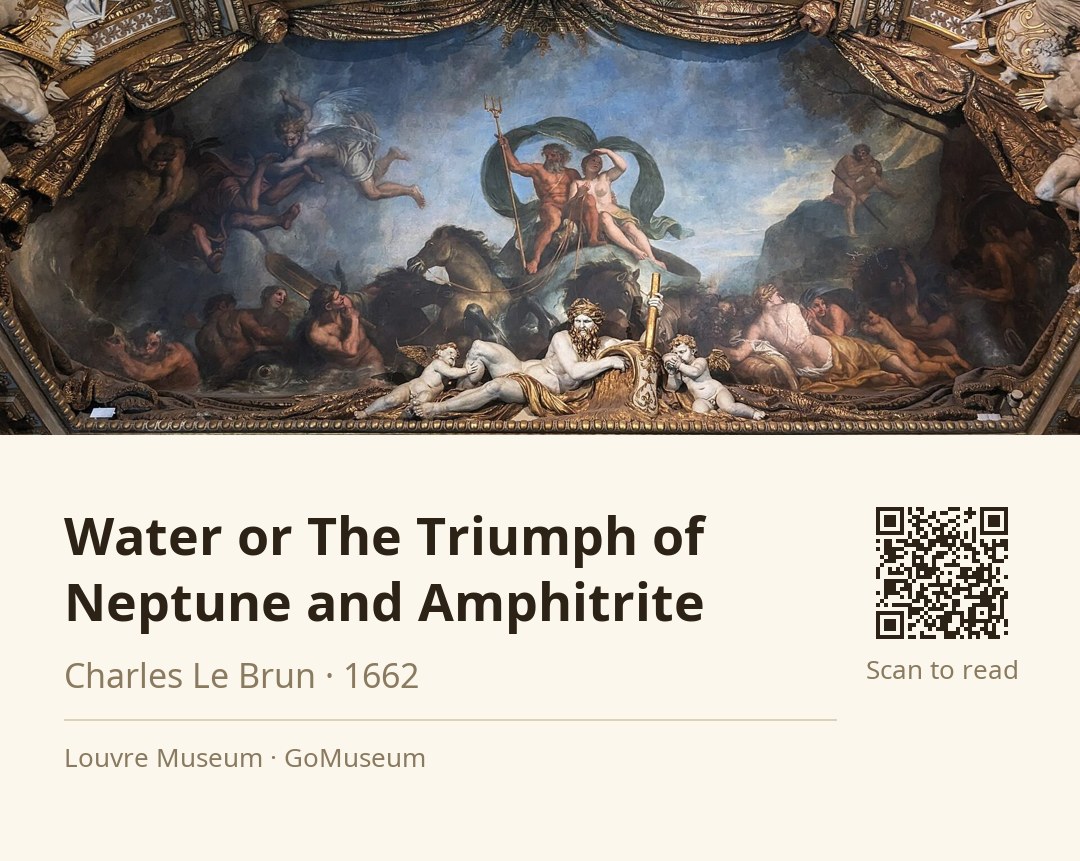
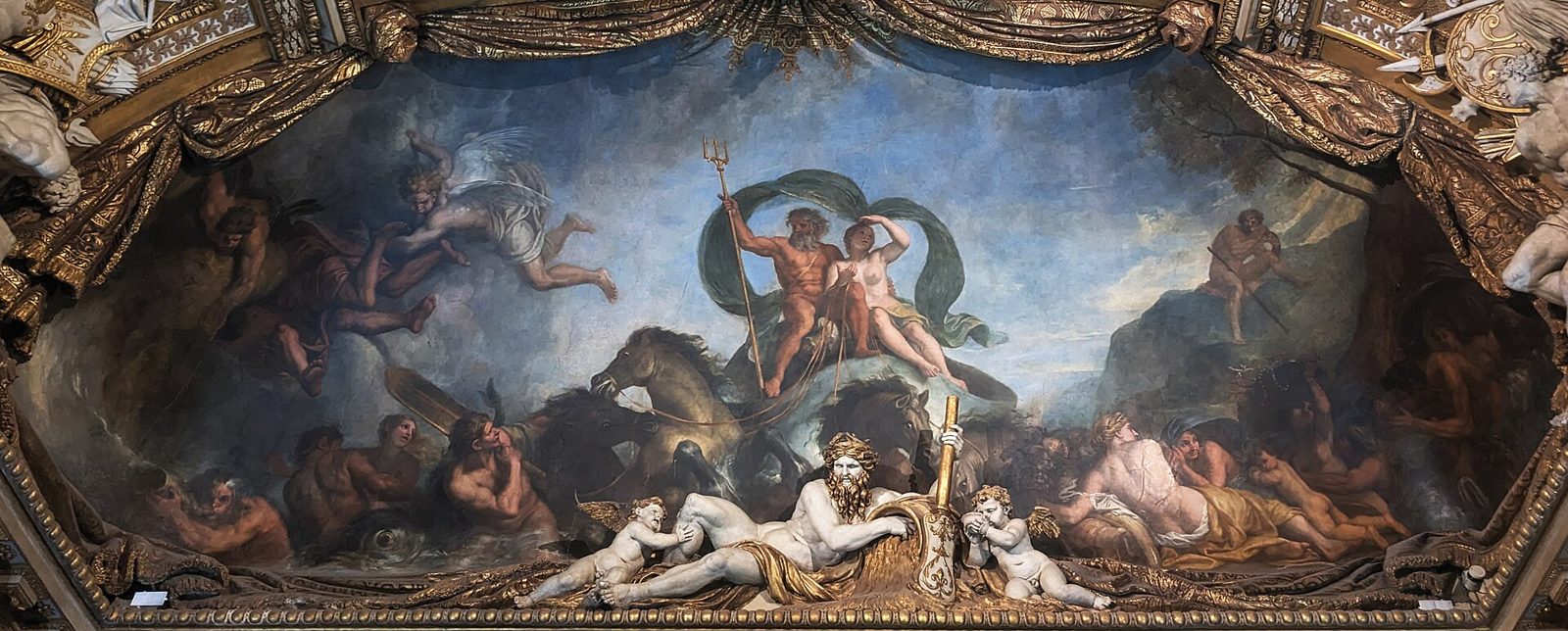
🎧 This work has audio narration — listen in the appNeptune, the god of the sea, commands attention as he reigns over a tumultuous scene, seated on a chariot pulled by powerful horses emerging from the waves. Beside him, Amphitrite is partially draped, her graceful form contrasting with the dynamic energy of the surrounding figures, some soaring through the air with wings, while others cling to rocky outcrops. The rich palette of blues, browns, and golds enhances the drama, while the ornate golden drapery frames the composition, creating a sense of grandeur.
This vivid portrayal of mythological triumph captures not just a moment of victory, but also reflects the Baroque fascination with movement and emotion. The swirling clouds and distant landscape in the background amplify the intensity of the scene, drawing the viewer into a world where gods and mortals intertwine. Le Brun's brushwork conveys a sense of fluidity, echoing the very essence of water and its allegorical significance in this narrative. The figures, both human and divine, are not merely decorative; they embody the power and majesty of the sea, a theme that resonates deeply within the context of 17th-century France, where the ocean was both a source of life and a symbol of royal authority.
Created in 1662, "Le triomphe des eaux ou Neptune et Amphitrite" is a testament to Charles Le Brun's mastery as a court painter under Louis XIV, reflecting the grandeur and ambition of the era.
Charles Le Brun was a prominent French painter and art theorist, born in Paris on February 24, 1619. He became a pivotal figure in 17th-century French art, serving as the court painter to Louis XIV, who hailed him as "the greatest French artist of all time." Le Brun's artistic journey began at a young age, receiving his early training under Simon Vouet and later studying in Rome, where he was influenced by the works of Nicolas Poussin and ancient Roman sculpture.
His return to Paris marked the beginning of a successful career, with significant commissions from influential patrons like Cardinal Richelieu and Nicholas Fouquet. As a founding member of the French Royal Academy of Painting and Sculpture, Le Brun played a crucial role in shaping the direction of French art, emphasizing a theoretical foundation that would influence generations. His work at the Gobelins manufactory further established his dominance in the artistic landscape, producing designs that would define the Louis XIV style.
Le Brun's grand projects, including the decoration of the Château de Versailles, showcased his ability to blend grandeur with narrative, particularly in his series depicting the history of Alexander the Great. His emphatic style resonated with the tastes of the king, leading to his ennoblement and appointment as Premier Peintre du Roi. Le Brun's legacy endures, as he not only shaped the aesthetics of his time but also laid the groundwork for future artistic endeavors in France and beyond, influencing the trajectory of European art for centuries. He passed away on February 12, 1690, leaving behind a rich artistic heritage.
An intriguing anecdote about Le Brun is that he was not only a painter but also a physiognomist, someone who studied the relationship between a person's appearance and their character. This interest influenced his artistic practice, as he believed that understanding human emotions could enhance the expression in his paintings. His theories on physiognomy were so influential that they were discussed in the context of art education, shaping how artists approached character portrayal in their work.
Le Brun studied physiognomy, which is the relationship between appearance and character, and this interest influenced how he expressed emotions in his paintings.
Le Brun played a crucial role in founding the French Royal Academy of Painting and Sculpture, which shaped the direction of French art for years to come.
In Rome, Le Brun studied ancient Roman sculpture, copied works by Raphael, and was influenced by local painters, which significantly contributed to his artistic style.