Ganymede abducted by Jupiter
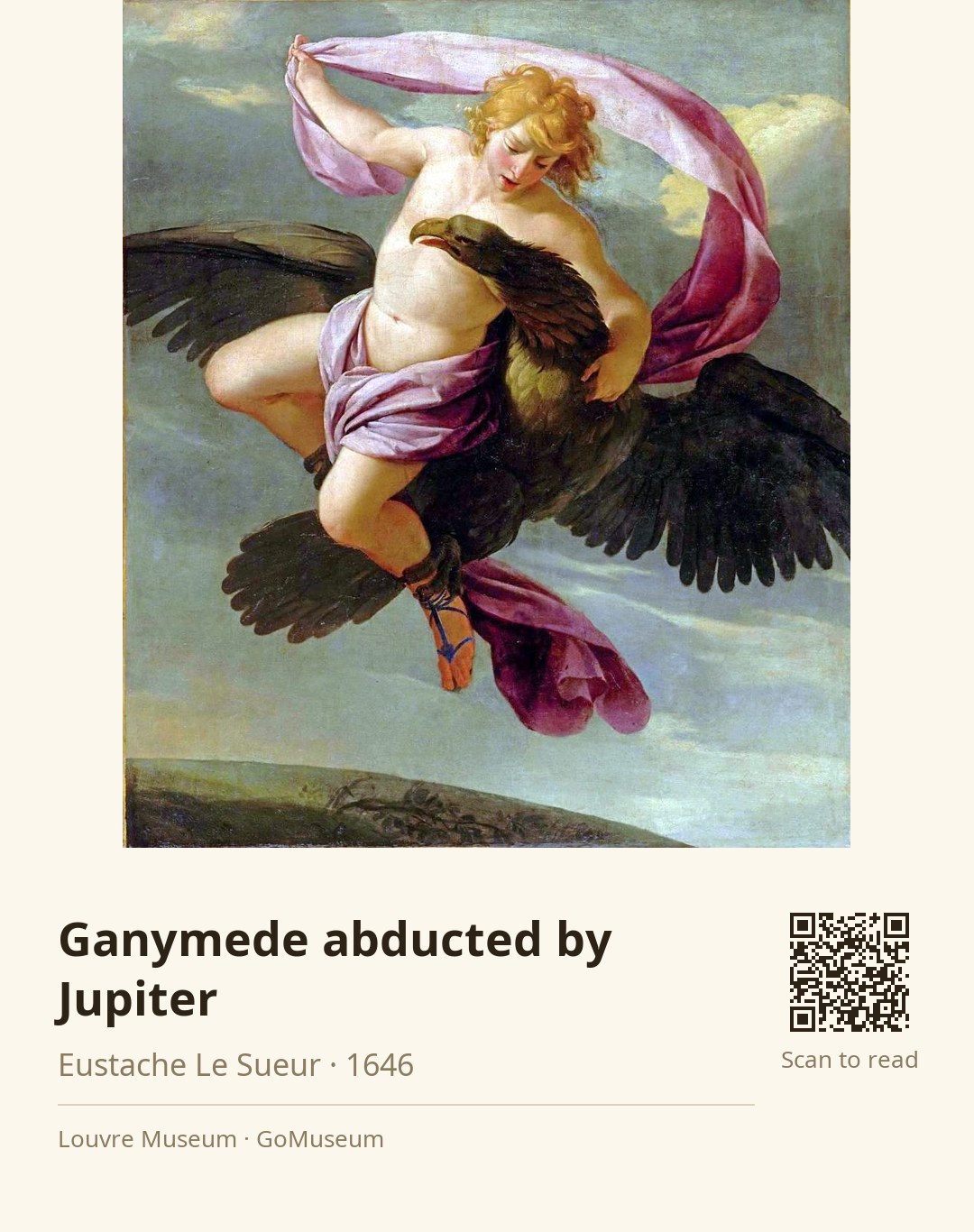
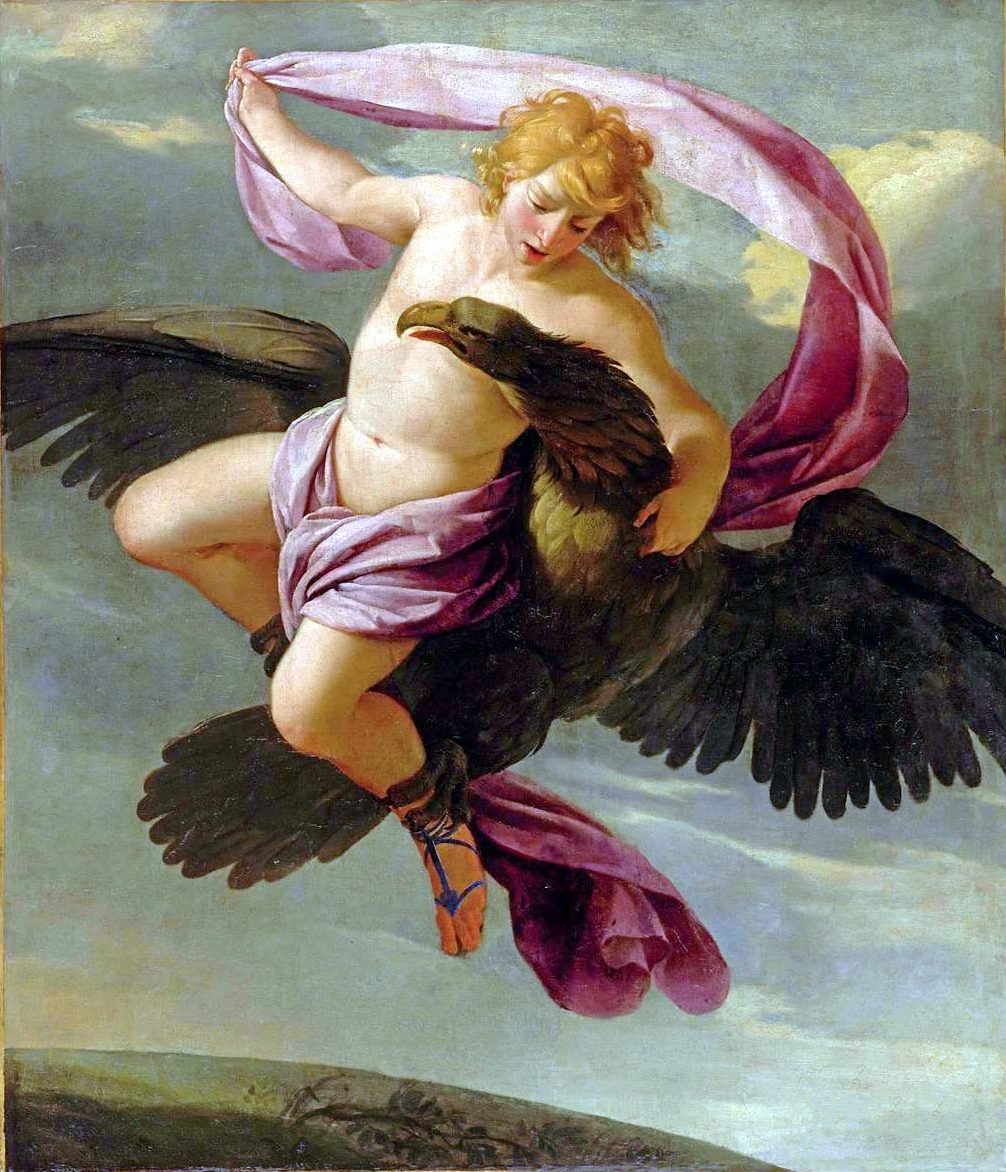
🎧 This work has audio narration — listen in the appThe youth in this painting is Ganymede, and he is being carried off into the sky on the back of a great dark eagle, the bird that stands for Jupiter. Look closely at the scarf: a long stream of pink-to-magenta fabric sweeps up in an arc above his head, held in one raised hand, while his other arm wraps around the eagle's neck. The eagle's wings spread wide on either side, and the lilac drape across his hips trails away below his legs, one foot still wearing a blue-strapped sandal.
These details carry the story. The scarf, lifted high and flying, gives the abduction its sense of motion, as if the air itself is rushing past. The eagle's outstretched wings fill the canvas and push the youth upward, so the moment reads as flight rather than a still pose. And the lowered head and eyes give Ganymede a quiet, almost resigned air, so the myth feels personal as well as dramatic.
What the material establishes is this: Eustache Le Sueur, born in Paris in 1616 or 1617, painted the work in oil on canvas during the second quarter of the seventeenth century, and the canvas stands about 127 by 108 centimetres. Later he helped found the Royal Academy of Painting and Sculpture in 1648, and he is remembered as one of the founders of French classical painting. Little is known about this painting's origins beyond these holdings, so the story of the canvas begins in the eighteenth century, when a royal collection took it in.
Eustache Le Sueur, born in Paris on November 19, 1617, was a pivotal figure in the development of French neoclassical painting. Trained under Simon Vouet, he quickly distinguished himself for his lyrical compositions and mastery of religious subjects. As a founding member of the French Academy of Painting and Sculpture, Le Sueur played a crucial role in shaping the artistic standards of his time. His notable works include the "Life of St. Bruno" series, which showcased his ability to blend classical inspiration with a refined, sober style.
Despite never traveling to Italy, he absorbed influences from the royal palaces and private collections in Paris, leading to a unique interpretation of the classical tradition. His paintings, characterized by noble figures and calculated compositions, often reflect a cold palette typical of Vouet's school, though he demonstrated a capacity for color in select pieces. Le Sueur's legacy endures through his extensive body of work, including many engravings, and his influence on subsequent generations of artists, marking him as a significant contributor to the evolution of French art. He passed away on April 30, 1655, leaving behind a rich artistic heritage.
This canvas was painted in 1646, by Eustache Le Sueur, a Parisian who spent his whole life in the city. It passed to Marin de la Haye by 1776, then to King Louis XVI, and so into the French Crown's collection. Its inventory number is INV 8062, and it is catalogued in the bibliography as C.P.I. 530.
The picture is painted in oil on canvas, and it measures about 127 by 108 centimetres. The figures and the bird fill nearly the entire surface, leaving only a band of pale grey-blue sky with small yellowish clouds, and a dark green hill with sparse twigs along the bottom edge. The body of the youth is rendered with smooth, blended flesh, while the drapery is handled more softly. The eagle is dark brown-black with an olive-gold breast and an open beak. Because the sky is so pale and the hill so dark, the figure reads clearly against a flat, open ground.
Its earlier history is largely unknown; the documented trail begins in the eighteenth century, when it passed to Marin de la Haye by 1776 and then to King Louis XVI.
Yes. Besides helping found the Académie royale de peinture et de sculpture, he was one of its first professors, at a time when the new classical style was taking hold in Paris.
Yes. His earliest pictures were carried out from drawings by his master Simon Vouet and under Vouet's direction, before he developed a more personal style.