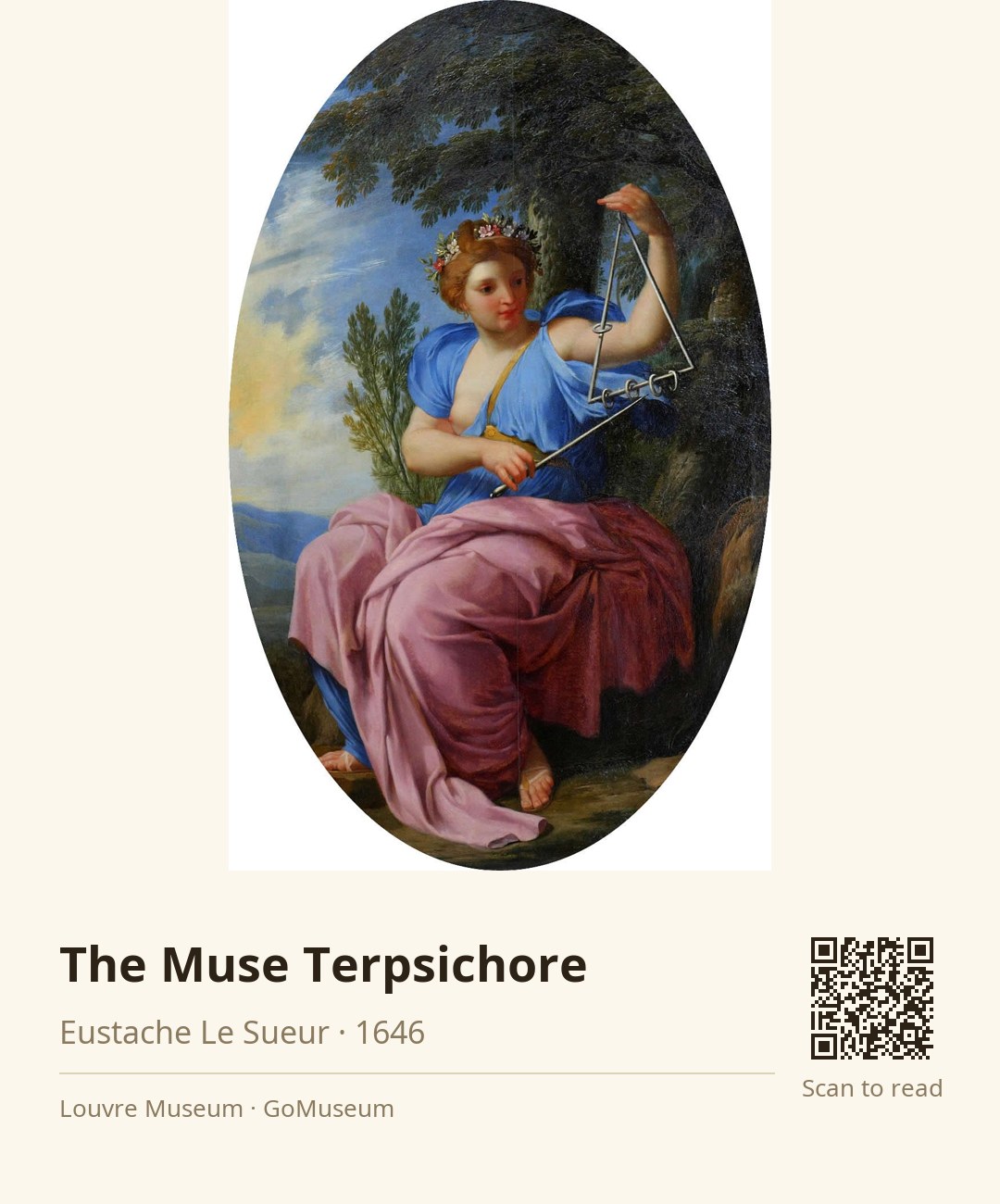
The Muse Terpsichore
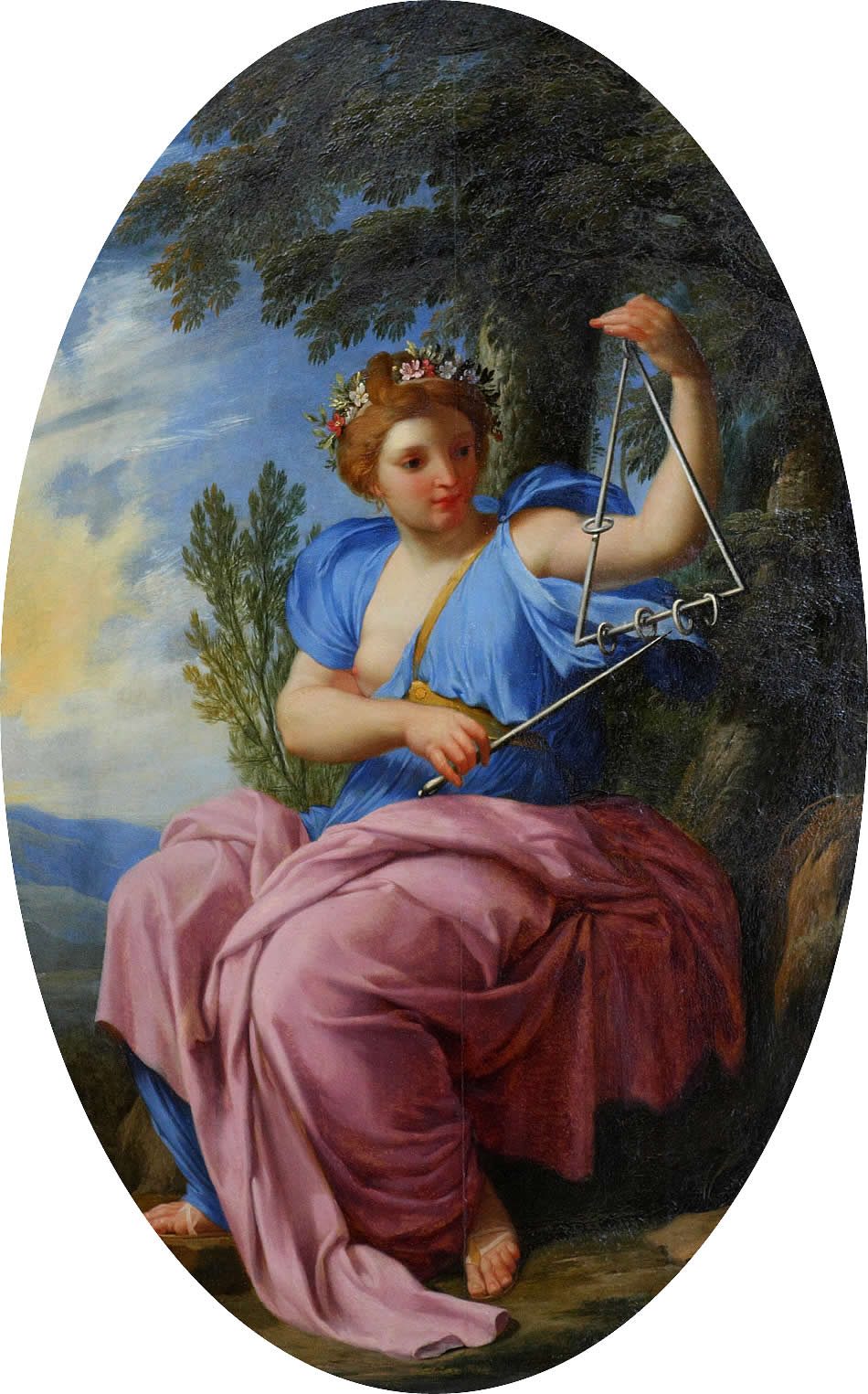
🎧 This work has audio narration — listen in the appTerpsichore, the muse of dance, sits gracefully in this vibrant scene, adorned in a flowing blue dress with a delicate pink drape. Her floral crown adds a touch of nature’s beauty, while her right arm lifts a triangular instrument, symbolizing the harmony of music and movement. The lush foliage behind her and the expansive blue sky create a serene backdrop that enhances her ethereal presence.
This portrayal captures not just the essence of Terpsichore, but also the celebration of artistic inspiration during the 17th century. The geometric instrument she holds signifies the connection between music and dance, reflecting the era's fascination with the arts as a harmonious blend of disciplines. The smooth brushwork emphasizes the texture of her attire and the surrounding foliage, showcasing Eustache Le Sueur's skill in rendering both human and natural forms with elegance.
Le Sueur, a prominent figure in the French neoclassical movement, was known for his mythological subjects and religious themes. His work often drew from classical influences, and in 1646, he created this painting as part of a broader exploration of the muses, which he depicted in various settings. The painting not only highlights Terpsichore's role in the arts but also serves as a testament to Le Sueur's dedication to capturing the beauty and grace of mythological figures.
Eustache Le Sueur, born in Paris on November 19, 1617, was a pivotal figure in the development of French neoclassical painting. Trained under Simon Vouet, he quickly distinguished himself for his lyrical compositions and mastery of religious subjects. As a founding member of the French Academy of Painting and Sculpture, Le Sueur played a crucial role in shaping the artistic standards of his time. His notable works include the "Life of St. Bruno" series, which showcased his ability to blend classical inspiration with a refined, sober style.
Despite never traveling to Italy, he absorbed influences from the royal palaces and private collections in Paris, leading to a unique interpretation of the classical tradition. His paintings, characterized by noble figures and calculated compositions, often reflect a cold palette typical of Vouet's school, though he demonstrated a capacity for color in select pieces. Le Sueur's legacy endures through his extensive body of work, including many engravings, and his influence on subsequent generations of artists, marking him as a significant contributor to the evolution of French art. He passed away on April 30, 1655, leaving behind a rich artistic heritage.
The smooth brushwork creates a lifelike texture, particularly in the flowing fabric of Terpsichore's dress and the lush foliage surrounding her. The vibrant blues and greens are not just colors; they evoke a sense of harmony and tranquility, enhancing the ethereal quality of the muse. The geometric instrument she holds is rendered with precision, drawing the viewer's eye and symbolizing the connection between music and dance. The balanced composition, with Terpsichore centrally positioned, invites contemplation, while the soft gradations of color and light create depth, making the scene feel almost three-dimensional. This careful handling of paint and form showcases Le Sueur's skill in marrying mythological themes with a refined artistic style.