 Image: Sailko
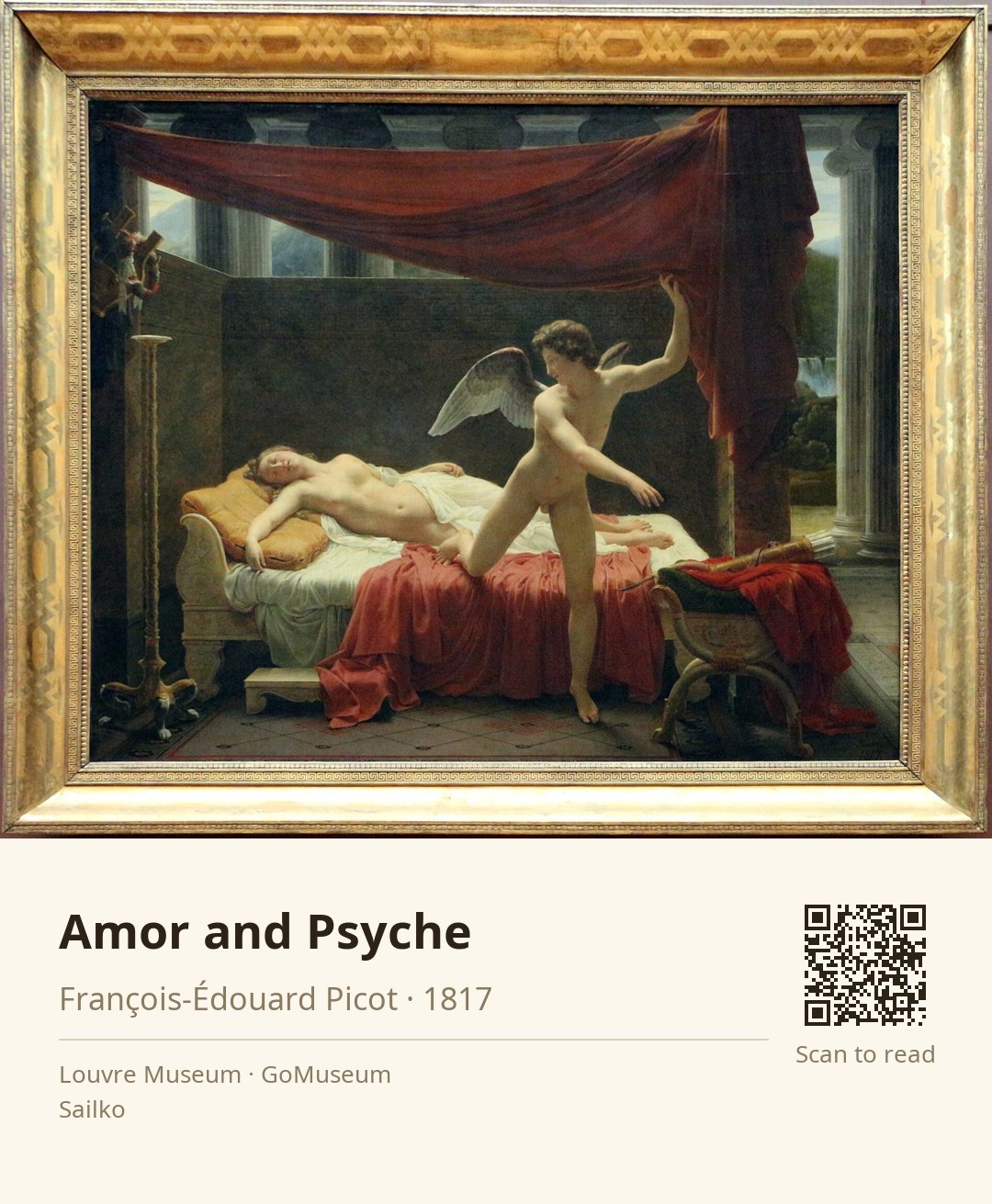
Amor and Psyche
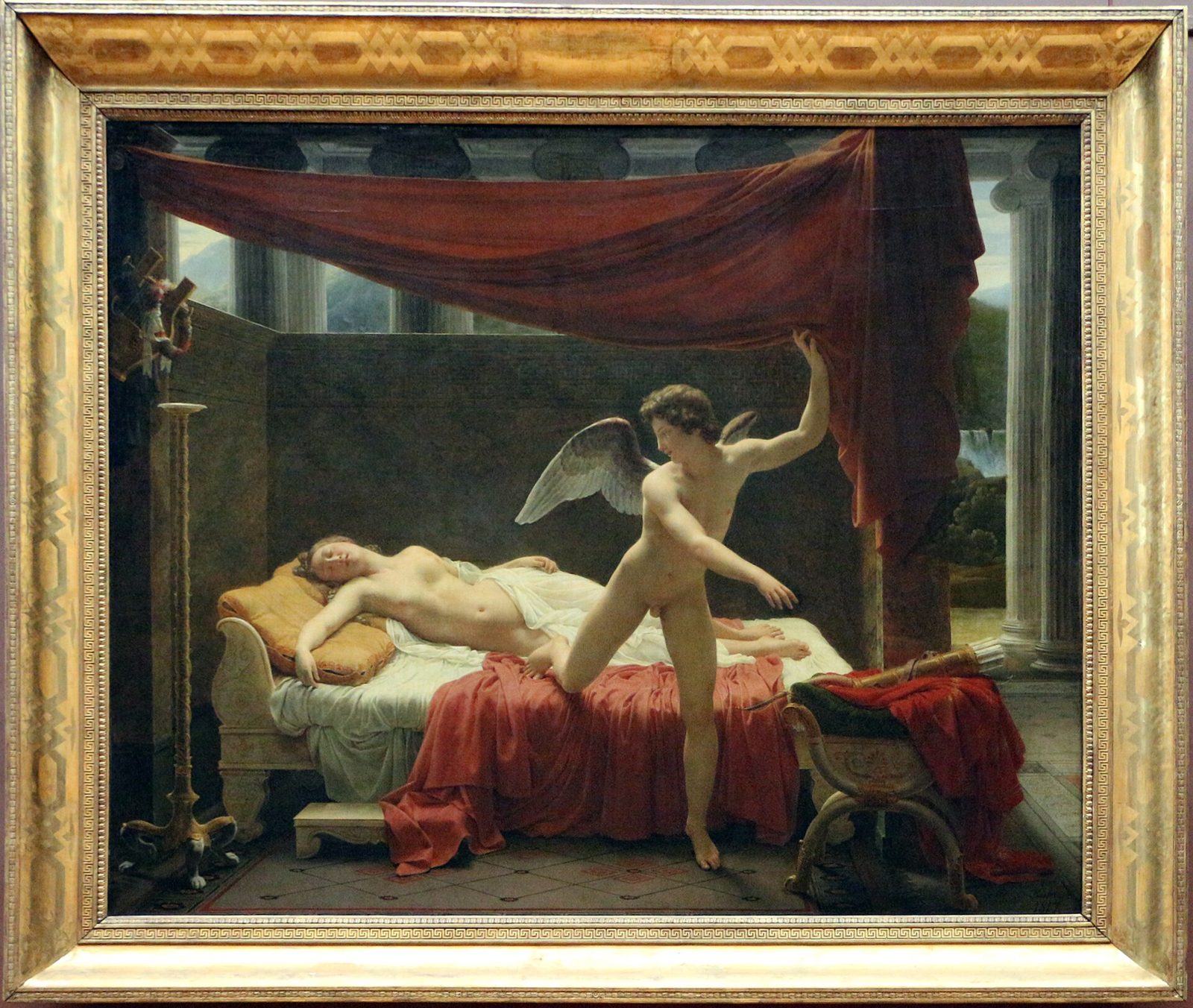
🎧 This work has audio narration — listen in the appThe sleeping figure of Psyche, draped in soft white and red fabrics, lies gracefully on her bed, embodying a moment of serene vulnerability. Beside her, Amor, with his delicate wings, is captured mid-motion, lifting a red curtain as he prepares to depart. This juxtaposition of Psyche's peaceful slumber against Amor's hesitance speaks to the tension between love and longing, a theme central to their mythological story.
Picot's choice of muted tones enhances the intimacy of the scene, while the classical architectural elements, like the columns and the glimpse of a lush landscape, ground the narrative in a timeless setting. The smooth brushwork highlights the textures of skin and fabric, inviting viewers to appreciate the delicate interplay of light and shadow that brings the figures to life. This painting, created in 1817, reflects the neoclassical style that Picot mastered, drawing on mythological subjects that were popular in his time.
Exhibited at the Salon des artistes français in 1819, "Amor and Psyche" showcases Picot's skill in merging narrative with aesthetic beauty, a hallmark of his artistic approach. The work remains a significant example of early 19th-century French painting, capturing a moment that resonates with themes of love and the complexities of human emotion.
François-Édouard Picot was a prominent French painter born in Paris on October 10, 1786. He studied under the renowned François-André Vincent and Jacques-Louis David, which shaped his neoclassical style. Picot gained recognition after winning the Prix de Rome in 1813, leading to his successful exhibition of "L'Amour et Psyché" at the 1819 Salon. His works often depicted mythological, religious, and historical themes, showcasing his skill in both large commissions and intimate portraits.
Throughout his career, Picot was active in the Paris Salon until 1839 and was elected to the Paris Academy in 1836. He received the title of officer of the Legion of Honor in 1832, reflecting his significant contributions to the art world. His notable works include "The Crowning of the Virgin" and various ceiling paintings in the Louvre. Picot also had a lasting influence as a teacher, mentoring many future artists, including William-Adolphe Bouguereau and Alexandre Cabanel.
He passed away in Paris on March 15, 1868, leaving behind a legacy that positioned him as a key figure in the neoclassical movement and the artistic landscape of 19th-century France.
Picot's technique in 'Amor and Psyche' showcases his mastery of oil painting, with smooth brushwork that creates a lifelike quality in the figures. The soft, muted color palette, dominated by warm reds and gentle whites, enhances the emotional depth of the scene. The careful handling of paint allows for intricate textures, particularly in the fabrics draped over Psyche and the delicate wings of Amor. The composition draws the viewer's eye through the architectural elements, like the classical columns, leading to the serene landscape beyond. This structure not only frames the figures but also emphasizes the narrative tension between the characters, capturing a fleeting moment of love and longing.
Picot was influenced by François-André Vincent and Jacques-Louis David, both prominent figures in the art world.
Picot won the Prix de Rome painting scholarship in 1813, which was a significant recognition for artists in his time.
Picot created a significant religious painting titled The Crowning of the Virgin, located in the church of Notre-Dame-de-Lorette.