Castor or The Morning Star
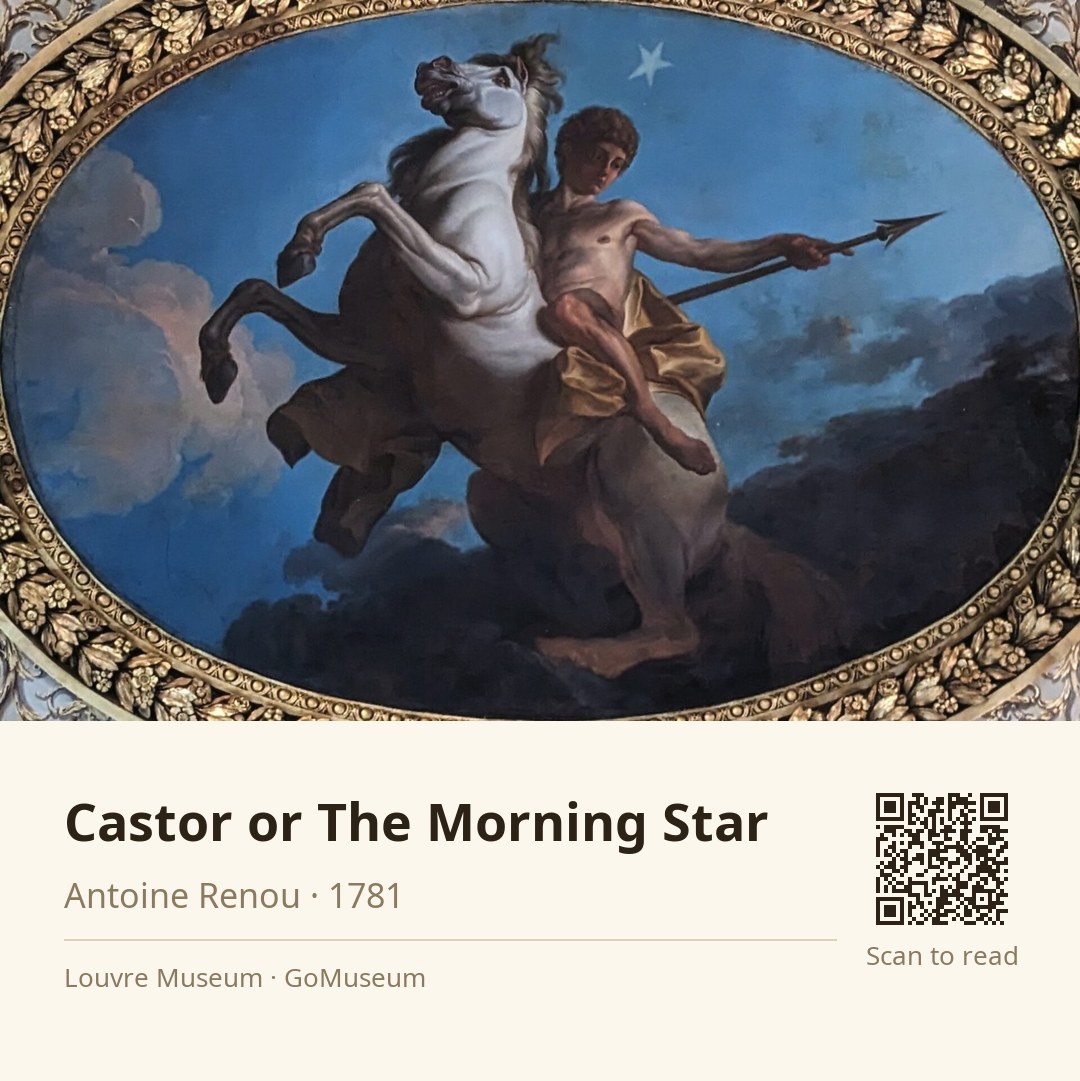
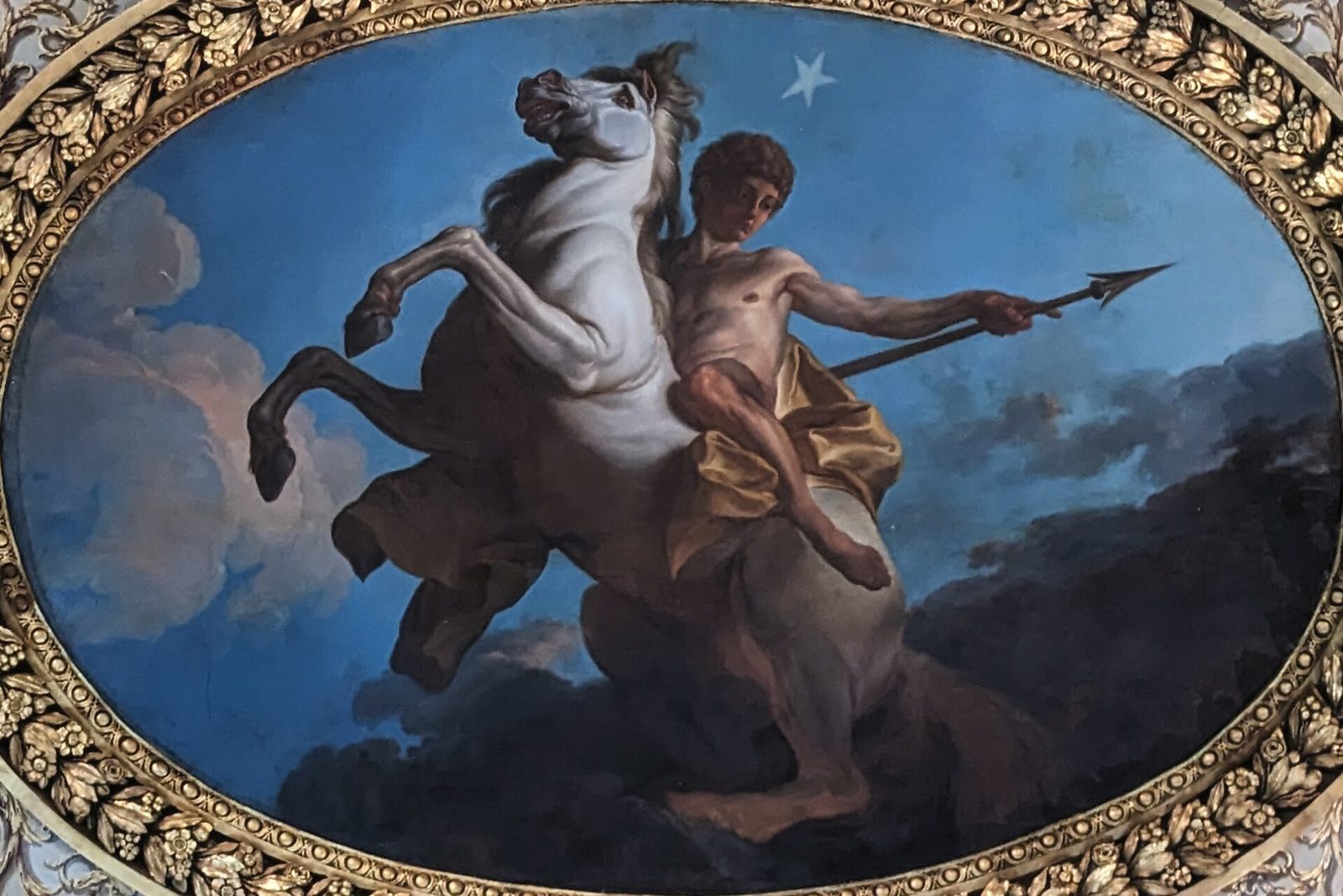
🎧 This work has audio narration — listen in the appThe young figure of Castor, astride a rearing white horse, captures a moment of dynamic energy in Antoine Renou's 1781 painting. His muscular form is partially draped in golden cloth, and he grips a spear, poised for action, while the horse’s powerful stance adds to the sense of movement. Above him, a bright star shines in a deep blue sky, symbolizing his mythological significance and connection to the divine.
This portrayal of Castor, a figure from Greek mythology, not only emphasizes his heroic qualities but also reflects the ideals of strength and valor prevalent in the late 18th century. The ornate floral border framing the scene enhances the dramatic effect, while the interplay of light and shadow accentuates the figures against the expansive sky, creating a striking visual contrast that draws the viewer in.
Renou, a member of the Académie royale de peinture et de sculpture, created this work as his reception piece, which was exhibited at the Salon des artistes français in Paris the same year. The painting, titled "Castor ou l'Étoile du Matin," stands as a testament to Renou's skill in blending mythological themes with the artistic trends of his time.
Antoine Renou was a French painter and playwright born in Paris in 1731, who left a significant mark on the art and theatrical landscapes of the 18th and early 19th centuries. Renowned for his role as a member and perpetual secretary of the Académie royale de peinture et de sculpture, he gained recognition for his work "L'Étoile du matin," created in 1781 as part of the Louvre's galerie d'Apollon. This painting served as his reception piece to the Académie, complementing Charles Le Brun's "Soir."
In addition to his contributions to painting, Renou was a prolific playwright, authoring around fifteen theatrical works, including notable tragedies such as "Térée et Philomèle" and "La Chute de Phaéton." His dual talents in visual arts and drama reflect a deep commitment to the cultural life of his time. Renou's legacy is marked by his ability to bridge the worlds of painting and theatre, securing his place in the annals of French art history until his death in 1806.
Antoine Renou's painting, titled 'Castor ou l'Étoile du Matin,' was created in 1781 as his reception piece for the Académie royale de peinture et de sculpture. This significant event took place during the Salon des artistes français in Paris, where it was first exhibited. Following its debut, the painting became part of Renou's legacy, eventually finding a place among the plafonnantes paintings in the galerie d'Apollon at the Louvre, where it stands as a counterpart to Charles Le Brun's 'Soir.' Renou's journey as an artist, marked by this pivotal work, illustrates his commitment to blending mythological themes with contemporary artistic trends.
The painting's impact lies in Renou's masterful technique and thoughtful choices. The dynamic pose of Castor, with his muscular form partially draped in golden cloth, is brought to life through fluid brushwork that captures the essence of movement. Renou's handling of oil paint allows for rich textures, particularly in the depiction of the horse's powerful stance and the shimmering fabric. The deep blue sky serves as a dramatic backdrop, contrasting with the bright star above, which symbolizes Castor's divine connection. The ornate floral border framing the scene not only enhances the visual appeal but also draws the viewer's eye inward, creating a sense of enclosure around the heroic figure. Renou's ability to manipulate light and shadow adds depth, emphasizing the muscularity of Castor and the vitality of the horse, making the entire composition feel alive and charged with energy.
One intriguing aspect of Renou's career is that he was not only a painter but also a playwright, having authored around fifteen theatrical works. This duality in his artistic pursuits showcases his versatility and the cultural milieu of the time, where the boundaries between different forms of art were often blurred. His theatrical background may have influenced the dramatic flair seen in his paintings, particularly in the way he captures movement and emotion.
Antoine Renou was also a playwright and wrote approximately fifteen theatrical works.
Renou's experience in theater likely contributed to the dramatic flair in his paintings, especially in how he portrays movement and emotion.
Renou's painting is one of the plafonnantes works in the galerie d'Apollon at the Louvre Palace.